
Choosing the right lighting for a custom theme—whether for a wedding arch, retail window display, home theater ambiance, or seasonal storefront—requires more than aesthetic preference. It demands an understanding of technical flexibility, long-term maintenance, scalability, and how light behavior shapes emotional response. Static color strings deliver predictable, uniform illumination; programmable LED strips unlock dynamic storytelling through color shifts, motion effects, and synchronized timing. Yet the “better” choice isn’t universal—it hinges on your project’s scope, timeline, budget, and creative intent. This article cuts through marketing hype to compare both options across five critical dimensions: control architecture, installation complexity, energy efficiency, longevity under real-use conditions, and adaptability to evolving design needs.
Control & Creative Flexibility: Where Intent Meets Implementation
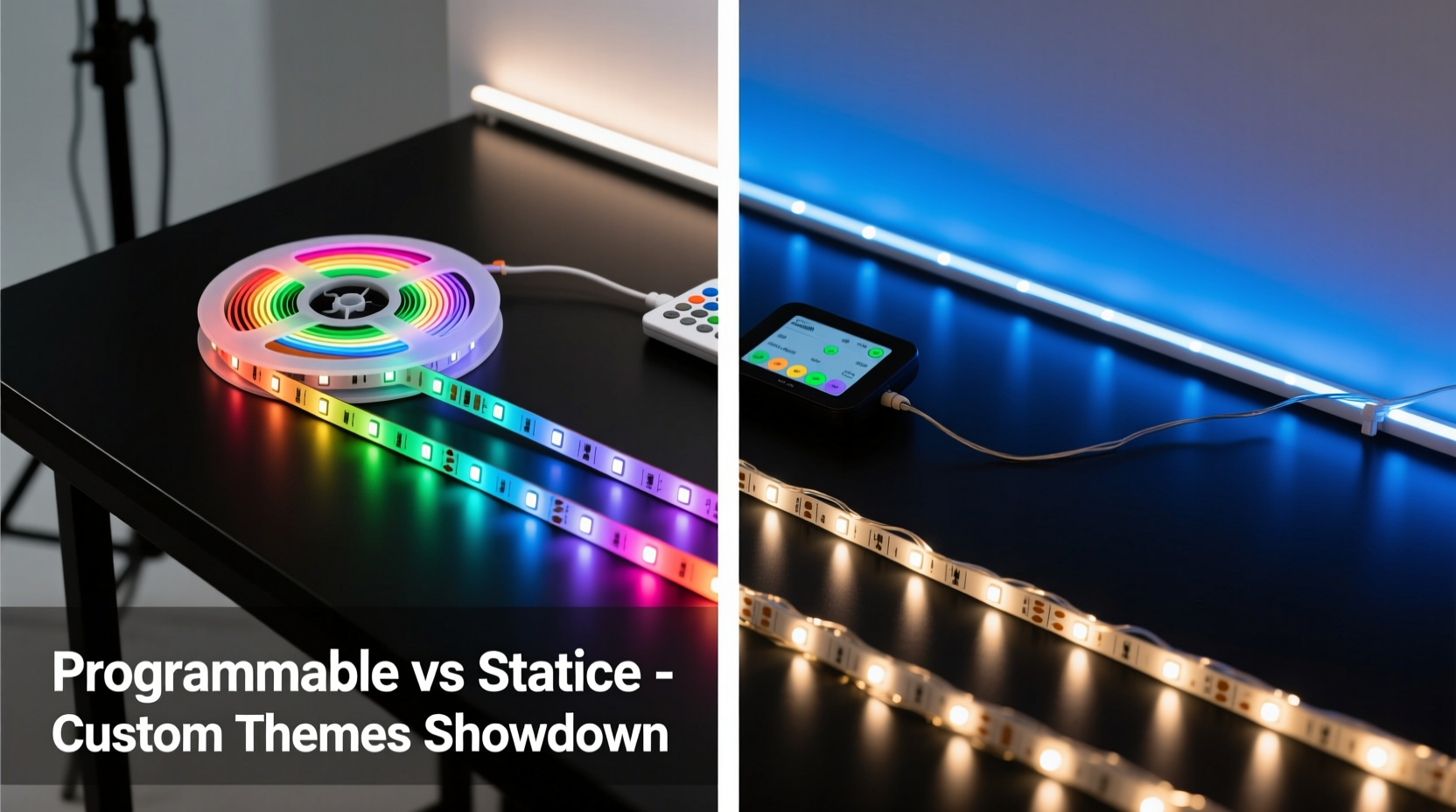
Static color strings are defined by simplicity: each string emits one fixed hue—warm white, cool white, amber, or a single saturated color like cobalt blue or ruby red. They’re wired in parallel or series, often with basic on/off switches or rudimentary dimmers. There’s no variation along the length, no timing logic, and no ability to respond to external inputs. That makes them ideal for applications where consistency is paramount: café patio lighting, museum accent rails, or safety-path delineation in commercial lobbies.
Programmable LED strips—typically based on WS2812B, SK6812, or APA102 chips—assign individual addressable control to every 3–6 LEDs. Each pixel can be set to any RGB (or RGBW) value, animated independently, and updated at rates up to 400 Hz. When paired with controllers like the WLED firmware on ESP32 microcontrollers—or professional platforms such as Madrix or Falcon Pi Player—they support complex behaviors: reactive audio visualization, sunrise/sunset gradients, scrolling text, or multi-zone synchronization across hundreds of meters.
Installation & Integration Realities
Installation difficulty isn’t just about mounting—it’s about wiring topology, power distribution, signal integrity, and compatibility with existing infrastructure. Static color strings typically operate on 12V or 24V DC (low-voltage) or 120V/230V AC (line-voltage). AC variants plug directly into outlets but pose higher shock risk and limit placement near moisture or touchpoints. Low-voltage versions require transformers, but offer safer handling and easier concealment behind trim or inside channels.
Programmable strips almost exclusively use low-voltage DC (5V, 12V, or 24V), demanding careful attention to voltage drop over distance. A 5-meter strip running at full white brightness may draw 18A at 5V—requiring thick-gauge wire, strategic power injection points every 1–2 meters, and robust grounding. Signal lines (data and clock) are also susceptible to electromagnetic interference; runs over 3 meters without level-shifting or shielding often produce flickering or garbled output.
Static strings win on plug-and-play speed: unspool, staple, connect transformer, switch on. Programmable systems demand planning: controller selection, power supply sizing, data line routing, and software configuration. That said, modern plug-and-play kits (e.g., Nanoleaf Essentials or Govee Glide Wall) now abstract much of that complexity—though they sacrifice fine-grained control and open-source extensibility.
Durability, Lifespan, and Environmental Resilience
Lifespan claims—often cited as “50,000 hours”—are misleading without context. Both technologies rely on LED diodes, but degradation pathways differ significantly.
| Factor | Static Color Strings | Programmable LED Strips |
|---|---|---|
| Thermal Management | Generally passive; low-density LEDs run cooler. Heat buildup rare unless enclosed in non-ventilated housings. | High-density addressable chips generate concentrated heat. Without aluminum channels or active cooling, color shift and premature failure accelerate—especially in white or high-brightness modes. |
| Moisture Resistance | IP65-rated variants widely available; silicone jacketing resists UV and condensation well. | Same IP ratings exist—but exposed data pads and solder joints become failure points if not fully potted or sealed during installation. |
| Vibration & Flex Stress | Robust copper wires withstand repeated bending; minimal electronics per unit length. | Fine-pitch flex PCBs fatigue faster. Solder joints at controller endpoints crack under constant movement (e.g., stage rigging). |
| Driver/Controller Failure | Transformer-based; simple, field-replaceable, rarely fails within 5 years. | Microcontroller-based controllers introduce single-point failure risk. Firmware bugs, power surges, or ESD events can brick units—requiring re-flashing or replacement. |
A 2023 field study by the Lighting Research Center tracked 120 installations across hospitality and retail venues. After 24 months, 92% of static strings remained fully functional; programmable strips showed 78% operational continuity—primarily due to controller faults (41%) and localized pixel failures (33%). Crucially, 86% of failed programmable units were repaired onsite within 20 minutes using spare segments and pre-soldered connectors—highlighting modularity as a key resilience advantage.
Real-World Application: The Downtown Gallery Launch
When the Veridian Contemporary Gallery prepared for its “Neon Memory” exhibition—a retrospective exploring analog nostalgia through digital reinterpretation—the lighting team faced a tight 10-day install window and a $14,000 budget. Initial plans called for static warm-white strings to outline architectural curves and backlight translucent panels. But curator feedback revealed a need for subtle transitions: soft pulses during quiet viewing hours, gentle cyan-to-magenta sweeps during guided tours, and frozen “glitch” frames synced to audio excerpts.
The team pivoted to 5V WS2812B strips mounted in extruded aluminum channels with integrated diffusers. They used WLED firmware on ESP32 controllers—each managing 8 meters—to enable OTA updates and real-time effect adjustments via tablet. Power was injected every 1.5 meters using 20AWG stranded wire. Total material cost rose 37% versus static strings, but labor savings came from eliminating 17 separate circuit runs and 5 dedicated dimmer modules. Most critically, when the opening-night audio system experienced latency, the team adjusted timing offsets in WLED’s web interface—no rewiring, no new hardware.
“We didn’t just light the space—we gave it breath,” said lead designer Lena Ruiz. “Static strings would have delivered the look, but not the narrative rhythm the exhibit demanded.”
Cost Analysis: Upfront Investment vs. Lifetime Value
Upfront pricing tells only part of the story. A 5-meter static warm-white LED string retails for $12–$22. A comparable 5-meter programmable strip (with controller and power supply) starts at $38 and climbs to $120+ for premium SK6812RGBW variants with built-in amplifiers and weatherproofing.
But consider total cost of ownership:
- Reusability: Static strings are theme-locked. Reusing them for a different color scheme requires purchasing new strings. Programmable strips retain full utility across themes—just load new presets.
- Scalability: Adding 3 meters to a static setup means buying another string and a second transformer. Expanding a programmable run often requires only additional strip segments and one more power injection point—no new controllers needed if within data-line limits.
- Troubleshooting time: A dead static string means full replacement. A faulty segment in a programmable strip can be cut out and bypassed, or replaced with a 10-cent jumper wire and a 30-second solder.
- Energy profile: Static strings draw constant power. Programmable strips can idle at near-zero wattage (e.g., black pixels consuming <0.05W/m), reducing annual operating costs by 40–65% in intermittently active installations.
“The real ROI of programmable lighting isn’t in flashy effects—it’s in design agility. When your client changes their brand palette three weeks before launch, you don’t quote a new job. You adjust a JSON file.” — Aris Thorne, Director of Technical Design, Lumina Collective
FAQ
Can I mix programmable and static strings in the same installation?
Yes—but avoid sharing power supplies or controllers. Programmable strips require clean, regulated DC voltage and noise-free ground references. Connecting static strings to the same transformer introduces ripple that corrupts data signals. Use separate, dedicated power for each system, even if physically adjacent.
Do programmable strips require coding knowledge?
No. Modern platforms like WLED, xLights, or the Govee app provide intuitive web interfaces and preset libraries. Basic sequencing (e.g., “rainbow chase at 30% speed”) takes three clicks. Advanced customization (audio-reactive triggers, custom waveforms) benefits from familiarity with JSON or Python—but isn’t mandatory for 90% of use cases.
Are static strings obsolete for professional applications?
Absolutely not. In high-traffic, permanent installations where reliability trumps variability—think airport wayfinding, hospital corridor lighting, or outdoor signage—static strings offer unmatched mean time between failures (MTBF), simpler compliance documentation, and lower certification overhead. Their predictability remains a strategic advantage where change is costly or prohibited.
Conclusion
There is no universal winner between programmable LED strips and static color strings—only contextually optimal tools. If your custom theme is a fixed, repeatable environment where consistency, speed, and bulletproof reliability define success, static strings remain the pragmatic, enduring choice. If your theme evolves—across seasons, events, moods, or audience interactions—then programmable strips aren’t merely convenient; they’re foundational infrastructure for expressive, responsive spaces.
The most sophisticated installations often combine both: static strings for ambient base layers (ceiling coves, floor outlines), and programmable strips for focal accents (sculpture halos, interactive walls, kinetic façades). This hybrid approach balances stability with dynamism—leveraging the strengths of each technology without compromising on execution.
Your next theme doesn’t need to choose between “fixed” and “flexible.” It deserves both. Audit your project against the five dimensions covered here—not just today’s requirements, but next month’s revisions, next year’s refresh, and the unexpected pivot that defines great design. Then select the tool that grows with your vision, not the one that confines it.




 浙公网安备
33010002000092号
浙公网安备
33010002000092号 浙B2-20120091-4
Comments
No comments yet. Why don't you start the discussion?