
Ambiance is more than just lighting—it's an emotional experience. The right glow can transform a room from sterile to intimate, from functional to magical. In recent years, two dominant lighting solutions have emerged in homes, cafes, event spaces, and offices: programmable LED strips and static string lights. While both deliver light, their impact on mood, atmosphere, and functionality varies significantly. Choosing between them isn’t about brightness alone—it’s about intention, flexibility, and design harmony.
This comparison dives deep into the strengths and limitations of each option, examining not only technical specs but also psychological effects, installation practicality, and long-term value. Whether you're enhancing a bedroom, setting the tone at a wedding, or designing a retail space, understanding these differences ensures your lighting supports the experience you want to create.
The Ambiance Equation: Light, Color, and Control
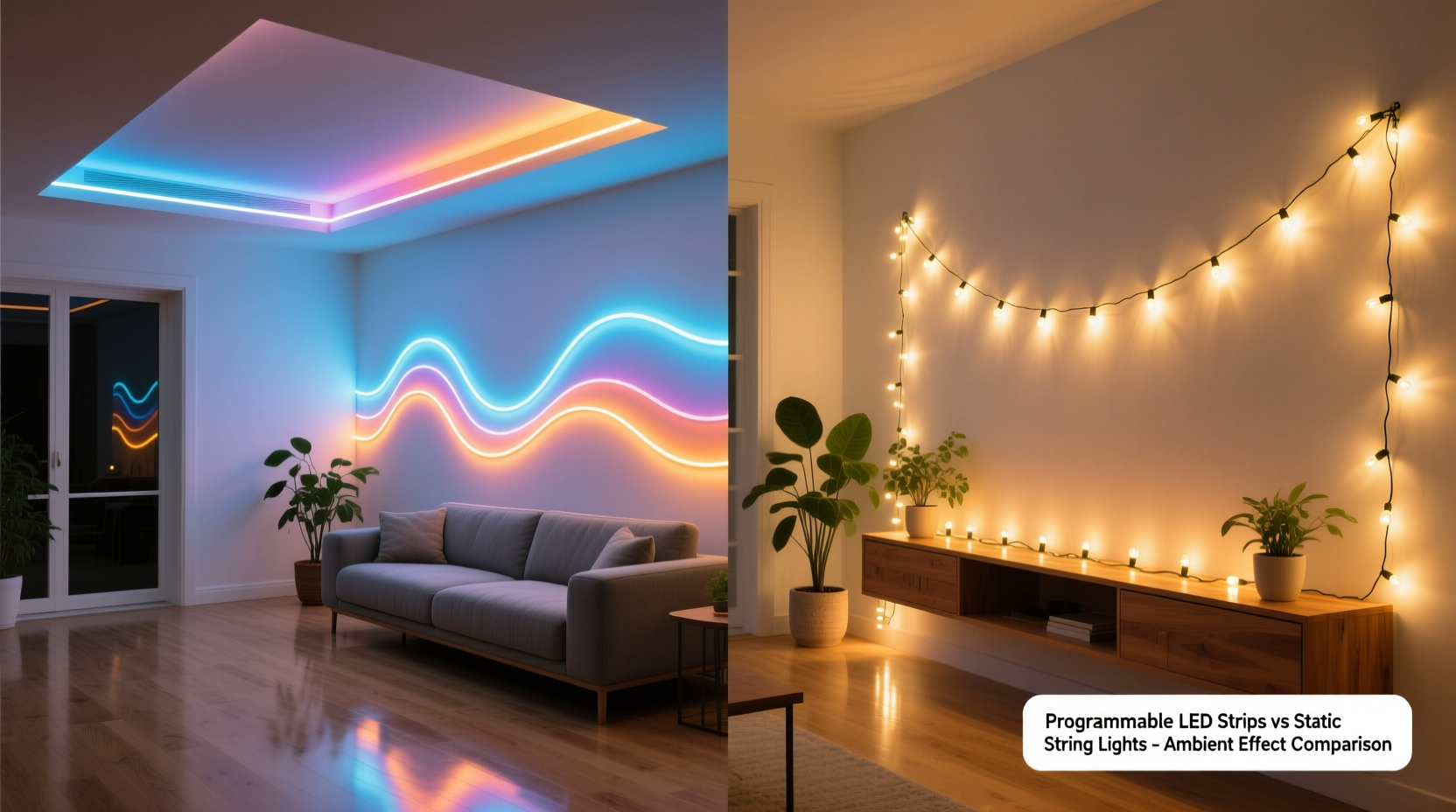
Ambiance is shaped by four key elements: color temperature, intensity, placement, and motion. Static string lights typically offer fixed white tones—warm, cool, or daylight—with limited dimming options. Their charm lies in simplicity: soft glows strung across ceilings or wrapped around railings evoke nostalgia, often associated with fairy tales, patios, and holiday cheer.
Programmable LED strips, by contrast, introduce dynamic control. They allow shifts in hue, saturation, brightness, and animation patterns—all adjustable via remote, app, or voice assistant. This level of customization enables lighting that adapts to time of day, activity, or emotion. A kitchen might shift from crisp white during meal prep to warm amber at dinner, then pulse gently during music playback.
Psychologically, color plays a powerful role. Warm whites (2700K–3000K) promote relaxation and intimacy, making them ideal for bedrooms and lounges. Cooler tones increase alertness—better suited for workspaces. Programmable LEDs can leverage this science intentionally, while static lights are constrained by their pre-set output.
Design Flexibility and Installation Practicality
One of the most tangible differences lies in adaptability. Static string lights come in fixed lengths with evenly spaced bulbs, usually connected by thin wire. They’re easy to hang but difficult to reconfigure without visible gaps or bunching. Draping them along irregular shapes—like crown molding or furniture edges—often results in awkward slack or tension points.
LED strips, meanwhile, are adhesive-backed flexible circuits that conform precisely to surfaces. You can cut them at marked intervals and install them under cabinets, behind TVs, along stair risers, or inside coves. Their low profile makes them nearly invisible when lit, creating a “floating” effect that enhances architectural details.
Installation complexity varies. String lights require hooks, clips, or nails and often need outlet access every few meters. LED strips require power supplies and controllers, sometimes involving basic wiring. However, plug-and-play kits now make setup accessible even for non-technical users. For permanent installations, LED systems integrate seamlessly into drywall or millwork, offering a clean, modern aesthetic.
“Lighting should disappear so the atmosphere remains the focus. LED strips achieve this invisibility better than any other solution.” — Lena Torres, Interior Lighting Designer
Comparative Analysis: Features at a Glance
| Feature | Programmable LED Strips | Static String Lights |
|---|---|---|
| Color Options | Full RGB spectrum + tunable white | Fixed (usually warm/cool white) |
| Brightness Control | Fully dimmable with precision | Limited or no dimming |
| Motion & Effects | Pulsing, fading, music sync, chasing | None (steady on/off) |
| Installation Flexibility | High – cuts, bends, adheres anywhere | Low – fixed length and spacing |
| Lifespan | 30,000–50,000 hours | 3,000–8,000 hours (incandescent); up to 25,000 (LED versions) |
| Energy Efficiency | Very high (low wattage per meter) | Moderate (especially older incandescent types) |
| Cost (Initial) | Higher (includes controller, power supply) | Lower (basic models) |
| Best Use Cases | Modern interiors, accent lighting, smart homes | Outdoor decor, seasonal displays, bohemian aesthetics |
Real-World Applications: Where Each Shines
Consider a boutique coffee shop aiming to attract evening customers. During the day, clean task lighting dominates. But as dusk falls, the owner wants a cozy, inviting glow. Programmable LED strips installed under shelves and counters shift to warm amber, gradually dimming as night deepens. On weekends, they sync subtly with background music, creating a lounge-like rhythm without distraction.
In contrast, a garden wedding uses static string lights draped across trees and pergolas. The goal here isn’t versatility but timeless charm. The uniform twinkle mimics starlight, evoking romance and simplicity. Guests aren’t meant to notice the technology—they’re immersed in the moment. Adding programmable colors or animations would distract from the natural elegance.
Another example: a home theater. LED strips placed behind the TV using bias lighting reduce eye strain and enhance perceived contrast. Using an app, the homeowner sets the strip to match the dominant color on screen—deep blues during ocean scenes, reds during action sequences. This immersive effect is impossible with static lighting.
Step-by-Step Guide: Choosing the Right Option for Your Space
- Define the Purpose: Is the lighting meant to set a mood, highlight architecture, or provide decorative flair? Functional ambiance favors LEDs; nostalgic charm leans toward strings.
- Assess the Environment: Indoor, dust-free areas suit both. Outdoor or high-moisture zones require IP65-rated LEDs or weatherproof string sets.
- Evaluate Control Needs: Do you want one-setting-fits-all or adaptive lighting? If you value scheduling or scene changes, choose programmable strips.
- Measure the Area: For long, continuous runs (e.g., baseboards), LED strips minimize seams. For open-air suspension (e.g., patio ceilings), strings are easier to manage.
- Budget for Long-Term Value: While LED strips cost more upfront, their energy savings and longevity often justify the investment within 2–3 years.
- Test Before Committing: Buy small samples of both types. Install them temporarily to observe how they affect the room’s feel at different times of day.
Common Pitfalls and How to Avoid Them
Both lighting types suffer from misuse. Overloading a room with bright white string lights kills warmth, turning a potential sanctuary into a dorm room. Similarly, poorly calibrated LED strips—set to neon green or strobing rainbows—can feel garish rather than atmospheric.
One frequent error is ignoring ambient light layers. Neither solution should act alone. Combine with overhead fixtures, floor lamps, or candles to create depth. A well-lit space has multiple sources at varying heights and intensities.
Another issue is poor power management. Long LED runs without proper voltage boosting result in dimming at the far end—a phenomenon known as voltage drop. Always calculate total wattage and use amplifiers for runs over 5 meters. For string lights, avoid daisy-chaining too many sets, which can overload circuits and pose fire risks.
Mini Case Study: Revamping a Home Office
Sophie, a freelance designer, struggled with focus in her basement workspace. Harsh overhead lighting caused glare on her monitor and headaches by midday. She wanted a calm yet productive environment.
She installed 2-meter warm-tunable LED strips under her desk and along the back edge of a floating shelf. Using a smartphone app, she programmed three scenes: “Focus” (4000K, 80% brightness), “Relax” (2700K, 30%), and “Creative Mode” (soft blue-to-purple gradient). She added a motion sensor so lights turned on gently when she entered.
Within a week, she reported improved concentration and fewer migraines. Clients noticed the professional look during video calls. The lighting didn’t dominate—it supported her workflow. A simple switch to static string lights would have added sparkle but failed to address her core needs: adaptability and comfort.
Expert Insight: Why Atmosphere Matters More Than Ever
“In post-pandemic design, people crave environments that respond to their emotional state. Lighting is the fastest, most affordable way to shift a room’s psychology. Programmable LEDs give designers that tool—but restraint is key. The best ambiance feels effortless, not engineered.” — Marcus Lin, Architectural Lighting Consultant
Frequently Asked Questions
Can I use programmable LED strips outdoors?
Yes, but only if they have a proper IP rating. Look for IP65 (protected against water jets) or IP67 (submersible up to 1 meter). Ensure connectors and power supplies are housed in waterproof enclosures. Never expose unsealed electronics to rain or irrigation.
Are static string lights outdated?
Not at all. They remain popular for seasonal decor, weddings, and rustic interiors. Their appeal lies in emotional resonance, not technical capability. When authenticity and simplicity are priorities, static lights often outperform high-tech alternatives.
Do LED strips damage walls when removed?
High-quality strips use 3M adhesive that typically removes cleanly from smooth surfaces like painted drywall or wood. However, on textured walls or aged paint, residue or peeling may occur. Test in a discreet area first. For rental spaces, consider magnetic tracks or clip-in channels instead of direct adhesion.
Checklist: Selecting Your Ideal Lighting Solution
- ☑ Determine primary use: mood enhancement, task support, or decoration
- ☑ Measure installation area and sketch layout
- ☑ Decide on color needs: single tone or full spectrum
- ☑ Check smart home compatibility (e.g., Alexa, Google Home)
- ☑ Verify power requirements and outlet access
- ☑ Choose appropriate IP rating for environment
- ☑ Purchase sample lengths to test in real conditions
- ☑ Plan for future adjustments—leave service loops or modular connections
Conclusion
When it comes to ambiance, neither programmable LED strips nor static string lights universally win. The decision hinges on intent. If you seek emotional warmth, simplicity, and instant charm—particularly in outdoor or temporary settings—static string lights deliver beautifully. But if you value precision, evolution, and integration with modern living, programmable LED strips offer unmatched depth and utility.
The most compelling spaces often blend both. Imagine string lights crisscrossing a backyard terrace, while LED strips outline steps and deck edges for safety and subtle drama. Together, they balance nostalgia with innovation, creating layered experiences that engage the senses.




 浙公网安备
33010002000092号
浙公网安备
33010002000092号 浙B2-20120091-4
Comments
No comments yet. Why don't you start the discussion?