
Control over lighting isn’t just about convenience—it’s about safety, energy efficiency, circadian rhythm support, and seamless integration into modern living. Yet many homeowners and renters face the same dilemma: should they invest in programmable smart lights or rely on affordable, widely available timer plugs? The answer isn’t binary—but it *is* highly contextual. Timer plugs offer mechanical simplicity and immediate cost savings. Smart lights deliver granular, adaptive, and networked control. What separates them isn’t just technology; it’s how deeply each solution understands—and responds to—human behavior, environmental conditions, and evolving household needs.
What “Control” Really Means in Modern Lighting
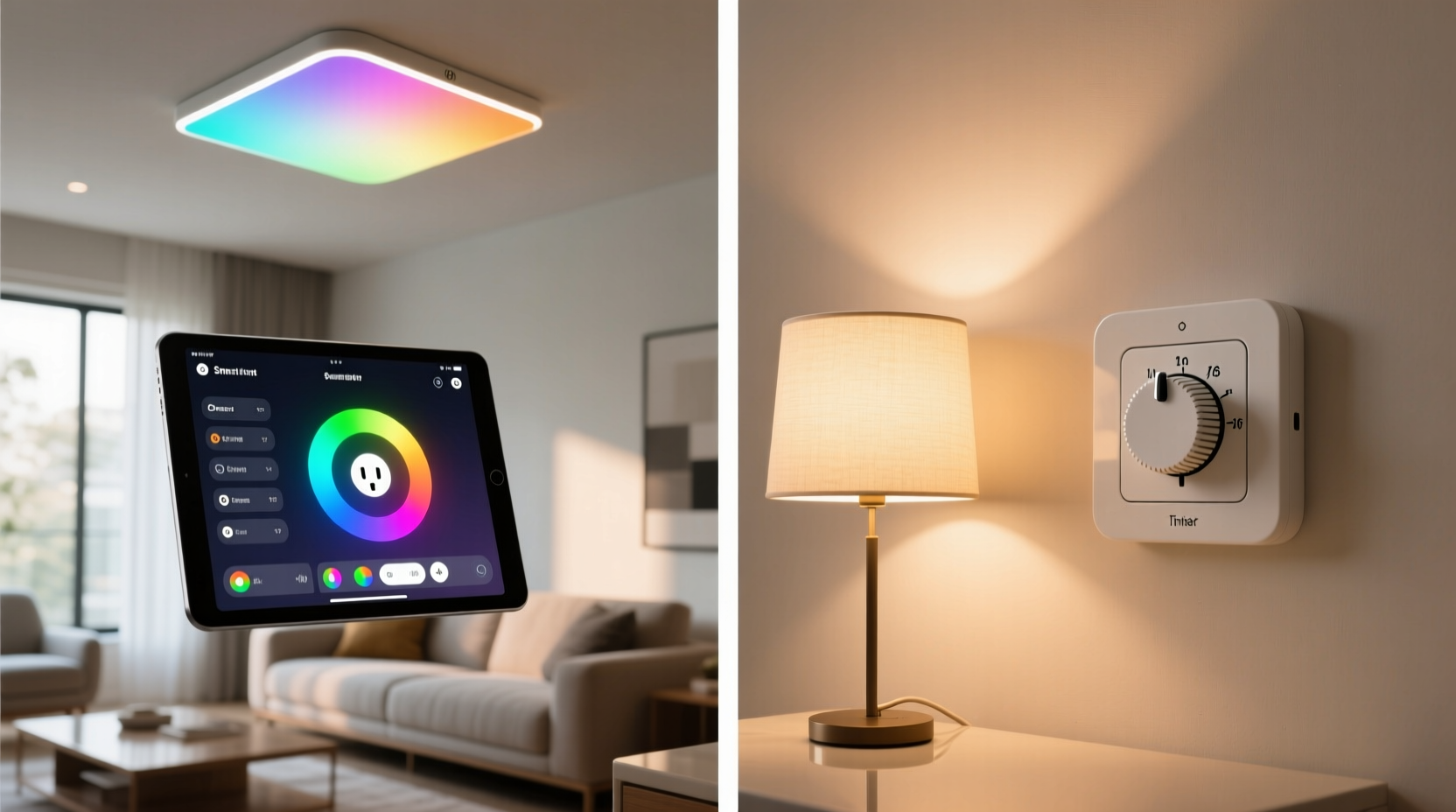
“Control” is often misinterpreted as simple on/off scheduling. In reality, meaningful lighting control encompasses five interdependent dimensions: timing precision, environmental responsiveness, user context awareness, integration flexibility, and adaptive learning. A timer plug may turn a lamp on at 7:00 p.m. every day—but it won’t dim gradually at sunset, brighten when motion is detected in a dark hallway, or shift color temperature to support melatonin production before bedtime. Programmable smart lights, by contrast, treat light not as an appliance but as an intelligent environmental layer.
This distinction becomes critical in real-world scenarios: a single-parent household needing staggered bedtime routines for children, a remote worker requiring dynamic task lighting throughout the day, or someone managing seasonal affective disorder (SAD) who relies on timed, spectrum-adjusted light exposure. Control, then, is measured less by how many buttons you press—and more by how few decisions you must consciously make.
Core Capabilities Compared: Beyond the On/Off Switch
| Feature | Programmable Smart Lights | Timer Plugs |
|---|---|---|
| Scheduling Granularity | Minute-level precision; recurring schedules per day of week; sunrise/sunset offsets; vacation modes with randomized activity | Typically 15–30 minute increments; limited to daily or weekly repeating patterns; no astronomical time sync |
| Environmental Triggers | Works with motion sensors, ambient light detectors, weather APIs (e.g., dim if cloudy), and door/window contact sensors | No environmental input—strictly time-based; operates independently of surroundings |
| Light Quality Control | Adjust brightness (0–100%), color temperature (2700K–6500K), and RGB color; supports circadian presets and scene recall | No light quality adjustment—only power delivery; bulb characteristics remain fixed |
| Remote & Voice Control | Real-time control via smartphone app, voice assistants (Alexa, Google, Siri), and web dashboard—even from outside home | Manual override only; no remote access unless paired with a Wi-Fi-enabled smart timer (which adds complexity and cost) |
| Integration Ecosystem | Native compatibility with Matter, Thread, HomeKit, SmartThings, and IFTTT; enables cross-device automations (e.g., “When front door unlocks after 8 p.m., foyer lights warm to 2700K at 40% brightness”) | Standalone operation; no native interoperability; requires third-party hubs or bridges for limited integration |
| Energy Monitoring & Insights | Many models report real-time wattage, historical usage, and estimated cost savings; some suggest optimization based on habits | No measurement capability—power flows unmonitored; no feedback loop for behavioral change |
The table reveals a structural asymmetry: timer plugs manage electricity delivery; smart lights manage light experience. That difference compounds over time—not just in utility, but in measurable outcomes like reduced energy waste, improved sleep hygiene, and lower long-term maintenance effort.
A Real-World Scenario: The Empty-Nester Home Office Transition
Consider Diane, 58, who converted her spare bedroom into a full-time home office after retiring from teaching. Her original setup used a $12 mechanical timer plug for her desk lamp—set to turn on at 8:30 a.m. and off at 5:30 p.m. It worked—for about three weeks. She soon noticed fatigue in the early afternoon, struggled to focus under static 5000K daylight bulbs, and frequently forgot to reset the timer during holidays. When she upgraded to Philips Hue White and Color Ambiance bulbs with the Hue Bridge, she reconfigured her lighting around physiology, not chronology.
Diane created three automated scenes: “Focus” (cool white, 100% brightness, active 9 a.m.–12 p.m.), “Calm” (soft amber, 60% brightness, auto-activates at 1 p.m. with gentle 10-minute fade-in), and “Wind Down” (2200K, 30% brightness, triggered by her calendar event ending at 4:45 p.m.). She also added a motion sensor near her desk: if she stepped away for >12 minutes, lights dimmed to 10%; returning resumed the active scene. Over six months, her self-reported afternoon alertness increased by 40%, and her electricity bill for lighting dropped 22%—not from using less light, but from eliminating unnecessary full-brightness hours and reducing manual overrides.
This wasn’t automation for automation’s sake. It was control that adapted to her biology, schedule fluidity, and attentional rhythms—something no timer plug, however well-programmed, could replicate.
Practical Decision Framework: Which Solution Fits Your Needs?
Choosing between smart lights and timer plugs shouldn’t hinge on budget alone—or even on “smartness.” It depends on your lighting goals, technical comfort, infrastructure, and tolerance for trade-offs. Below is a step-by-step guide to clarify the decision:
- Map your lighting use cases: List every lamp or fixture you intend to automate. Note whether each serves functional (task lighting), ambient (mood), safety (hallway nightlight), or health-related (SAD therapy, circadian support) purposes.
- Evaluate your existing ecosystem: Do you already use Alexa, Apple Home, or Google Home? Is your router stable and relatively modern (Wi-Fi 5 or newer)? Are outlets easily accessible—or would hardwired switches be needed?
- Assess scalability needs: Will you add more devices in 6–12 months? If yes, smart lights offer unified management; stacking multiple timer plugs creates fragmented, non-synced schedules.
- Calculate true lifetime cost: A $25 smart bulb lasts ~25,000 hours; a $10 timer plug lasts ~5 years. Factor in bulb replacement frequency, electricity waste from poor scheduling, and the intangible cost of manual intervention (e.g., walking downstairs to turn off a forgotten lamp).
- Test one zone first: Install smart bulbs in your highest-impact location (e.g., living room or bedroom). Use its native app for two weeks before expanding. Compare actual behavior against your timer plug’s theoretical schedule—you’ll quickly see where gaps exist.
Expert Insight: Why Context Beats Chronology
“The biggest misconception about lighting control is that time is the primary variable. In practice, human behavior is irregular, environments change constantly, and light’s biological impact depends on intensity, spectrum, timing, and prior exposure. A timer plug fixes time—but smart lighting systems orchestrate context. That’s why studies show users of adaptive lighting report 31% higher satisfaction with home automation than those relying solely on time-based triggers.” — Dr. Lena Torres, Human Factors Engineer & Lighting Research Lead, UL Solutions
Dr. Torres’ research underscores a pivotal truth: control isn’t defined by what a device *can* do—but by how reliably it aligns with what people *need*, often before they realize it themselves. Smart lights don’t just follow instructions—they observe, infer, and adjust. A timer plug waits for the clock. A smart system watches the sky, listens for footsteps, checks the weather, and reads your calendar.
When Timer Plugs Still Make Strategic Sense
Smart lights aren’t universally superior—just superior for specific control objectives. Timer plugs retain clear advantages in three scenarios:
- Renters with strict lease restrictions: Many landlords prohibit permanent modifications or hub installations. A plug-and-play timer requires zero wiring, no wall changes, and leaves no trace upon move-out.
- High-wattage appliances on dedicated circuits: For space heaters, aquarium pumps, or window AC units—where precise on/off timing matters more than light quality—a heavy-duty timer plug ($25–$40) delivers reliable, certified electrical control without risking circuit overload from smart bulb drivers.
- Legacy fixtures with non-standard sockets: Vintage lamps, commercial track lighting, or outdoor floodlights often use E26/E27 bases incompatible with smart bulbs—or require rewiring. A smart timer plug (e.g., TP-Link Kasa KP115) bridges the gap, adding scheduling and energy monitoring to otherwise “dumb” hardware.
In these cases, the right strategy isn’t choosing one over the other—it’s layering them. Use timer plugs for high-power, non-lighting loads and legacy fixtures; deploy smart lights where light quality, adaptability, and human-centric automation matter most.
Frequently Asked Questions
Can I combine timer plugs and smart lights for hybrid control?
Yes—but cautiously. Never plug a smart bulb or smart switch into a timer plug set to cut power entirely. Smart devices need standby power to maintain Wi-Fi/Bluetooth connections and receive commands. Instead, use the timer plug for coarse-grained control (e.g., “cut all power to entertainment center at 2 a.m.”) while letting smart lights handle fine-grained scheduling within their powered window. For true synergy, opt for smart plugs *designed* to work alongside smart lighting ecosystems—like the Wemo Mini Smart Plug, which integrates natively with Apple Home and supports IFTTT-based lighting triggers.
Do smart lights increase my home’s cybersecurity risk?
Minimal risk—if configured properly. Choose brands with end-to-end encryption (e.g., Nanoleaf, Hue, LIFX), disable remote access unless needed, and keep firmware updated. Avoid obscure, no-name smart bulbs lacking security certifications (UL 2900, Matter). By comparison, basic mechanical timer plugs pose virtually no cybersecurity threat—but offer zero protection against accidental overuse or schedule drift.
Will smart lights work during an internet outage?
Most modern Matter- and Thread-certified smart lights retain local control (via smartphone app or voice assistant on the same network) and execute pre-loaded automations—even with no internet. Bluetooth-only bulbs lose remote access but retain local phone control. Timer plugs, of course, continue operating during outages—but lack intelligence to compensate for changed conditions (e.g., extended daylight saving time shifts or unexpected travel).
Conclusion: Control Is a Verb—Not a Feature
Programmable smart lights and timer plugs both deliver control—but at fundamentally different levels of intentionality. Timer plugs automate the *when*. Smart lights automate the *why*, the *how much*, the *what kind*, and the *under what conditions*. Better control isn’t about more buttons or flashier apps. It’s about fewer decisions, less friction, and lighting that anticipates instead of waits. If your goal is simply to mimic a switch flipped at the same time each day, a timer plug remains a pragmatic, economical tool. But if you want lighting that supports your health, adapts to your life, reduces waste without reminders, and evolves as your needs change—you’re not buying bulbs or plugs. You’re investing in responsive, human-centered infrastructure.
Start small. Pick one room where lighting directly affects your well-being—your bedroom, home office, or entryway. Install two smart bulbs, configure one sunrise simulation and one motion-triggered path light, and live with it for ten days. Notice when you stop thinking about light—and start experiencing it as part of your environment. That’s not automation. That’s control, finally earned.




 浙公网安备
33010002000092号
浙公网安备
33010002000092号 浙B2-20120091-4
Comments
No comments yet. Why don't you start the discussion?