
The revival of retro gaming has never been more accessible. With digital storefronts and curated subscription services, players can dive into classic titles without hunting for cartridges or maintaining aging hardware. Two platforms stand out in this space: the PlayStation Vita’s legacy via the PS Vita Collection and Nintendo’s Switch Online service. While both offer nostalgic experiences, they differ dramatically in scope, presentation, and long-term value. Understanding these differences helps gamers decide where to invest their time—and possibly their money.
The Evolution of Retro Gaming Access
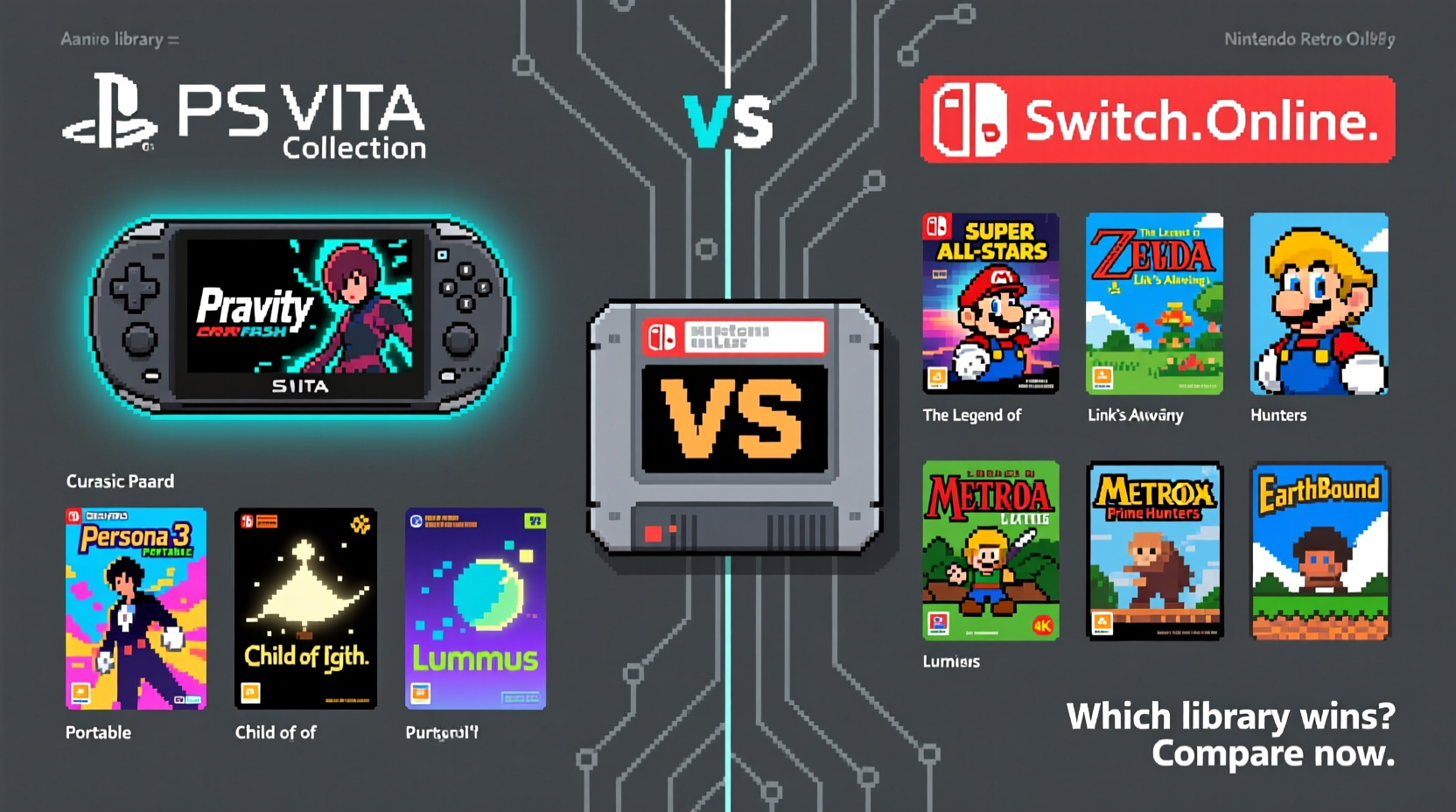
Retro gaming was once a niche pursuit involving modded consoles, flash carts, or expensive original hardware. Today, official emulation and cloud-based libraries have made it mainstream. Sony and Nintendo have taken different paths: Sony leveraged its handheld legacy through the PS Vita, while Nintendo built a subscription model around its iconic franchises. The PS Vita Collection isn’t a formal service but rather a curated set of backward-compatible PSP and PS1 games available for purchase on the Vita. In contrast, Switch Online is a paid membership that grants access to hundreds of NES, SNES, N64, and Sega Genesis titles, with additional tiers offering Game Boy and TurboGrafx-16 games.
At first glance, Switch Online appears more comprehensive. But depth doesn’t always equal richness. The quality of emulation, bonus features, regional availability, and game selection all influence how “rich” a retro library truly feels.
Game Selection and Platform Representation
Nintendo’s Switch Online boasts an ever-growing catalog of over 100 NES titles, nearly 60 SNES games, 40+ N64 titles, and dozens from the Game Boy line. With the Expansion Pack tier, users gain access to Sega Genesis, Game Boy Advance, and TurboGrafx-16 classics. These include legendary series like Super Mario Bros., The Legend of Zelda, Donkey Kong Country, and Sonic the Hedgehog. The inclusion of co-op multiplayer for many titles enhances replayability, especially in couch-style play or online sessions.
The PS Vita Collection, however, is not a unified service. It consists of individually purchased PSP and PS1 Classics—titles originally released on those systems and re-released digitally. This includes gems like Final Fantasy Tactics: War of the Lions, Patapon, Persona 3 Portable, and Grand Theft Auto: Liberty City Stories. For PS1, you’ll find Final Fantasy VII–IX, Tony Hawk’s Pro Skater 2, and Crash Bandicoot trilogy ports. These aren’t emulated in the traditional sense but rebuilt or adapted for the Vita’s screen and controls.
While Switch Online leans heavily on foundational 8-bit and 16-bit experiences, the Vita’s offerings span early 3D console gaming and early portable innovation. The difference lies in era focus: Switch Online preserves the arcade-to-home transition of the late '80s and '90s, while the Vita reflects the experimental early 2000s when handhelds began rivaling home consoles.
“Retro gaming isn’t just about nostalgia—it’s about context. The platform shapes how we experience history.” — Marcus Tran, Digital Archivist at the Video Game History Foundation
Emulation Quality and User Experience
Switch Online uses accurate software emulation for most titles, preserving original behavior with modern enhancements like suspend points, rewind functionality (added in later updates), and customizable display filters (CRT scanlines, borders). However, some users report input lag, particularly in fast-paced games like Mega Man X or Super Metroid. Additionally, Nintendo’s emulation lacks save states beyond the single suspend slot per title, limiting flexibility.
On the Vita, PS1 and PSP games were often enhanced during porting. Many include trophy support, touch controls, and optimized frame rates. For example, LocoRoco utilizes the rear touchpad, and Jet Super Strike Gunner allows gyro aiming. These aren’t pure emulations—they’re remasters with added features. However, this also means they may deviate slightly from original behavior, such as audio compression or altered load times.
Another key factor is interface design. Switch Online integrates directly into the system menu, making library access seamless. Vita’s store, now defunct for new purchases in many regions, requires navigating legacy menus and relies on a browser-based workaround for redownloads. This fragmented experience reduces usability, even if individual games perform well.
Library Depth and Hidden Gems
Switch Online excels in breadth but sometimes lacks depth in specific genres. While it includes major RPGs like Chrono Trigger and EarthBound, it misses deeper cuts such as Tactics Ogre: Let Us Cling Together or Seiken Densetsu 3 (until recently added). Its N64 lineup includes Ocarina of Time and GoldenEye 007, but omits lesser-known but influential titles like F-Zero X or 1080° Snowboarding.
In contrast, the Vita’s PSP library is a treasure trove for genre enthusiasts. Tactical RPG fans have access to Final Fantasy Tactics and Growlanser: Wayfarer of Time. Music game lovers can enjoy Lumines and CATIA. Action-adventure players benefit from portable exclusives like God of War: Ghost of Sparta and inFAMOUS: Festival of Blood. These aren’t just ports—they represent entire subcultures of gaming that thrived on portable hardware.
Moreover, the PS1 section on Vita includes Japan-exclusive visual novels and cult horror titles like Rule of Rose (in select regions), which are absent from Switch Online. While not officially part of a “collection,” dedicated users who built libraries before the store closure have access to a broader range of niche content than Switch Online currently supports.
Comparison Table: Key Features at a Glance
| Feature | PS Vita Collection | Switch Online |
|---|---|---|
| Access Model | Purchase per title | Subscription-based |
| Total Games Available | ~200+ (PSP + PS1) | 500+ (across tiers) |
| Emulation Type | Adapted ports / rebuilt | Software emulation |
| Save Flexibility | Multiple saves + trophies | One suspend point per game |
| Multiplayer Support | Limited (ad-hoc only) | Online co-op for many titles |
| Modern Enhancements | Touch controls, gyroscope | Display filters, rewind (partial) |
| Current Availability | Store closed in most regions | Actively updated |
Real-World Example: A Collector’s Journey
Take Alex Rivera, a retro enthusiast based in Austin, Texas. He initially subscribed to Switch Online for its convenience and family-friendly appeal. “I loved showing my kids Super Mario World and playing Donkey Kong Country 2 together online,” he says. But after six months, he found himself craving deeper RPGs and experimental titles. Remembering his old Vita, he dug it out and re-downloaded his previously purchased PSP library.
“Suddenly, I had Disgaea: Afternoon of Darkness, Ys Seven: Origins, and Prinny: Can I Really Be the Hero?—games with hundreds of hours of content. The Vita didn’t have online saves or cloud sync, but the games themselves felt more substantial.” Alex now uses both systems: Switch Online for quick nostalgia hits, and Vita for immersive retro adventures. His experience highlights a crucial truth—the richness of a library isn’t just about quantity, but about what kind of engagement it enables.
Expert Insight on Preservation and Accessibility
Digital preservation remains a critical issue in gaming. Unlike physical media, digital-only titles risk disappearing when stores close. Sony shut down the PS Vita and PSP store in 2021 for most regions, meaning no new purchases—though existing owners can still redownload. This sudden cutoff left gaps in accessibility, especially for newcomers.
In contrast, Switch Online continues to expand. Nintendo has shown commitment by adding Game Boy Advance and adding fan-requested titles like Super Mario RPG. However, licensing issues still prevent full representation—no Kirby’s Dream Land 3 on SNES, for instance, due to music rights.
“The real tragedy isn’t lost games—it’s lost context. When platforms vanish overnight, we lose the ecosystem that gave those games meaning.” — Dr. Lena Park, Media Archaeologist, UC Irvine
This underscores a key limitation of the Vita model: its reliance on user-owned libraries. While technically superior in some aspects, its future is frozen. Switch Online, despite occasional emulation flaws, benefits from ongoing curation and infrastructure support.
Actionable Checklist: Maximizing Your Retro Experience
- Evaluate your gaming preferences: Do you prefer short, pick-up-and-play classics or deep, narrative-driven RPGs?
- Check region availability: Some titles vary by geography—use a VPN or secondary account if needed (within legal limits).
- Invest in compatible controllers: The Switch Pro Controller enhances retro play; for Vita, consider a Bluetooth controller for comfort.
- Back up your data: If using Vita, ensure your account is linked and downloads are saved—store access is limited.
- Explore free trials: Switch Online offers one-month trials—test before subscribing.
- Join community forums: Sites like r/retrogaming and ResetEra track new additions and workarounds.
Frequently Asked Questions
Can I still buy games for PS Vita?
No—Sony closed the PS Store for Vita and PSP in most regions as of July 2021. You can only redownload previously purchased titles. A few third-party sellers offer pre-loaded memory cards, but these come with risks.
Does Switch Online include Game Boy Advance games?
Yes, but only with the Expansion Pack tier. Titles like Metroid Fusion, Fire Emblem: The Sacred Stones, and Pokémon Mystery Dungeon: Red Rescue Team are available, though the selection is smaller than NES or SNES.
Which service has better emulation accuracy?
Switch Online generally offers more faithful emulation, especially for NES and SNES. Vita ports are polished but modified, which can alter timing or responsiveness. For purists, Switch wins; for enhanced usability, Vita has advantages.
Conclusion: Which Library Is Richer?
The answer depends on how you define “rich.” In sheer volume and ease of access, **Nintendo Switch Online** is unmatched. It delivers a broad, curated journey through gaming’s formative decades, with strong multiplayer integration and continuous updates. It’s ideal for casual players, families, and those seeking shared nostalgia.
However, the **PS Vita Collection**, though now inaccessible to new users, offered a denser, more diverse catalog of mid-tier and niche titles. Its strength lay in depth—not just in RPGs and action games, but in experimental genres that defined the early 2000s handheld scene. For collectors and genre specialists, the Vita library remains richer in substance, even if it’s frozen in time.
If you’re starting fresh today, Switch Online is the only viable option. But for those who preserved their Vita libraries, the depth and uniqueness of its retro offerings still hold unmatched appeal. Ultimately, richness isn’t measured in numbers alone—it’s in the variety of experiences, the emotional resonance of discovery, and the ability to revisit eras that shaped modern gaming.




 浙公网安备
33010002000092号
浙公网安备
33010002000092号 浙B2-20120091-4
Comments
No comments yet. Why don't you start the discussion?