
When Sony launched the PlayStation 5 in late 2020, it set a new standard for console design and gaming performance. With its bold, futuristic look and powerful hardware, the original PS5 quickly became a must-have device. But in late 2023, Sony introduced a revised model—the PS5 Slim—offering a more compact form factor and updated features. For gamers deciding between the two, the question arises: Is the smaller version actually worth choosing over the classic model?
This isn’t just about size or aesthetics. The decision involves trade-offs in storage, expandability, price, and long-term usability. Whether you're upgrading from an older console, replacing a worn-out unit, or buying your first PS5, understanding the differences can save you money and enhance your gaming experience.
Design and Physical Differences
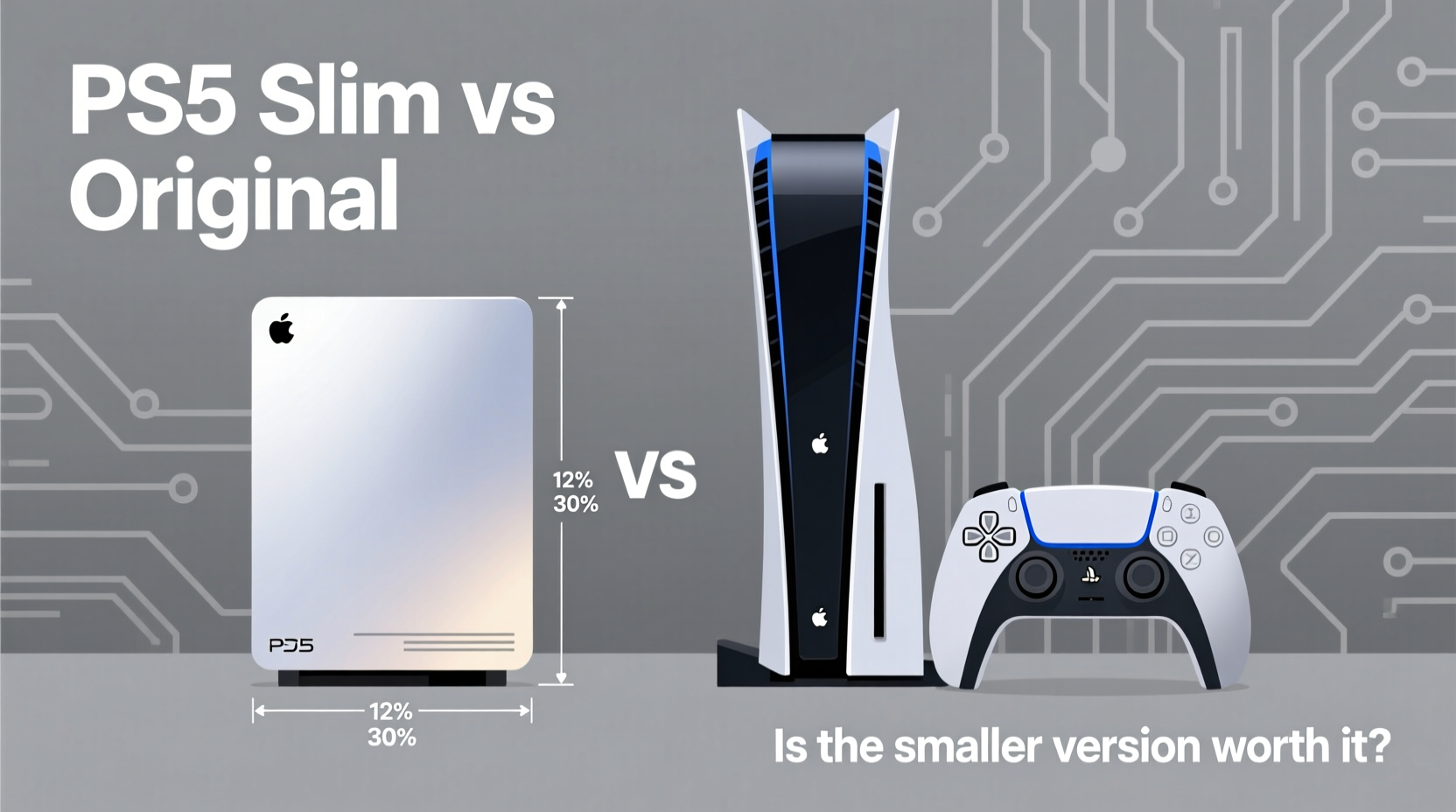
The most noticeable change between the original PS5 and the PS5 Slim is the physical footprint. The Slim model reduces the overall volume by approximately 30%, making it significantly more compact. This redesign makes it easier to fit into entertainment centers, shelves, or travel cases without dominating the space.
The original PS5 was criticized for its large size—standing at roughly 390mm tall and weighing around 4.5 kg (9.9 lbs) for the disc edition. The PS5 Slim, in contrast, measures about 358mm in height and weighs closer to 3.2 kg (7.1 lbs), depending on the configuration. That’s nearly a 1.3 kg reduction, which adds up if you’re moving your console frequently.
Another major visual shift is the modular disc drive. On the original PS5, the disc drive was fixed. In the Slim model, it's detachable and sold separately. This allows users to purchase a digital-only version and add the drive later if needed—a flexibility that wasn't available before.
Performance: Identical Power, Same Experience
One of the most important points to clarify is that both the original PS5 and the PS5 Slim deliver identical internal performance. They use the same custom AMD CPU and GPU, the same 16GB of GDDR6 memory, and support the same ray tracing, 4K resolution, and 120Hz output capabilities. Gamers will not notice any difference in load times, frame rates, or graphical fidelity between the two models.
Sony made no upgrades to the core processing hardware with the Slim release. Instead, the focus was on refining manufacturing efficiency and reducing component size. This means thermal performance has been re-engineered rather than improved. The Slim uses a redesigned heatsink and more compact cooling solution, but real-world testing shows temperatures remain within safe limits under normal usage.
“From a performance standpoint, the PS5 Slim is indistinguishable from the original. It’s a refinement, not a reinvention.” — Mark Delaney, Editor-in-Chief, GameSpot
However, some early reports noted slightly higher fan noise under heavy loads, likely due to the denser internal layout requiring faster airflow. While not disruptive during gameplay, this may be noticeable in quiet environments.
Storage Capacity and Expandability
Storage is where the PS5 Slim introduces meaningful changes—both positive and negative. The original PS5 came with 825GB of internal SSD storage, of which approximately 667GB is usable after system files. The PS5 Slim doubles that base capacity: the digital edition now has 1TB, while the disc edition offers 1.2TB.
This extra space is welcome. Modern AAA titles like *Call of Duty: Modern Warfare III* or *Final Fantasy VII Rebirth* can consume over 150GB each. More onboard storage means fewer immediate deletions or reliance on external drives for games you want to keep installed.
| Feature | Original PS5 (Disc) | PS5 Slim (Disc) | PS5 Slim (Digital) |
|---|---|---|---|
| Internal Storage | 825GB (~667GB usable) | 1.2TB (~1000GB usable) | 1TB (~830GB usable) |
| Expandable SSD Slot | Yes (M.2 NVMe) | Yes (M.2 NVMe) | Yes (M.2 NVMe) |
| External USB Support | Yes (HDD/SSD for PS4 games) | Yes | Yes |
| Base Weight | 4.5 kg | 3.2 kg | 2.6 kg |
| Disc Drive | Integrated | Modular (included) | Optional (sold separately) |
All models still support M.2 NVMe SSD expansion via the internal bay, allowing users to upgrade storage up to 8TB. The process remains unchanged: open the side panel, insert a compatible PCIe Gen4 drive, and format it through the settings menu. External USB drives can store and play backward-compatible PS4 titles, though PS5 games must reside on internal or M.2 storage.
Real-World Use Case: Choosing Based on Lifestyle
Consider Sarah, a college student living in a dorm room with limited shelf space. She primarily downloads games during sales and streams movies through Netflix and Disney+. When her original PS5 broke down after three years, she faced a choice: replace it with another standard model or try the newer Slim.
She opted for the PS5 Slim Digital Edition. The smaller size allowed it to fit neatly beside her monitor, and the added 1TB of storage meant she could keep five full games installed without constant management. Later, when she inherited her brother’s collection of PS5 disc games, she purchased the optional disc drive for $79 and attached it herself in under five minutes. The modular design turned out to be a long-term advantage.
In contrast, Mike, a home theater enthusiast with a dedicated media cabinet, preferred the presence and symmetry of the original PS5. He values the integrated disc drive and doesn’t mind the bulk. For him, the Slim offered no compelling benefit beyond slightly more storage.
This illustrates a key insight: the best choice depends less on technical superiority and more on personal setup and usage patterns.
Pricing and Value Comparison
The PS5 Slim comes at a premium compared to the original launch pricing, though it reflects current market conditions rather than inflation alone. As of 2024:
- PS5 Slim Disc Edition: $499.99 (includes disc drive)
- PS5 Slim Digital Edition: $449.99
- Standalone Disc Drive: $79.99 (for digital owners)
The original PS5 launched at $499 (disc) and $399 (digital). While the Slim’s digital model is $50 more, it includes double the base storage. The disc version matches the original price point but adds 400GB of usable space and a sleeker design.
If you already own a digital PS5 and later want to add disc compatibility, the $80 add-on may feel steep. However, bundling options are occasionally available through retailers, offering slight savings. Buying the disc version upfront remains the most cost-effective route for hybrid users.
Step-by-Step Guide: How to Decide Which Model Fits You
Follow this simple decision framework to determine the right PS5 for your needs:
- Evaluate your game library type. Do you buy physical discs, collect special editions, or borrow games from friends? Choose the disc model. If you exclusively download games, the digital edition suffices.
- Assess your available space. Measure your entertainment center. If clearance is tight vertically or behind the TV, the Slim’s reduced height helps significantly.
- Estimate your storage needs. Multiply the number of games you typically keep installed by 80–100GB. If you regularly play four or more large titles, the Slim’s larger base storage reduces future expansion costs.
- Consider future flexibility. The Slim’s modular drive allows you to start digital and upgrade later. This is ideal if you’re uncertain about long-term preferences.
- Compare total cost. Factor in potential future expenses—like an M.2 SSD or external drive—when weighing initial price differences.
Frequently Asked Questions
Can I upgrade the internal storage on both models?
Yes. Both the original PS5 and PS5 Slim support M.2 NVMe SSD expansion up to 8TB. The installation process is identical: access the slot under the removable panel, insert the drive, and format it in Settings > Storage.
Is the detachable disc drive reliable?
Early concerns about durability have largely been unfounded. The drive connects via a secure internal ribbon cable and has performed reliably in stress tests. Users report seamless switching between configurations with no data loss or connection issues.
Does the PS5 Slim support all accessories from the original?
Absolutely. All official DualSense controllers, Pulse headsets, charging stations, and HD cameras work across both models. Firmware updates ensure full backward compatibility with existing peripherals.
Conclusion: Is the PS5 Slim Worth It?
The PS5 Slim isn’t a revolutionary upgrade, but it is a thoughtful evolution. It retains everything that made the original great—lightning-fast load times, immersive DualSense feedback, and stunning 4K visuals—while addressing practical concerns like size and storage.
For new buyers, the Slim is almost certainly the better choice. The increased base storage, lighter weight, and modular flexibility offer tangible benefits without sacrificing performance. Even the higher starting price is justified by the added value.
Existing PS5 owners don’t need to upgrade unless their current console is failing or they have specific space constraints. There’s no performance incentive to switch.
Ultimately, the PS5 Slim refines the experience rather than redefining it. And sometimes, refinement is exactly what a successful product needs.




 浙公网安备
33010002000092号
浙公网安备
33010002000092号 浙B2-20120091-4
Comments
No comments yet. Why don't you start the discussion?