
When it comes to immersive virtual reality, the absence of wires is more than a convenience—it’s a transformation. Tether-free movement allows players to step fully into digital worlds, turning VR from a novelty into an experience that feels real. Two leading contenders in this space are Sony’s PSVR2 and Meta’s Quest 3. While both promise high-fidelity VR, their approach to immersion—especially in relation to cables—diverges sharply. One is built on wired precision; the other champions wireless freedom. So, which truly offers better immersion without wires?
The answer isn’t as simple as “wireless wins.” Immersion depends on multiple factors: visual fidelity, audio integration, controller responsiveness, spatial awareness, and how naturally the system adapts to human movement. Let’s break down these elements across both platforms to determine where true immersion lies.
Understanding Immersion in Virtual Reality
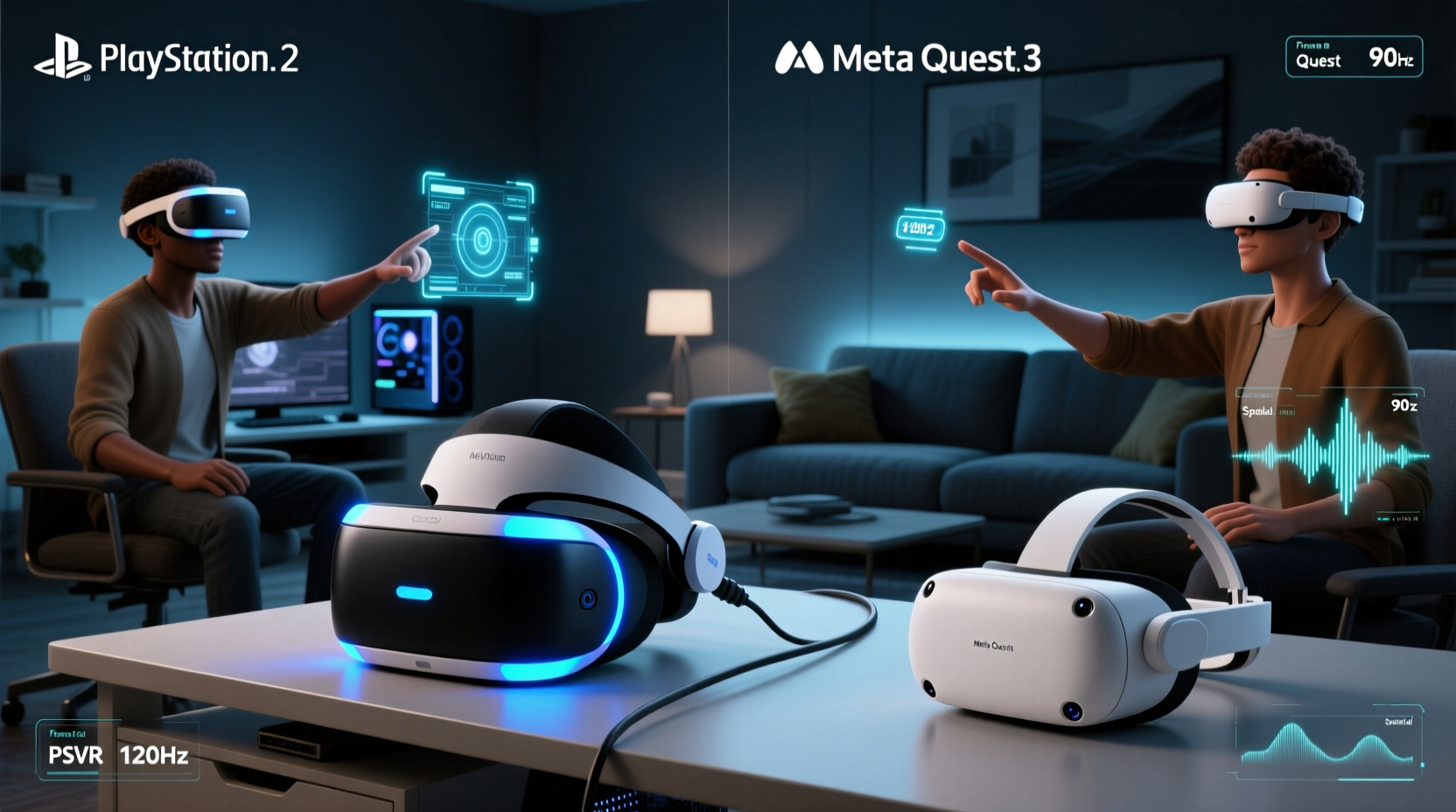
Immersion in VR isn’t just about graphics or field of view—it’s the sum of sensory feedback, interaction realism, and freedom of motion. A truly immersive headset makes you forget you’re wearing one. It responds instantly to your head movements, tracks your hands accurately, and places sound precisely around you. When all these components align, suspension of disbelief becomes effortless.
One major disruptor to that illusion? Cables. A physical tether can yank you back into reality when you turn too far or trip over a cord. That’s why wireless systems like the Meta Quest 3 have gained popularity—they eliminate that constraint entirely. But removing wires introduces trade-offs in processing power, latency, and display quality. The PSVR2, while connected via USB-C to the PlayStation 5, compensates with higher-resolution OLED displays and advanced haptics.
So the core question becomes: does the liberation of wireless outweigh the technical advantages of a wired connection?
Design and Freedom of Movement: The Wireless Advantage
The Meta Quest 3 is designed from the ground up as a standalone device. There are no external sensors, no PC requirement, and most importantly, no cords. This complete lack of physical tethers gives users unparalleled freedom. You can crouch, spin, leap, or walk backward without worrying about tripping or disconnecting.
This freedom directly enhances immersion. In games like *Lucky’s Tale* or *Resident Evil 4 VR*, being able to physically sidestep zombies or duck behind cover without restriction makes the experience feel visceral. Spatial awareness is preserved because your body’s natural instincts aren’t interrupted by hardware limitations.
In contrast, the PSVR2 uses a single USB-C cable to connect to the PS5. While Sony improved ergonomics with a slimmer cable and breakout box, it’s still a tether. During fast-paced gameplay—such as dodging energy blasts in *Star Wars: Tales from the Galaxy’s Edge*—the cord can pull or twist, breaking focus. Some users report unconsciously adjusting their stance to avoid tangling, which subtly undermines the sense of presence.
However, PSVR2 does offer inside-out tracking with four embedded cameras, eliminating the need for external sensors. Setup is relatively simple, and once calibrated, tracking is highly accurate. But the wire remains a psychological and physical barrier to total immersion.
Visual Fidelity and Display Technology
Visuals are foundational to immersion. If the image lags, blurs, or lacks detail, the brain rejects the illusion. Here, the PSVR2 holds a significant edge in raw specs.
| Feature | PSVR2 | Meta Quest 3 |
|---|---|---|
| Display Type | OLED HDR (per-eye) | Fast-switch LCD (penalty-free) |
| Resolution (per eye) | 2000 x 2040 | 2064 x 2208 |
| Refresh Rate | Up to 120Hz | Up to 120Hz |
| Field of View | Approx. 110° | Approx. 110° |
| HDR Support | Yes | No |
The PSVR2’s OLED panels deliver deeper blacks, richer contrast, and HDR support—features that enhance depth perception and environmental realism. In dark scenes, such as exploring a derelict spaceship in *Horizon Call of the Mountain*, shadows feel tangible, and lighting cues guide your attention naturally. This level of visual nuance contributes directly to immersion.
The Quest 3 uses fast-switch LCDs, which avoid motion blur but lack the per-pixel contrast of OLED. While resolution is slightly higher, the absence of HDR means less dynamic range. Colors remain vibrant, but scenes don’t “breathe” with the same lifelike variation.
Still, the Quest 3 compensates with mixed reality passthrough. Its high-resolution color cameras allow digital objects to blend into your real environment, creating a unique form of immersion—especially in titles like *Fable* or *Metro Awakening*. You can see your actual floor, furniture, and even pets while battling virtual enemies, making the overlay feel astonishingly real.
“Mixed reality isn’t just a gimmick—it redefines what ‘presence’ means in VR. When you see your coffee table become part of a battlefield, the mind accepts the fiction more readily.” — Dr. Lena Torres, Human-Computer Interaction Researcher, MIT Media Lab
Audio, Haptics, and Controller Feedback
Spatial audio and tactile feedback deepen immersion by engaging additional senses. The PSVR2 integrates 3D audio through Tempest Engine support, delivering pinpoint directional sound. When a drone buzzes past your left ear or footsteps echo behind you, the effect is startlingly real. Additionally, the headset features subtle haptic feedback—vibrations in the headband that sync with in-game events, such as explosions or weather changes. These micro-sensations reinforce environmental cues without requiring visual confirmation.
The Sense controllers offer adaptive triggers and finger touch detection, mimicking resistance when drawing a bowstring or gripping a weapon. This level of detail pulls players deeper into interactions.
The Quest 3 uses stereo speakers built into the headset band, providing decent spatial audio but lacking the sophistication of Tempest. However, its Touch Plus controllers are lighter and feature improved tracking. They also support hand tracking for select applications, allowing users to interact without holding anything—a step toward more natural immersion.
Where the Quest 3 shines is accessibility. No setup beyond initial calibration is required. You put it on, and within seconds, you’re in a virtual world. The PSVR2 requires pairing with a console, firmware updates, and sometimes recalibration—small delays that interrupt the flow of entry into VR.
Real-World Example: A Night with Both Headsets
Consider Alex, a VR enthusiast who owns both systems. On a Friday night, he starts with PSVR2, launching *Gran Turismo 7 VR mode*. The cockpit view is stunning—the leather texture on the steering wheel, reflections on the windshield, and engine rumble synced to haptics create a convincing simulation. But halfway through a race, he turns sharply and feels the cable tug against the desk. He pauses, repositions, loses focus, and crashes.
Later, he switches to Quest 3 and loads *Gorilla Tag*. No setup needed. He jumps into a jungle gym map, swinging by his arms, leaping between platforms, and crawling under obstacles—all without a single wire. The game is less graphically refined, but the physical freedom makes him feel like he’s actually climbing. He plays for 45 minutes straight, drenched in sweat, completely absorbed.
For Alex, immersion wasn’t defined by pixels—it was defined by uninterrupted action. The Quest 3 won not because it looked better, but because it got out of his way.
Step-by-Step: Choosing Based on Your Immersion Priorities
If you’re deciding between these two headsets, follow this decision path:
- Assess your space: Do you have a dedicated, clutter-free area? If yes, wireless works well. If space is tight, either can function, but Quest 3 adapts better.
- Determine your content preference: Are you drawn to cinematic, story-driven experiences (*Rez Infinite*, *Tetris Effect*)? PSVR2 excels here. Prefer active, social, or fitness apps (*Supernatural*, *Walkabout Mini Golf*)? Quest 3 dominates.
- Evaluate your tech ecosystem: Own a PS5? PSVR2 integrates seamlessly. Use Android/iOS devices and want cross-platform access? Quest 3 connects easily.
- Test comfort over time: PSVR2 is heavier (560g vs 500g). Long sessions may cause neck strain. Try both if possible.
- Prioritize future-proofing: Quest 3 supports AR and MR development. PSVR2 is focused purely on VR with limited roadmap beyond current-gen Sony.
Frequently Asked Questions
Can I use PSVR2 wirelessly with a PC or adapter?
No official wireless solution exists for PSVR2. Third-party adapters are unreliable and not supported by Sony. The headset requires a direct USB-C connection to the PS5 for power and data.
Does the Quest 3 require Wi-Fi to work?
Not for standalone use. Once apps are downloaded, you can play offline. However, software updates, multiplayer features, and cloud saves require internet access.
Is inside-out tracking reliable on both devices?
Yes. Both PSVR2 and Quest 3 use inside-out tracking with excellent accuracy under good lighting. Low-light conditions can affect camera-based systems, but neither uses external base stations, simplifying setup.
Final Verdict: Where True Immersion Lies
The PSVR2 delivers a premium, high-fidelity VR experience with unmatched visual depth and audio precision. It’s ideal for gamers seeking cinematic quality and deep integration with AAA titles. But its reliance on a wired connection fundamentally limits physical freedom—an essential component of immersion.
The Meta Quest 3, while slightly behind in display technology, removes the single biggest barrier to presence: the cord. Its standalone design, rapid launch times, mixed reality capabilities, and natural movement tracking create a more seamless, uninterrupted experience. For most users, especially those new to VR or prioritizing active gameplay, this freedom translates to greater immersion.
In the end, immersion without wires isn’t just about cutting a cable—it’s about removing friction between thought and action. The Quest 3 achieves this more consistently, making it the better choice for those who value fluid, untethered presence in virtual worlds.




 浙公网安备
33010002000092号
浙公网安备
33010002000092号 浙B2-20120091-4
Comments
No comments yet. Why don't you start the discussion?