
Waiting for quest results can be frustrating, especially when delays disrupt workflows, research timelines, or user experiences in applications relying on real-time data. Whether you're working with online surveys, gamified learning platforms, AI-driven assessments, or backend analytics systems, slow result generation undermines efficiency and trust. Understanding the root causes behind delayed outcomes is the first step toward implementing effective fixes. This guide breaks down the most frequent technical and operational reasons for sluggish quest result processing—and provides actionable strategies to resolve them.
Common Causes of Delayed Quest Results
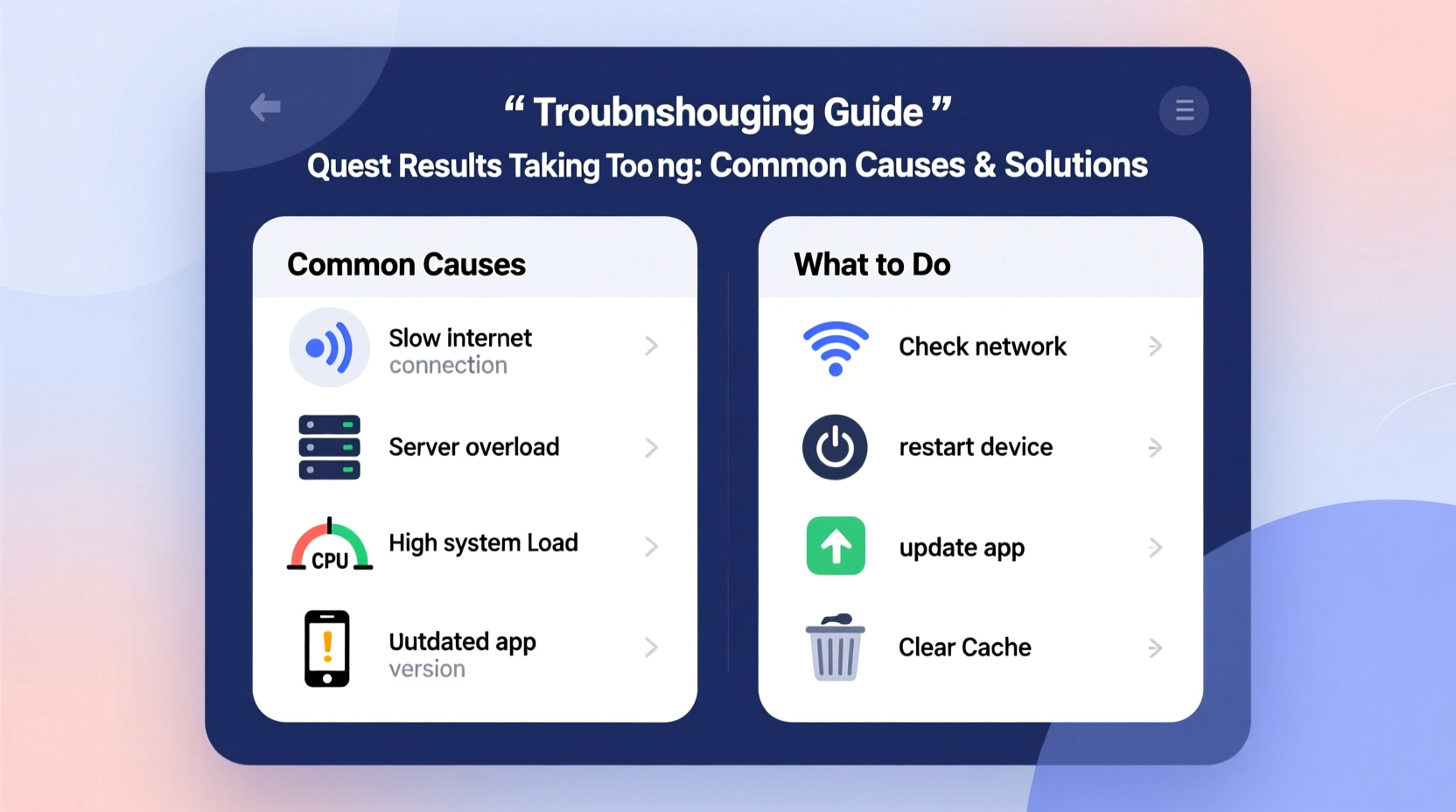
Delays in receiving quest results rarely stem from a single issue. More often, they are symptoms of deeper inefficiencies across infrastructure, design, or execution layers. Identifying these underlying problems allows for targeted interventions.
- Server Overload: High traffic volumes or insufficient server capacity can bottleneck request processing.
- Inefficient Database Queries: Poorly optimized queries—especially those involving joins across large datasets—can take seconds or even minutes to execute.
- Synchronous Processing: Systems that process each step in sequence instead of parallelizing tasks create unnecessary wait times.
- Third-Party API Dependencies: External services used for scoring, authentication, or validation may have latency issues beyond your control.
- Data Validation Bottlenecks: Excessive client-side or server-side checks without caching can delay final output delivery.
- Lack of Caching: Repeated computations for identical inputs waste resources and time.
- Client-Side Rendering Delays: Frontend frameworks waiting for all assets before rendering can make results appear slower than they actually are.
Step-by-Step Guide to Diagnose and Fix Slow Results
Resolving performance bottlenecks requires a methodical approach. Follow this timeline to pinpoint and eliminate sources of delay.
- Monitor System Performance (Day 1–2): Deploy logging and tracing tools to capture response times at each stage—frontend, API gateway, database, and external services.
- Analyze Logs for Latency Spikes (Day 3): Look for patterns during peak usage hours or after specific actions (e.g., submission bursts).
- Profile Database Queries (Day 4–5): Run EXPLAIN ANALYZE on key queries; optimize indexes and eliminate N+1 query problems.
- Implement Asynchronous Processing (Day 6–7): Offload heavy computation (scoring logic, report generation) to background workers using queues (e.g., RabbitMQ, Celery).
- Add Strategic Caching (Day 8): Cache frequently accessed results using Redis or Memcached, especially for read-heavy operations.
- Optimize Frontend Delivery (Day 9): Enable lazy loading, reduce JavaScript bundle size, and use skeleton screens to improve perceived performance.
- Test Under Load (Day 10): Simulate high-concurrency scenarios using tools like JMeter or k6 to validate improvements.
Do’s and Don’ts: Best Practices Table
| Do | Don't |
|---|---|
| Use pagination or chunking for large result sets | Load entire datasets into memory at once |
| Cache static or semi-static results (e.g., leaderboard rankings) | Rely solely on real-time computation for every request |
| Scale horizontally with load balancers during traffic surges | Run everything on a single underpowered server |
| Set timeouts for third-party API calls (e.g., 5 seconds) | Allow indefinite waits that block downstream processes |
| Compress responses (gzip/Brotli) for faster transmission | Send uncompressed JSON payloads over slow connections |
Real Example: Educational Platform Speed-Up Case Study
An edtech startup offering gamified quizzes noticed users abandoning sessions due to 15–30 second delays in receiving quest feedback. Upon investigation, engineers found that each quiz submission triggered multiple synchronous API calls to an external grading service, combined with unindexed database lookups for user history.
The team restructured the system: they introduced a message queue to decouple submission from scoring, cached common answer validations, and added composite indexes on user_id + quiz_id fields. They also implemented immediate acknowledgment with a “results pending” UI state.
Within two weeks, average result delivery dropped to under 3 seconds. User completion rates increased by 42%, and server costs decreased due to reduced redundant processing.
“Performance isn’t just about speed—it’s about reliability and user confidence. When people know they’ll get timely feedback, engagement follows.” — Dr. Lena Torres, Lead Systems Architect at EduFlow Labs
Actionable Checklist to Improve Quest Result Timeliness
Use this checklist as a quick reference to audit and enhance your current setup:
- ✅ Audit all endpoints involved in result generation for response times
- ✅ Identify and eliminate long-running database queries
- ✅ Replace synchronous workflows with asynchronous job queues where possible
- ✅ Introduce caching for repetitive computations or static content
- ✅ Set reasonable timeouts and fallbacks for external dependencies
- ✅ Compress and minify data payloads sent to clients
- ✅ Monitor performance continuously using APM tools
- ✅ Test scalability under simulated peak loads
- ✅ Optimize frontend rendering to show progress indicators early
- ✅ Document SLAs for expected result delivery times
Frequently Asked Questions
Why do some users get fast results while others experience long waits?
This often points to inconsistent infrastructure behavior—such as uneven load balancing, regional differences in CDN performance, or variable network quality. It could also indicate session-specific complexity (e.g., longer quests requiring more processing). Review per-user logs and correlate wait times with input size and location.
Can browser settings affect how quickly I see quest results?
Yes. Browser extensions, ad blockers, outdated caches, or disabled JavaScript can interfere with dynamic content loading. Additionally, older devices may struggle with heavy frontend frameworks. Recommend users clear their cache or try incognito mode if delays persist despite backend optimizations.
Is it better to show partial results quickly or wait for full accuracy?
In most cases, providing immediate feedback—even if preliminary—improves user experience. For example, display \"Processing complete, calculating score...\" instantly upon submission, then update with final results. This reduces perceived latency and keeps users engaged.
Conclusion: Take Control of Your Quest Performance
Slow quest results aren’t inevitable—they’re signals of inefficiency waiting to be addressed. By systematically diagnosing technical debt, optimizing critical paths, and adopting modern architectural practices like queuing and caching, you can dramatically reduce wait times and restore user trust. The difference between frustration and satisfaction often comes down to a few well-placed improvements.




 浙公网安备
33010002000092号
浙公网安备
33010002000092号 浙B2-20120091-4
Comments
No comments yet. Why don't you start the discussion?