
In recent years, a quiet but powerful shift has taken place in how employees approach their jobs. No longer defined solely by promotions or corner offices, professional satisfaction is increasingly tied to autonomy, respect, and emotional well-being. Terms like “quiet quitting” and “acting your wage” have emerged from social media into mainstream conversation, sparking debate across industries. While often misunderstood as disengagement or laziness, these concepts actually reflect a deeper cultural reckoning—one where workers are reevaluating what they owe their employers and what they expect in return.
The core idea isn’t about doing less; it’s about doing *only* what’s fair. It’s about rejecting hustle culture, refusing unpaid labor, and honoring personal time. As burnout rates soar and job fulfillment declines, more professionals are drawing clear lines between duty and overcommitment. This article explores the nuances of quiet quitting versus acting your wage, examines their real-world implications, and offers practical guidance for navigating modern work expectations—without guilt.
Understanding the Terms: What Do They Really Mean?
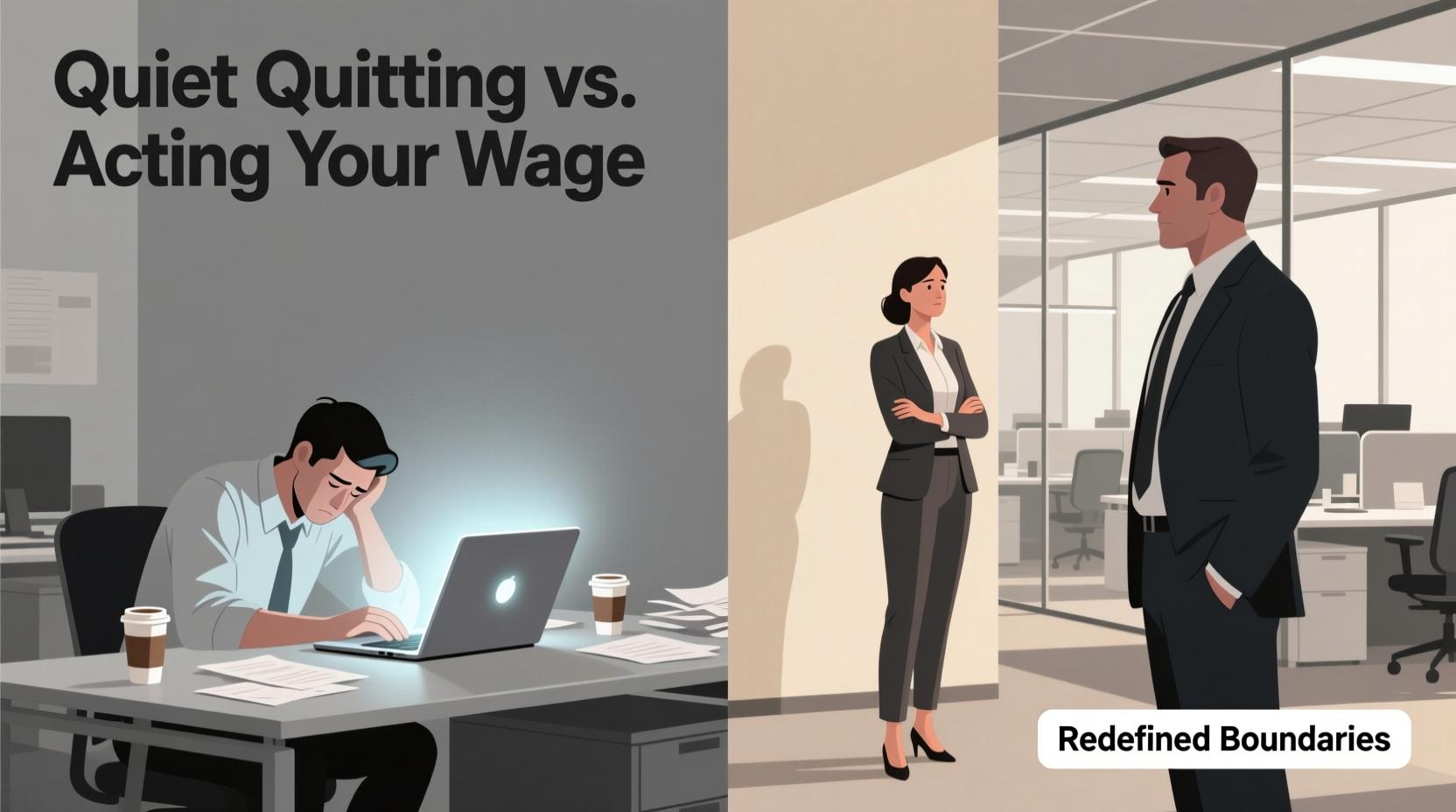
Despite viral popularity, both phrases are frequently misinterpreted. Let's clarify them with precision.
Quiet quitting does not mean resigning or slacking off. Instead, it refers to an employee who fulfills their job responsibilities exactly as outlined in their role—no more, no less. They stop going \"above and beyond\" unless formally recognized or compensated. For example, a project manager might decline after-hours emails on weekends or refuse to cover shifts outside their scope simply because it’s expected.
Acting your wage takes this a step further. It means aligning your effort, availability, and emotional investment strictly with your compensation level. If you’re paid $60,000 a year, you don’t act like someone earning $120,000. You clock in, do the work, and clock out—without volunteering for extra tasks, answering Slack messages at midnight, or absorbing emotional labor that isn't part of your pay grade.
These behaviors aren’t new. What’s changed is visibility. Platforms like TikTok and LinkedIn have amplified worker frustrations, turning individual coping mechanisms into collective movements. According to a 2023 Gallup poll, 59% of U.S. employees reported feeling emotionally detached from their jobs—a record high—and many cite lack of recognition and imbalance as key drivers.
“Employees aren’t suddenly becoming lazy. They’re responding to years of being asked to do more with less. Acting your wage is self-preservation.” — Dr. Lena Torres, Organizational Psychologist
Why These Mindsets Are Gaining Traction
The rise of boundary-conscious work cultures stems from systemic issues long ignored by leadership. Several factors explain why quiet quitting and acting your wage resonate so deeply today:
- Hustle culture fallout: For decades, employees were praised for working late, skipping vacations, and prioritizing work over health. Now, many realize those sacrifices didn’t lead to advancement—just exhaustion.
- Stagnant wages vs rising costs: Inflation has outpaced salary growth for most workers since 2020. When people feel financially strained, they reassess whether extra effort is worth it.
- Remote work blurring lines: Without physical separation between office and home, work creeps into personal time. Responding to emails during dinner becomes normal—until it doesn’t.
- Generational shifts: Younger workers, particularly Millennials and Gen Z, prioritize mental health and purpose over titles or tenure. They value transparency and fairness more than loyalty for its own sake.
- Lack of upward mobility: Many organizations have flattened hierarchies, leaving skilled employees stuck in roles with little room to grow—despite increasing demands.
Quiet Quitting vs Acting Your Wage: Key Differences
While overlapping, the two concepts differ in motivation and expression. The table below outlines their distinctions:
| Aspect | Quiet Quitting | Acting Your Wage |
|---|---|---|
| Core Principle | Fulfilling job duties without overextending | Matching effort directly to compensation level |
| Motivation | Preventing burnout, protecting boundaries | Fairness, economic realism |
| Visibility | Low (behavioral change only noticeable over time) | Moderate (may include direct conversations about pay) |
| Risk of Misinterpretation | High (seen as disengaged or apathetic) | Moderate (can be framed as principled stance) |
| Long-Term Goal | Sustainable work rhythm | Equitable exchange of labor and pay |
Both represent pushback against exploitation disguised as opportunity. But while quiet quitting is passive—pulling back quietly—acting your wage can be more assertive, even confrontational when used to challenge underpayment.
Real-World Example: A Day in Two Offices
Consider two marketing coordinators, both named Jordan, working similar roles at different companies.
Jordan A works at a fast-growing startup known for its “family-like” culture. Despite being salaried, they routinely check emails at 10 PM, attend last-minute weekend Zoom calls, and redesign campaigns during vacation—all without additional pay. Colleagues praise their dedication, but Jordan feels drained, undervalued, and trapped by unspoken expectations.
Jordan B works at a mid-sized firm with clearer policies. After completing daily tasks by 5:30 PM, they log off. When asked to join an evening meeting, they respond: “I’m unavailable after hours unless it’s urgent and pre-scheduled.” They decline weekend work unless compensated with overtime or comp time. Their manager respects the boundary, noting improved focus during core hours.
Jordan A is quietly burned out. Jordan B is quietly thriving. Both could be described as “quiet quitters” by critics—but only one is acting sustainably.
This contrast illustrates that context matters. Culture, leadership norms, and structural support determine whether boundary-setting leads to success or stagnation.
How to Set Healthy Boundaries Without Career Consequences
Drawing lines at work requires strategy, especially in environments where overwork is normalized. Here’s a step-by-step guide to implementing boundary-conscious behavior professionally:
- Clarify your job description. Review your official responsibilities. Identify which tasks fall outside your scope. Use this document as a neutral reference point.
- Track your time and contributions. For two weeks, log every task, including informal requests. You may discover you’re regularly doing work equivalent to 1.5 full-time jobs.
- Initiate a conversation with your manager. Frame the discussion around sustainability and quality. Say: “I want to ensure I’m focusing on high-impact work. Can we review my current priorities?”
- Negotiate availability. If after-hours communication is expected, propose alternatives: “I’ll respond first thing in the morning,” or “Let’s schedule urgent items ahead of time.”
- Practice polite refusal. Use templates like: “I’d love to help, but I’m at capacity with current deadlines. Can we revisit this next quarter?”
- Align effort with compensation. If you’re underpaid relative to market rate, either advocate for a raise or adjust expectations accordingly. Continuing to over-deliver without reward enables inequity.
- Protect your identity beyond work. Engage in hobbies, relationships, and rest that remind you you’re more than your job title. This reduces emotional dependency on workplace validation.
“When employees stop over-giving, it exposes broken systems—not broken people.” — Marcus Reed, HR Innovation Consultant
Actionable Checklist: Redefine Your Work Boundaries
Use this checklist to assess and strengthen your professional boundaries:
- ✅ Reviewed my official job description recently
- ✅ Tracked my actual workload vs. expected duties
- ✅ Declined at least one non-essential request this month
- ✅ Stopped checking work messages during personal time
- ✅ Had a conversation about workload with my manager
- ✅ Aligned my effort level with my current compensation
- ✅ Scheduled regular time off and protected it
- ✅ Identified signs of burnout and responded proactively
Frequently Asked Questions
Isn’t quiet quitting just being lazy?
No. Quiet quitting is not about avoiding work—it’s about refusing unpaid labor and emotional overextension. Most quiet quitters still meet performance standards. The difference is they no longer sacrifice personal well-being for approval.
Can acting your wage hurt my career growth?
Potentially, in toxic environments where overwork is rewarded. However, sustainable careers are built on mutual respect, not exploitation. If your organization punishes reasonable boundaries, it may not be a place where long-term growth is possible anyway.
What if I want to go above and beyond sometimes?
That’s fine—as long as it’s your choice. The issue arises when “above and beyond” becomes the baseline expectation. Voluntary extra effort should remain just that: voluntary, occasional, and ideally recognized.
Conclusion: Reclaiming Agency in the Modern Workplace
Quiet quitting and acting your wage are symptoms of a larger truth: the social contract between employer and employee has shifted. Workers are no longer willing to trade health, time, and dignity for vague promises of loyalty or future rewards. Instead, they demand clarity, fairness, and respect.
Setting boundaries isn’t rebellion—it’s responsibility. It allows individuals to show up as their best selves during work hours, preserve energy for life outside the office, and model healthier norms for teams. Organizations that adapt will retain talent, reduce turnover, and foster cultures of trust. Those that resist risk alienating the very people they rely on.
You don’t have to choose between being competent and being whole. You can deliver excellent work without letting it consume you. Start small. Protect your time. Honor your wage. And remember: doing your job—fully, fairly, and without apology—is never underperformance.




 浙公网安备
33010002000092号
浙公网安备
33010002000092号 浙B2-20120091-4
Comments
No comments yet. Why don't you start the discussion?