
For decades, the printed book has been the gold standard for deep reading, study, and intellectual engagement. But with the rise of e-readers like the Amazon Kindle, more people are shifting their reading habits to digital formats. While convenience, portability, and accessibility are undeniable advantages of e-readers, a growing body of research suggests that the medium may influence how we process, remember, and emotionally connect with what we read.
The central question is no longer just about preference—it’s about cognitive impact. Does reading on a Kindle affect memory retention compared to physical books? The answer isn’t black and white, but science is beginning to reveal meaningful differences in comprehension, recall, and mental engagement between screen-based and paper-based reading.
The Cognitive Impact of Reading Mediums
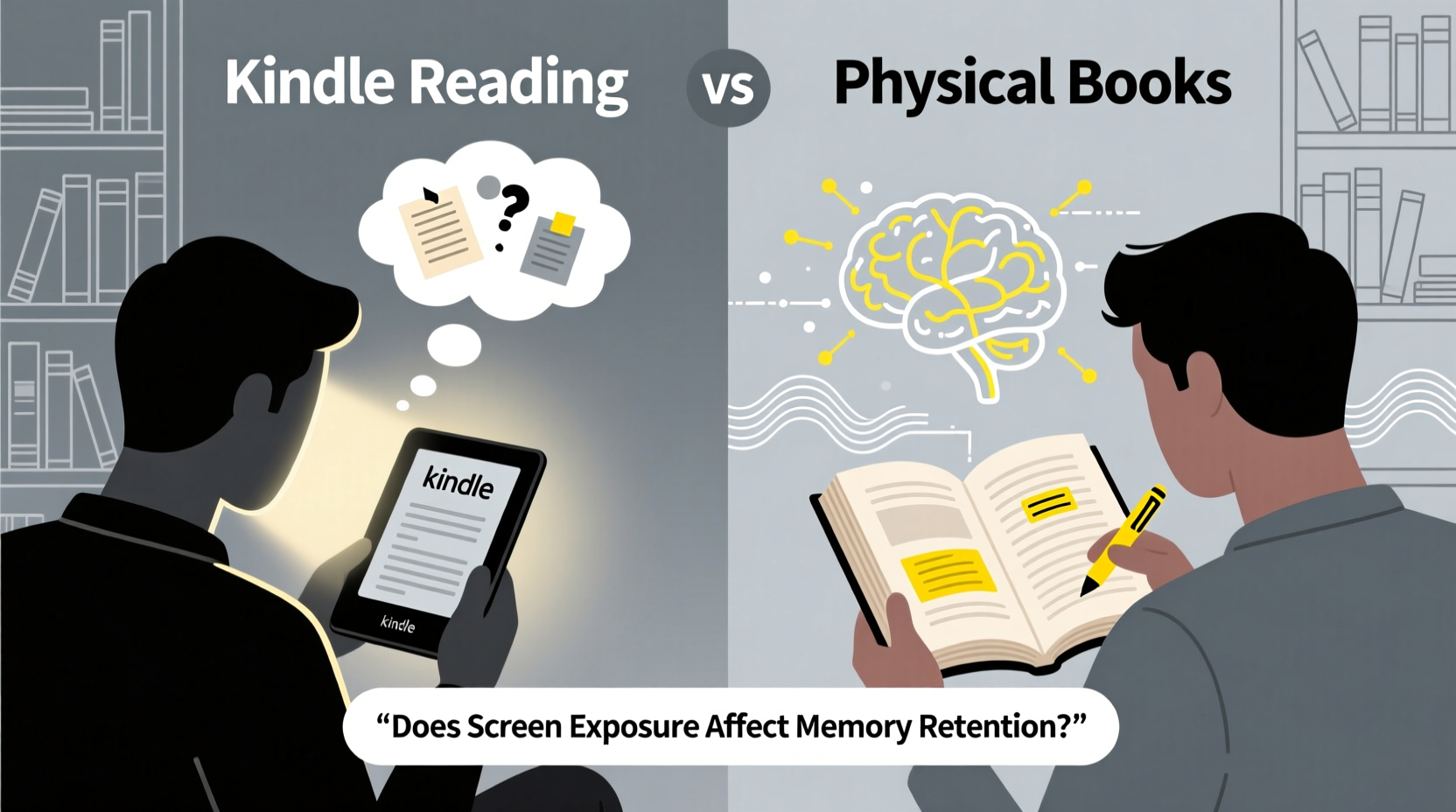
Our brains don’t process information the same way across all mediums. When we read, multiple cognitive functions come into play: attention, working memory, spatial navigation, and emotional resonance. The physicality of a printed book—its weight, texture, page turns, and even its smell—contributes to a richer sensory experience that can enhance memory encoding.
Studies have shown that readers of print books often demonstrate better comprehension and recall than those reading digitally. A 2014 meta-analysis published in Psychological Science in the Public Interest found that screen reading leads to slightly lower comprehension, especially for longer or more complex texts. One reason may be the lack of tactile cues. In a physical book, readers build a mental map of the text based on where passages appear—top or bottom of a page, left or right side, early or late in the book. This spatial memory helps anchor information.
E-readers like the Kindle attempt to replicate this with features like progress bars and page numbers, but they still fall short of providing the same embodied experience. As Maryanne Wolf, cognitive neuroscientist and author of *Reader, Come Home*, explains:
“We were not born to read. Our brain repurposes circuits originally meant for vision and language, and these circuits respond differently depending on the medium. Physical books engage more multisensory pathways, which strengthens memory traces.” — Dr. Maryanne Wolf, Cognitive Neuroscientist
Kindle Advantages: Convenience vs. Cognitive Load
The Kindle offers undeniable benefits: thousands of books in one device, adjustable font sizes, built-in dictionaries, night mode, and instant access to new titles. These features make reading more accessible, especially for people with visual impairments or those who travel frequently.
However, convenience comes with trade-offs. The backlit screens of some devices (though not the basic Kindle, which uses e-ink) can cause eye strain and disrupt sleep patterns due to blue light exposure. Even e-ink displays, which mimic paper and reduce glare, introduce subtle distractions—notifications, hyperlinks, or the temptation to switch apps—that fragment attention.
A 2018 study from the University of Stavanger compared students reading a short story on paper versus on a Kindle. Afterward, participants were tested on plot sequence, character details, and emotional tone. Those who read the physical version scored significantly higher on narrative comprehension and temporal sequencing. Researchers attributed this to “tangibility” — the ability to flip back, feel progress, and visually track location.
Memory Retention: How Format Shapes Recall
Memory retention depends on two key processes: encoding (how information is absorbed) and retrieval (how it’s later recalled). Physical books appear to support both more effectively than digital counterparts.
In a controlled experiment at Princeton University, participants read identical academic texts in either print or digital form. When tested one week later, print readers recalled 30% more factual details and demonstrated better understanding of conceptual relationships. They also reported higher levels of immersion and lower perceived effort.
Why? Several factors contribute:
- Tactile feedback: Turning pages creates motor memory, reinforcing where information was located.
- Fewer distractions: Print eliminates pop-ups, ads, or the urge to multitask.
- Spatial anchoring: Readers mentally map content to physical locations in the book.
- Reduced cognitive load: E-ink screens still require more mental effort to process than reflective paper.
Interestingly, the gap narrows when reading shorter, less complex material—like news articles or light fiction. But for academic, technical, or emotionally layered texts, print consistently outperforms digital in long-term retention.
Do E-Ink Screens Make a Difference?
Not all screens are equal. The Kindle’s e-ink technology is designed to mimic paper by reflecting ambient light rather than emitting it. Unlike tablets or smartphones, e-ink doesn’t produce blue light, reducing eye fatigue and sleep disruption.
While e-ink is gentler on the eyes, it still lacks the full sensory engagement of paper. Page turns are simulated, margins are fixed, and there’s no variation in texture or weight. Some users report feeling “disconnected” from the text, as if skimming rather than absorbing.
Still, for readers prioritizing portability or accessibility, the Kindle remains a strong option—especially when used mindfully.
Comparing Kindle and Physical Books: A Practical Breakdown
| Feature | Kindle (E-Ink) | Physical Book |
|---|---|---|
| Portability | ★★★★★ (Thousands of books in one device) | ★☆☆☆☆ (Bulky when carrying multiple) |
| Eye Comfort | ★★★★☆ (E-ink reduces glare; no blue light) | ★★★★★ (Natural reflection; zero emissions) |
| Memory Retention | ★★★☆☆ (Moderate; weaker spatial cues) | ★★★★★ (Stronger encoding and recall) |
| Distractibility | ★★☆☆☆ (Notifications, Wi-Fi, other apps) | ★★★★★ (No interruptions) |
| Annotation & Highlighting | ★★★★☆ (Searchable notes, cloud sync) | ★★★☆☆ (Handwritten notes, but harder to organize) |
| Emotional Connection | ★★★☆☆ (Functional, efficient) | ★★★★★ (Tactile, nostalgic, immersive) |
Real-World Example: A Student’s Semester Experiment
Jenna, a third-year psychology major, decided to test the impact of reading format on her academic performance. For one semester, she alternated between reading textbooks and journal articles on her Kindle Paperwhite and purchasing physical copies.
She focused on two courses: Cognitive Psychology (dense, theory-heavy) and Introduction to Sociology (more narrative-based). Each week, she tracked her reading time, note quality, quiz scores, and subjective focus level.
By midterms, clear patterns emerged. Her quiz scores in Cognitive Psychology were 15% higher when she used the physical textbook. She found herself rereading paragraphs less often and remembering diagrams more easily. In contrast, while her Sociology scores were similar across formats, she admitted to “zoning out” more during Kindle sessions.
“With the print book, I felt like I was inside the material,” Jenna said. “I could flip back to earlier chapters without breaking flow. On the Kindle, I kept losing my place, and the highlights didn’t stick in my memory the same way.”
She concluded that for high-stakes, concept-dense subjects, print was worth the extra cost and weight.
Actionable Tips for Maximizing Memory Retention
Whether you prefer Kindles or physical books—or use both—here are practical strategies to improve memory retention regardless of format:
- Minimize distractions: Turn off Wi-Fi and notifications when reading deeply. Treat your Kindle like a dedicated reading tool, not a multipurpose device.
- Take handwritten notes: Even if highlighting digitally, transcribe key ideas into a notebook. The act of writing boosts retention.
- Use physical markers: Place sticky notes or a bookmark at key sections to create tactile reference points, mimicking page-turn memory.
- Read in chunks: Follow the Pomodoro technique—25 minutes of focused reading, followed by a 5-minute break to reflect and summarize.
- Revisit structure: Before finishing, skim the table of contents or chapter headings to reinforce the overall framework of the material.
Checklist: Optimizing Your Reading for Memory
- ☑ Choose print for complex, technical, or emotionally rich texts
- ☑ Use Kindle for travel, convenience, or quick-reference materials
- ☑ Disable distractions during deep reading sessions
- ☑ Combine digital highlights with handwritten summaries
- ☑ Review material within 24 hours to strengthen memory consolidation
- ☑ Read in a quiet, consistent environment to build context-dependent memory
Frequently Asked Questions
Does reading on a Kindle cause eye strain?
Basic Kindle models use e-ink displays that reflect light like paper, making them easier on the eyes than tablets or phones. However, prolonged reading without breaks can still cause fatigue. Models with built-in lights should be adjusted to match ambient brightness to avoid strain.
Can I retain information as well from a Kindle as from a printed book?
You can—but it often requires more deliberate effort. Digital reading tends to encourage skimming and shallow processing. To match print-level retention, use active reading strategies like note-taking, summarizing, and self-testing.
Are audiobooks worse for memory than reading?
Not necessarily. Audiobooks engage auditory processing and can be excellent for narrative retention, especially during commutes or chores. However, for technical or detailed content requiring close analysis, reading (especially in print) generally supports deeper comprehension.
Conclusion: Choosing the Right Tool for the Task
The debate between Kindle and physical books isn’t about declaring a winner—it’s about matching the medium to the purpose. For leisure reading, travel, or accessibility needs, the Kindle is an exceptional tool. Its portability and customization options make reading more inclusive and convenient than ever.
But when memory retention, deep comprehension, and emotional engagement matter most—such as studying, learning complex subjects, or savoring literature—physical books still hold a distinct advantage. The sensory richness, spatial cues, and distraction-free environment of print foster stronger cognitive connections.
The smartest approach is hybrid: use the Kindle for breadth, portability, and efficiency, but turn to print when depth, focus, and long-term retention are priorities. By understanding how each format affects your brain, you can read more intentionally—and remember more of what matters.




 浙公网安备
33010002000092号
浙公网安备
33010002000092号 浙B2-20120091-4
Comments
No comments yet. Why don't you start the discussion?