
Every December, homes across North America and Europe transform into luminous displays: strings of LEDs draped over eaves, animated light sculptures in front yards, and multi-tiered indoor trees wired with dozens of circuits. Yet behind the festive glow lies a quiet vulnerability—electrical strain. According to the U.S. Consumer Product Safety Commission, holiday-related electrical fires surge by 42% between Thanksgiving and New Year’s Eve, with overloaded circuits accounting for nearly 60% of incidents. When breakers trip or wiring fails mid-celebration, the sudden plunge into darkness isn’t just inconvenient—it disrupts meal prep, endangers children navigating stairs, and silences carols playing through smart speakers. Rechargeable lanterns are not novelty gadgets; they’re purpose-built resilience tools engineered for exactly this moment. Unlike candles (fire hazards) or disposable flashlights (single-use, dim, unreliable), modern rechargeable lanterns deliver consistent, wide-angle illumination, long runtime, and intelligent power management—all without drawing from a compromised circuit.
Why Standard Holiday Lighting Creates Circuit Vulnerability
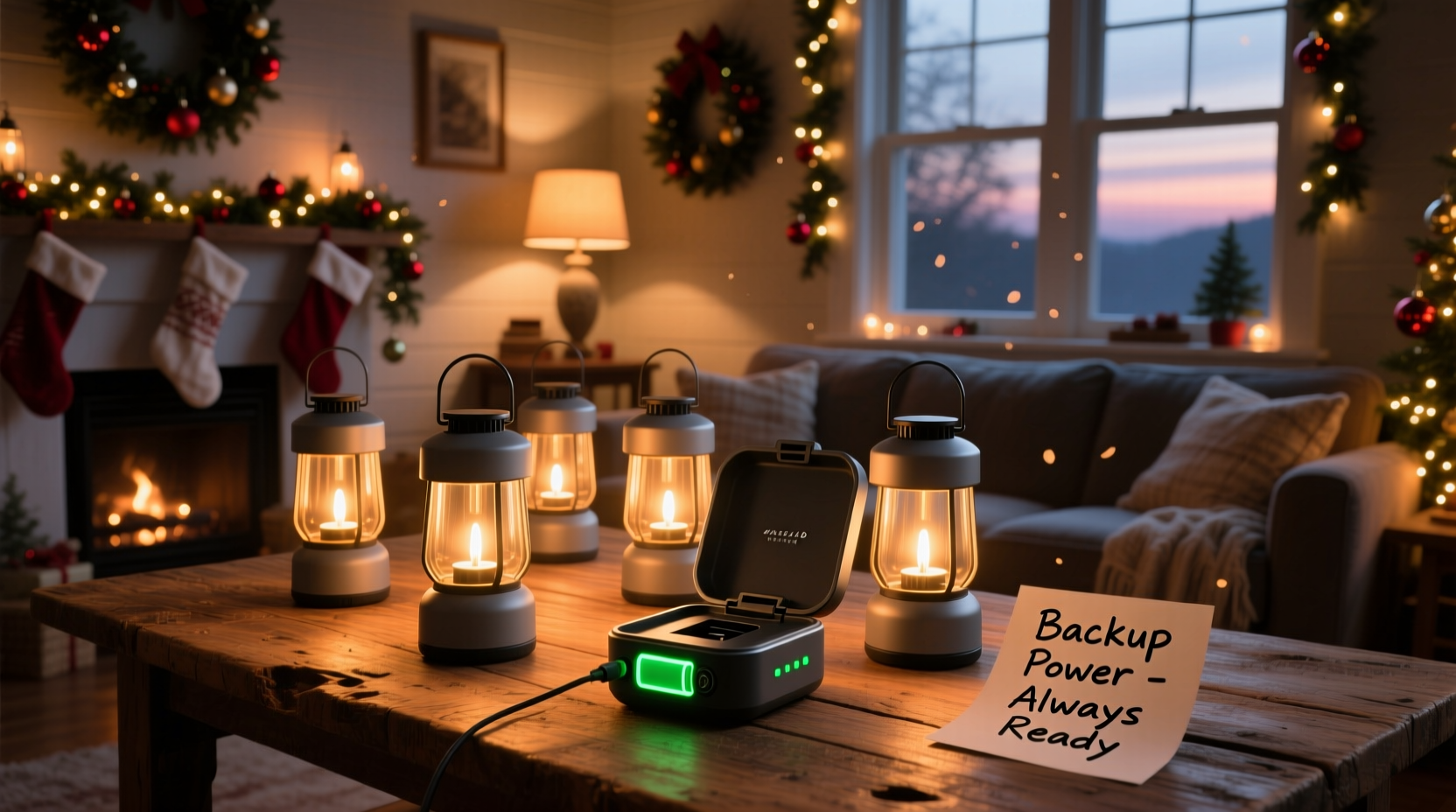
Modern Christmas lighting appears energy-efficient—but volume erodes that advantage. A single 100-light string of warm-white LEDs draws ~4.8 watts. That sounds negligible until you multiply: a typical suburban home uses 5–12 strings indoors *plus* 3–8 outdoor runs, often daisy-chained across multiple outlets. Add electric garlands, animated reindeer, inflatable yard displays (many requiring 60–120W each), and heated outdoor mats—and total draw can exceed 1,200 watts on a single 15-amp, 120-volt circuit (1,800W max). Real-world conditions worsen this: aging wiring, shared neutrals, extension cords with undersized gauges, and simultaneous use of kitchen appliances during dinner prep push systems past safe thresholds. Breakers don’t always trip cleanly—they may “nuisance trip” under marginal loads, cutting power intermittently, or worse, fail silently while insulation degrades.
This isn’t theoretical. In December 2023, a utility report covering 17 Midwestern states documented 3,412 residential outages directly tied to holiday load spikes—78% occurred between 4 p.m. and 9 p.m., precisely when families gather and lights reach peak usage.
Key Features That Make Rechargeable Lanterns Superior Backup Lighting
Not all lanterns perform equally under holiday stress. The right model must balance brightness, runtime, durability, and usability—not just specs on a box. Here’s what matters:
- Lumen output & beam quality: Look for 300–800 lumens with a wide flood pattern (120°+). Avoid narrow spot beams—they illuminate only one corner, leaving hallways and stairwells dangerously dark.
- Battery chemistry & capacity: Lithium-ion (Li-ion) or lithium-iron-phosphate (LiFePO₄) cells outperform NiMH. A 4,000–6,000mAh battery delivers 6–12 hours at medium brightness—enough to cover dinner, gift opening, and cleanup.
- Charging versatility: USB-C input is essential. It allows charging from laptops, power banks, solar chargers, or even car ports—bypassing wall outlets entirely.
- Durability & safety: IPX4 rating (splash-resistant) handles accidental spills or humid basements. Overcharge/over-discharge protection prevents thermal runaway—a critical safeguard when stored near tree stands or wrapped gifts.
- User interface: One-button operation with memory function (returns to last-used brightness) avoids fumbling in the dark. Red-light mode preserves night vision during late-night feedings or pet care.
Real-World Readiness: A Case Study from Portland, Oregon
In December 2022, Sarah M., a pediatric nurse and mother of three in Portland, experienced a cascading failure during her family’s Christmas Eve dinner. Her home’s 1950s-era wiring couldn’t handle simultaneous use of an electric roaster (1,500W), two strands of vintage incandescent lights (each 200W), and a newly installed outdoor projection display (180W). At 6:42 p.m., the kitchen breaker tripped—then the living room breaker followed seconds later. Power didn’t return for 47 minutes.
“The kids were terrified,” she recalled. “My youngest had just started walking, and our oak staircase has no handrail on one side. I grabbed my Black Diamond Moji 300 (charged that morning) and placed it on the landing. Its 300-lumen flood lit every step clearly. I kept the red-light mode on for the nursery so my baby wouldn’t wake fully. We finished dinner by lantern light—no candles, no panic.”
Crucially, Sarah hadn’t bought the lantern *for* Christmas. She’d purchased it months earlier for camping—then realized its value during a summer brownout. Her proactive charging routine (every Sunday evening) meant it was always ready. She now keeps two lanterns: one in the kitchen drawer, one in the coat closet—both plugged into USB-C wall adapters that draw minimal standby power.
What to Look For (and Avoid): A Comparative Decision Table
| Feature | Recommended | Avoid |
|---|---|---|
| Battery Type | Lithium-ion (Li-ion) or LiFePO₄ with built-in protection circuit | NiMH, alkaline, or unbranded lithium packs without thermal cutoff |
| Brightness Control | 3–5 preset levels + memory function | Single-brightness or non-memory switches requiring full reset |
| Runtime at 300 Lumens | ≥6 hours (verified via independent review, not manufacturer claim) | <4 hours or “up to X hours” without test conditions specified |
| Charging Port | USB-C with 5V/2A input (charges in ≤4 hours) | Micro-USB only or proprietary docks requiring wall adapter |
| Safety Certifications | UL 153 (portable electric lamps) or ETL listed | No certification markings or “CE” used deceptively (not valid in US/Canada) |
Step-by-Step: Building Your Holiday Lighting Resilience Plan
Resilience isn’t passive—it’s practiced. Follow this sequence to ensure your lanterns work when needed:
- Assess your risk (Week of Nov. 20): Map all holiday lighting circuits. Note which outlets share breakers (use a circuit breaker finder tool). Identify high-load zones: kitchen counters, tree stands, porch outlets.
- Select & purchase (Nov. 25–Dec. 1): Choose two lanterns meeting the criteria above. Prioritize models with USB-C charging and ≥500-lumen output. Buy spare USB-C cables—don’t rely on phone cables.
- Charge & validate (Dec. 1–5): Fully charge both lanterns. Run each at medium brightness for 5 hours. Record remaining charge. Replace any unit dropping below 75%.
- Position strategically (Dec. 10): Place Lantern A in the kitchen drawer (near stove/outlets) and Lantern B in the hallway closet (central location, accessible from stairs). Both should be within arm’s reach of USB-C wall adapters.
- Conduct a dry run (Dec. 18, 8 p.m.): Flip your main holiday circuit breaker. Activate both lanterns. Time how long it takes to locate them, turn them on, and navigate safely from kitchen to living room to stairs. Refine placement if response exceeds 12 seconds.
“The most effective emergency lighting isn’t the brightest—it’s the one you can find, activate, and trust in under 5 seconds of darkness. That requires habit, not hardware.” — Dr. Lena Torres, Human Factors Engineer, National Fire Protection Association
FAQ: Addressing Common Concerns
Can I leave my rechargeable lantern plugged in all December?
Yes—if it uses modern lithium-ion with auto-cutoff circuitry (standard in UL/ETL-listed models). These stop charging at 100% and trickle-maintain safely. Avoid older NiMH models or uncertified units, which may overheat or degrade faster when continuously charged.
Won’t the lantern’s light interfere with the Christmas ambiance?
Not if used intentionally. Set lanterns to low (100–150 lumens) or red-light mode for ambient fill. Reserve high-output (600+ lumens) only for task lighting—like reading wrapping instructions or checking on pets. Their neutral-white light (5000K–5700K) complements warm-white LEDs without clashing.
How do I maintain lantern performance year after year?
Store at 40–60% charge in a cool, dry place (not garages or attics). Recharge every 3 months if unused. Wipe contacts monthly with isopropyl alcohol. Never submerge or spray cleaners directly—damp cloth only. Replace batteries every 3 years, even if functional; capacity degrades silently.
Expert-Validated Safety & Performance Tips
Rechargeable lanterns reduce risk—but only when integrated thoughtfully. Electrical safety professionals emphasize these non-negotiable practices:
- Never daisy-chain power strips for holiday lighting. Each strip adds resistance and heat buildup. Use a single, heavy-duty (12-gauge) extension cord rated for outdoor use if needed—and plug only one light string per outlet.
- Install AFCI/GFCI breakers in older homes. Arc-fault circuit interrupters detect dangerous arcing before fire starts; ground-fault interrupters prevent shock near moisture-prone areas like porches or basements.
- Use LED-only strings—even vintage-style bulbs. Incandescents generate 90% waste heat and draw 10x more power than equivalent LEDs. A 100-bulb incandescent string pulls ~400W; the same LED version uses ~4W.
- Label your breakers clearly. Use printed labels—not tape or markers—that identify “Front Porch Lights,” “Tree & Mantel,” and “Kitchen Decor.” During an outage, seconds count.
Conclusion: Light Is Not Luxury—It’s Foundation
Christmas is built on continuity: the steady glow of candles symbolizing hope, the predictable twinkle of lights representing tradition, the shared warmth of gathering despite winter’s chill. When circuits fail, that continuity fractures—not because of malice or neglect, but because we ask fragile infrastructure to bear extraordinary loads. Rechargeable lanterns restore agency. They transform helplessness into calm capability. They let you serve pie by steady light instead of candle flicker. They mean your toddler can climb stairs without stumbling. They ensure your elderly parent doesn’t hesitate before reaching for medication in the dark. This isn’t about preparing for disaster; it’s about honoring the quiet dignity of everyday safety. You don’t need to overhaul your entire electrical system to gain resilience. Start small: buy one certified lantern this week. Charge it. Place it where darkness would hurt most. Then tell someone else—your neighbor, your sibling, your friend who always hosts Christmas dinner. Because preparedness multiplies when shared. Light doesn’t wait for perfect conditions. Neither should you.




 浙公网安备
33010002000092号
浙公网安备
33010002000092号 浙B2-20120091-4
Comments
No comments yet. Why don't you start the discussion?