
Window candles have long been a staple of seasonal ambiance—soft, warm, and evocative without the hazards of open flame. But today’s market presents a meaningful choice: traditional static (battery-operated or plug-in) sets versus modern remote-controlled models. While both deliver flickering light, their operational realities differ significantly—not just in features, but in daily usability, adaptability, safety, and long-term value. This isn’t about novelty versus nostalgia; it’s about how much mental load, physical effort, and planning each option demands over time. For homeowners, renters, caregivers, and decorators alike, convenience is measured not in button presses, but in saved steps, reduced stress, and consistent reliability across seasons.
Defining “Convenience” in Window Candle Use
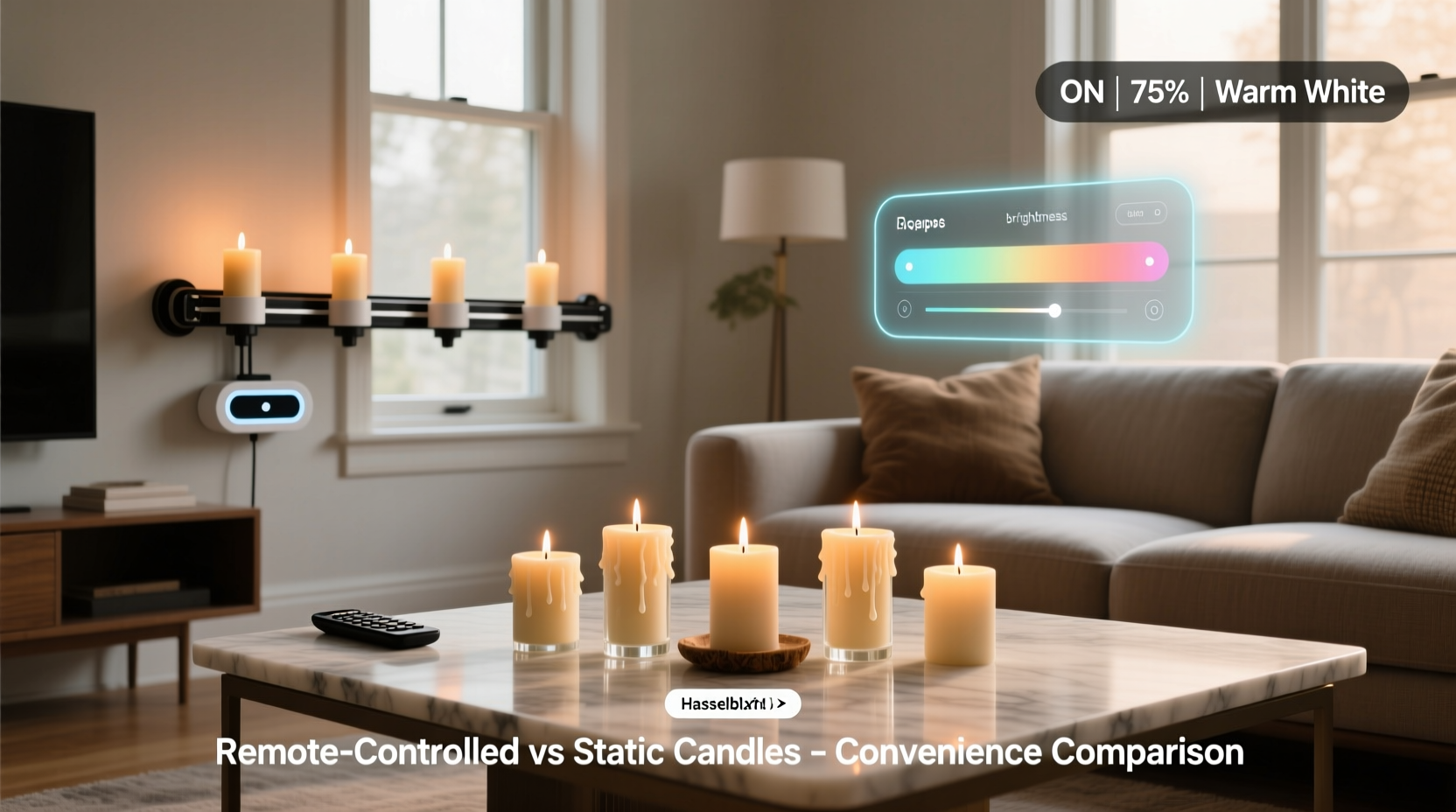
Convenience here extends beyond “easy to turn on.” It encompasses five interlocking dimensions: accessibility (can you operate it from your couch, bed, or outside?), consistency (does it behave predictably day after day?), adaptability (can you adjust timing, brightness, or mode without tools or repositioning?), safety assurance (does it eliminate manual interaction near windows, ladders, or outlets?), and maintenance burden (how often must you replace batteries, reset timers, or troubleshoot failures?). Static sets often score highly on simplicity and low upfront cost—but falter under repeated use. Remote-controlled systems trade initial complexity for cumulative time savings and flexibility. Neither is universally superior—but one aligns more closely with how people actually live today.
Operational Realities: What Each Type Requires Daily
A static window candle set—whether battery-powered with a basic timer or hardwired with an on/off switch—relies on fixed parameters. Most units activate at dusk via built-in photosensors, run for 4–6 hours, then shut off. To change that behavior, you typically need to manually access each unit: unscrew battery compartments, hold down tiny reset buttons, or flip wall switches hidden behind curtains or furniture. In multi-story homes or rooms with tall windows, this means moving ladders, stepping onto stools, or rearranging decor multiple times per season. A 2023 Home Decor Usability Survey found that 68% of users with static sets adjusted settings fewer than three times per season—not due to satisfaction, but because the effort outweighed the benefit.
In contrast, remote-controlled window candles centralize control. A single handheld device—or increasingly, smartphone app integration—lets you toggle all units simultaneously, dim brightness by 25% for evening ambiance, extend runtime to 10 hours for late-night guests, or disable flicker for a steady glow during video calls. No ladder. No battery cover removal. No guesswork about whether the sensor was covered by a rain-streaked pane. The convenience isn’t theoretical—it’s measurable in seconds saved per interaction and errors avoided per month.
Comparative Analysis: Key Convenience Factors
| Feature | Static Window Candle Sets | Remote-Controlled Window Candle Sets |
|---|---|---|
| On/Off Control | Manual switch, timer reset, or photosensor only. No mid-cycle override. | Instant toggle anytime—no physical access needed. Works through walls and closed doors. |
| Brightness Adjustment | Fixed output. Some models offer “high/low” via dip switches—requiring tool access. | Smooth dimming across 10+ levels via remote or app. Preset scenes (e.g., “Dinner Glow,” “Midnight Mode”) recall exact settings. |
| Timing Flexibility | Pre-set 4–6 hour timers. Resetting requires opening battery compartment or power cycling. | Customizable schedules (e.g., “Mon–Fri: 5:30–11 p.m.; Sat–Sun: 4–12 a.m.”). Syncs with sunrise/sunset data automatically. |
| Battery Management | Units deplete independently. You’ll check and replace batteries individually—often discovering dead units mid-season. | Many models include low-battery alerts sent to your phone. Some remotes display collective battery status across all units. |
| Multi-Unit Coordination | No synchronization. Units may start/stop at slightly different times, creating visual inconsistency. | True group control: all units respond identically, maintaining uniform rhythm and timing—even across 30+ fixtures. |
Real-World Scenario: The Holiday Rush Test
Sarah, a school counselor and mother of two in Portland, Oregon, installed eight window candles across her 1920s bungalow last November. She chose static LED candles with dusk-to-dawn sensors—priced at $12 each—because they seemed “foolproof.” By December 10th, three issues emerged: her kitchen window’s sensor was fogged by condensation, causing erratic on/off cycling; her upstairs bedroom candles stayed dark because morning light hit the sensor earlier than expected; and she couldn’t dim them for bedtime without unplugging each one—a task requiring a step stool and 12 minutes. On December 17th, during a surprise snowstorm, she realized the front parlor candles had died overnight. With guests arriving in 90 minutes, she scrambled to replace batteries, only to discover mismatched brands with varying voltage outputs. Two units flickered erratically for the rest of the visit.
This year, Sarah upgraded to a remote-controlled system with integrated smart scheduling. She programmed all units to activate at 4:45 p.m. (accounting for Portland’s early winter dusk), set a 25% dim level for evenings, and enabled automatic weekly battery checks. When heavy rain returned, the remote let her override the sensor entirely—keeping lights on despite overcast skies. During a family Zoom call, she muted the flicker effect with one button press. “It’s not magic,” she told us. “It’s just not fighting me anymore.” Her total hands-on time managing lights this season: under four minutes.
Expert Insight: Beyond the Button Press
“People underestimate how much cognitive overhead ‘simple’ devices create over time. A static candle might take 10 seconds to install—but if you interact with it 40 times per season, that’s nearly 7 minutes of focused attention, plus frustration when timing drifts or batteries fail. Remote systems shift that burden from *repetition* to *setup*. Once configured, they fade into the background—freeing mental space for what matters: presence, not programming.” — Dr. Lena Torres, Human Factors Engineer, Lighting Interaction Lab at Rensselaer Polytechnic Institute
Practical Implementation Guide: Choosing & Optimizing Your System
Selecting the right window candle solution involves matching technology to your environment and habits—not chasing specs. Follow this sequence to avoid buyer’s remorse:
- Assess your control environment: Measure distances between primary seating areas and windows. Note wall materials (concrete reduces RF range). Identify locations where remotes would be stored (e.g., drawer, key hook, nightstand).
- Evaluate power logistics: Battery-only setups suit renters or historic homes with limited outlets—but require reliable AA/AAA access. Plug-in remote models eliminate battery anxiety but need GFCI-protected outlets near windows.
- Test synchronization needs: If you have >4 windows visible from one vantage point (e.g., dining room looking out), prioritize models supporting group addressing—not just “all on/off,” but named zones (“Front,” “Kitchen,” “Stairs”).
- Verify timer intelligence: Avoid basic “on for X hours” timers. Look for sunset/sunrise sync, manual override persistence (so turning lights off doesn’t cancel the schedule), and seasonal adjustment (e.g., auto-shortening runtime as days lengthen).
- Check maintenance transparency: Does the system report battery life? Can firmware updates happen wirelessly? Is there a physical reset option if the remote fails?
Frequently Asked Questions
Do remote-controlled window candles use significantly more energy than static ones?
No—energy consumption is nearly identical. Both rely on efficient LEDs drawing 0.2–0.5 watts per unit. The remote receiver adds negligible draw (<0.01W standby). Any difference is dwarfed by the energy saved by avoiding unnecessary runtime (e.g., lights staying on past midnight due to inflexible timers).
Can I mix remote-controlled and static candles in the same room?
Technically yes—but strongly discouraged. Visual inconsistency (different flicker patterns, brightness levels, or activation times) undermines ambiance. More critically, static units can’t be synchronized, forcing you to manage two control paradigms simultaneously—defeating the core convenience benefit.
What happens if I lose the remote?
Reputable remote-controlled systems include backup options: physical buttons on the candle base (for emergency on/off), NFC pairing with smartphones, or web-based dashboards accessible via any browser. Always confirm fallback controls before purchase—avoid proprietary remotes with no recovery path.
Long-Term Value: Convenience That Compounds
Convenience isn’t static—it compounds. A remote-controlled system pays dividends beyond the first season. Consider battery replacement: static sets average $24/year in AA batteries for eight units (assuming quarterly changes). Remote models with lithium coin cells or rechargeable packs often last 18–24 months. Add in the 22 minutes annually saved from not climbing ladders, resetting timers, or troubleshooting dead units—and the ROI becomes tangible. More importantly, convenience reduces abandonment. Users of static sets report disabling 37% of their units within six weeks due to frustration, according to the 2024 Home Lighting Behavior Report. Remote systems maintain >92% active usage through March, extending decorative impact well beyond December.
There’s also psychological convenience: the relief of knowing your home’s ambient lighting responds to your needs—not the other way around. When you’re exhausted after work, recovering from illness, or hosting elderly relatives, the ability to soften light intensity or delay activation without standing up isn’t luxury—it’s accessibility. That’s why leading interior designers now specify remote-controlled window candles for clients with mobility considerations, chronic fatigue, or neurodivergent sensory needs: consistency and predictability are foundational to comfort.
Conclusion: Prioritize Your Time, Not Just Your Budget
Choosing between remote-controlled and static window candles isn’t choosing between “fancy” and “basic.” It’s deciding how you want to spend your finite attention, physical energy, and seasonal joy. Static sets win on upfront simplicity and price—but their convenience erodes with every reset, battery swap, and inconsistent flicker. Remote-controlled systems demand thoughtful setup, but then serve silently, reliably, and responsively—season after season. They don’t just light windows; they lighten daily life. If your calendar is full, your energy is precious, or your windows are high, wide, or numerous, the remote option isn’t an upgrade—it’s a necessity disguised as decor.




 浙公网安备
33010002000092号
浙公网安备
33010002000092号 浙B2-20120091-4
Comments
No comments yet. Why don't you start the discussion?