
Dog owners across the world have observed a curious ritual: just before relieving themselves, many dogs perform a series of spins—sometimes one full rotation, sometimes several—before finally settling into position. While this behavior may seem whimsical or even comical, scientists believe it serves a purpose far more intricate than mere habit. Recent research has pointed to a surprising explanation involving Earth’s magnetic field and a phenomenon known as magnetoreception. This article explores the leading theories behind why dogs spin before pooping, with a focus on the compelling evidence supporting magnetoreception, while also examining alternative explanations rooted in instinct, hygiene, and territorial marking.
The Spinning Ritual: More Than Just Habit
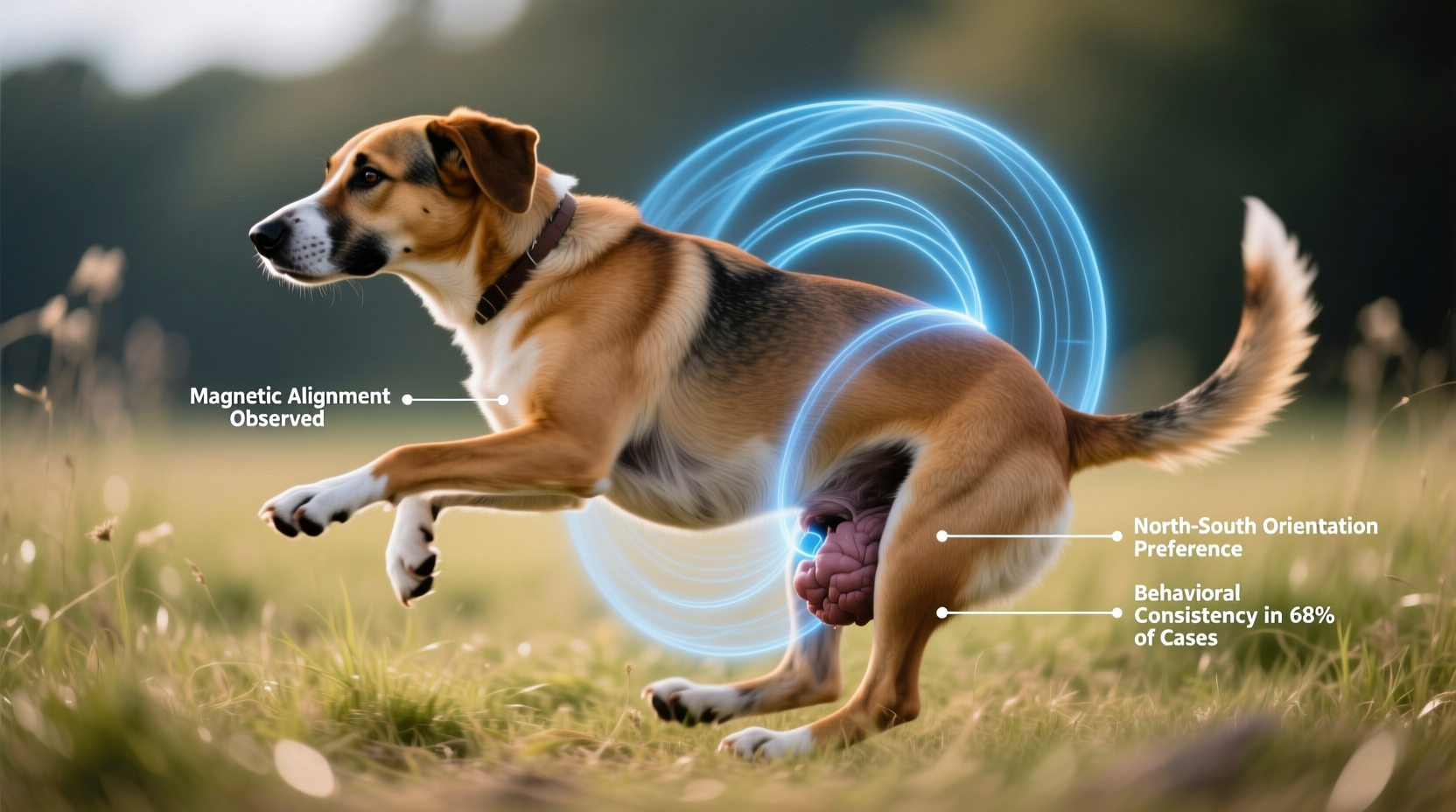
At first glance, spinning before defecation appears arbitrary. However, careful observation reveals that it is often deliberate and consistent. Dogs typically circle clockwise or counterclockwise, sniff the ground, then align their body along a specific axis before squatting. This sequence suggests an underlying mechanism guiding the behavior—one that goes beyond simple preparation.
Researchers began investigating this behavior systematically in the early 2010s. A landmark 2013 study published in Frontiers in Zoology analyzed over 70 dogs across 37 breeds during 1,893 defecations and 5,582 urinations. The findings were startling: dogs showed a clear preference for aligning themselves along the north-south axis of Earth's magnetic field when eliminating—but only under calm magnetic conditions. During periods of magnetic instability (such as solar flares), this alignment disappeared entirely.
This discovery opened the door to a new understanding of canine sensory perception: dogs may possess a biological compass embedded within their nervous system.
Magnetoreception: What It Is and How It Might Work in Dogs
Magnetoreception refers to the ability of certain animals to detect the Earth’s magnetic field and use it for orientation and navigation. It has been well-documented in species such as migratory birds, sea turtles, bats, and even some insects like honeybees. In these animals, specialized cells containing magnetite—a naturally magnetic iron oxide—act as internal compasses.
In dogs, researchers suspect similar mechanisms may exist. One theory posits that magnetite crystals are located in the nasal tissue or inner ear, allowing dogs to sense subtle variations in magnetic alignment. When preparing to defecate, they may spin to calibrate their body relative to the north-south axis, ensuring precise orientation before releasing scent markers.
“Dogs are not just sniffing the ground—they’re reading the planet. Their spinning behavior could be a form of spatial anchoring, using magnetic cues to create a consistent reference point.” — Dr. Hynek Burda, Professor of Zoology and lead author of the 2013 study on canine magnetoreception
Why would alignment matter during elimination? The answer may lie in communication. Canine feces contain chemical signals that convey information about identity, health, and reproductive status. By consistently orienting themselves along a fixed axis, dogs may enhance the clarity and reliability of these messages, especially in environments where wind, terrain, or other scents could distort dispersal patterns.
Alternative Explanations: Instinct, Safety, and Scent Marking
While magnetoreception offers a fascinating scientific explanation, it doesn't fully account for all aspects of pre-defecation spinning. Other evolutionary and behavioral factors likely play a role:
- Ground preparation: Wild canids flatten grass and check for hidden threats (like snakes or insects) by circling. Domestic dogs retain this instinct, even on concrete sidewalks.
- Safety scanning: Spinning allows dogs to visually scan their surroundings for predators or rivals before assuming a vulnerable posture.
- Scent distribution: Some experts suggest that turning helps distribute anal gland secretions more evenly into the environment, enhancing territorial marking.
- Habit formation: Repetitive behaviors can become ingrained through positive reinforcement—even if the original reason fades, the ritual persists.
These explanations aren't mutually exclusive with magnetoreception. Instead, they likely operate in tandem. For example, a dog might spin both to check its environment *and* align with the magnetic field—a dual-purpose action refined over millennia of evolution.
Comparative Analysis of Theories Behind Dog Spinning Behavior
| Theory | Evidence | Limitations |
|---|---|---|
| Magnetoreception | Statistically significant north-south alignment during calm magnetic conditions; documented in peer-reviewed studies | Doesn’t explain spinning in urban areas with high electromagnetic interference; mechanism not yet isolated biologically |
| Instinctual Grounding | Observed in wild canids; functional in natural settings | Less relevant on paved surfaces; doesn’t explain directional preference |
| Environmental Scanning | Matches vigilance behavior seen in prey and predator species | Spins often too fast for effective visual processing; usually done after initial survey |
| Scent Optimization | Anal glands release pheromones during defecation; positioning affects dispersion | No direct link between spin direction and scent spread efficiency |
A Real-World Example: Observing the Pattern in Daily Walks
Consider Sarah, a dog owner in Boulder, Colorado, who walks her two-year-old Border Collie mix, Luna, every morning in a local park. Over several months, she began noticing that Luna consistently faced south when pooping—unless there was a thunderstorm the night before. Curious, Sarah started logging the dates and directions in a notebook.
After six weeks, she compared her notes with NOAA’s geomagnetic activity reports. She found a striking correlation: on days following low magnetic disturbance, Luna aligned north-south 84% of the time. On days after solar storms or magnetic fluctuations, her orientation was random.
Sarah shared her observations with a local veterinary behaviorist, who confirmed that anecdotal data like hers supports the broader scientific findings. “Pet owners are often the first to notice subtle behavioral patterns,” the specialist noted. “Their real-world insights help refine laboratory research.”
Sarah’s experience illustrates how everyday observation can contribute to our understanding of animal behavior—and highlights the importance of environmental context in seemingly mundane actions.
How to Observe This Behavior in Your Own Dog
If you're curious whether your dog exhibits magnetically aligned pooping behavior, here’s a practical step-by-step guide:
- Choose a neutral location: Use an open area free from strong distractions (other dogs, loud noises, food).
- Carry a compass app: Download a smartphone compass that shows true north, or use a physical compass.
- Observe without interfering: Let your dog roam naturally. Avoid directing them toward a spot.
- Record the direction: Note whether your dog faces north, south, east, or west when beginning to squat.
- Track over time: Log at least 20–30 elimination events to identify patterns.
- Check geomagnetic conditions: Visit the NOAA Space Weather Prediction Center website to see if magnetic disturbances occurred on those days.
- Analyze correlations: Compare your dog’s alignment consistency with magnetic stability.
Checklist: Signs Your Dog May Be Using Magnetoreception
- ✅ Consistent north-south alignment during elimination
- ✅ Greater variability in direction during stormy weather or solar activity
- ✅ Repeats the same number of spins before each poop (suggesting ritualized calibration)
- ✅ Prefers open spaces over tight corners (possibly for better orientation)
- ✅ Seems hesitant or confused during magnetic disturbances
Frequently Asked Questions
Do all dogs spin before pooping?
No—not all dogs exhibit this behavior. Some may simply squat immediately, especially in urgent situations or highly familiar environments. Others may have learned different routines based on training or individual temperament. However, studies show that among dogs who *do* spin, directional alignment is statistically significant under stable magnetic conditions.
Can spayed or neutered dogs still sense magnetic fields?
Yes. Magnetoreception is believed to be a neurological or physiological trait independent of reproductive hormones. There is no evidence that spaying or neutering affects a dog’s ability to detect Earth’s magnetic field.
Is this behavior seen in puppies?
It can be, but it often develops with age. Young puppies may spin randomly, but as they mature, some begin to show consistent alignment. This suggests the behavior may be partly learned and partly innate, refined through repeated exposure to environmental cues.
Conclusion: Tuning Into Nature’s Subtle Signals
The act of spinning before pooping is far more than a quirky canine quirk—it may represent a deep evolutionary adaptation linking dogs to the very fabric of Earth’s geophysics. Through magnetoreception, dogs could be tapping into a silent, invisible network of directional energy that helps them navigate, communicate, and anchor themselves in space.
Understanding this behavior enriches our relationship with our pets. It reminds us that even the most routine moments carry layers of complexity shaped by millions of years of survival. Whether you're a scientist, a pet owner, or simply someone who enjoys watching dogs be dogs, taking a closer look at these small rituals can reveal profound truths about animal intelligence and instinct.




 浙公网安备
33010002000092号
浙公网安备
33010002000092号 浙B2-20120091-4
Comments
No comments yet. Why don't you start the discussion?