
When it comes to smart doorbells, two names dominate the conversation: Ring and Nest. Both offer high-definition video, motion detection, and seamless mobile app experiences. But as more homeowners build out their smart ecosystems, a critical question emerges—does Nest Hello’s deep integration with Google’s platform actually give it an edge over Ring, especially when compared to Amazon’s Alexa-focused system?
The answer isn’t as straightforward as brand loyalty might suggest. While Nest Hello was designed from the ground up for Google’s ecosystem, Ring has evolved significantly under Amazon’s ownership. Real-world performance, privacy policies, long-term reliability, and interoperability all play pivotal roles in determining which device suits your needs best.
This article dives into the core differences between Ring Doorbell and Nest Hello, focusing particularly on how each integrates within its respective tech ecosystem—and whether Google’s approach delivers tangible benefits for everyday users.
Design and Installation: Practicality Meets Aesthetics
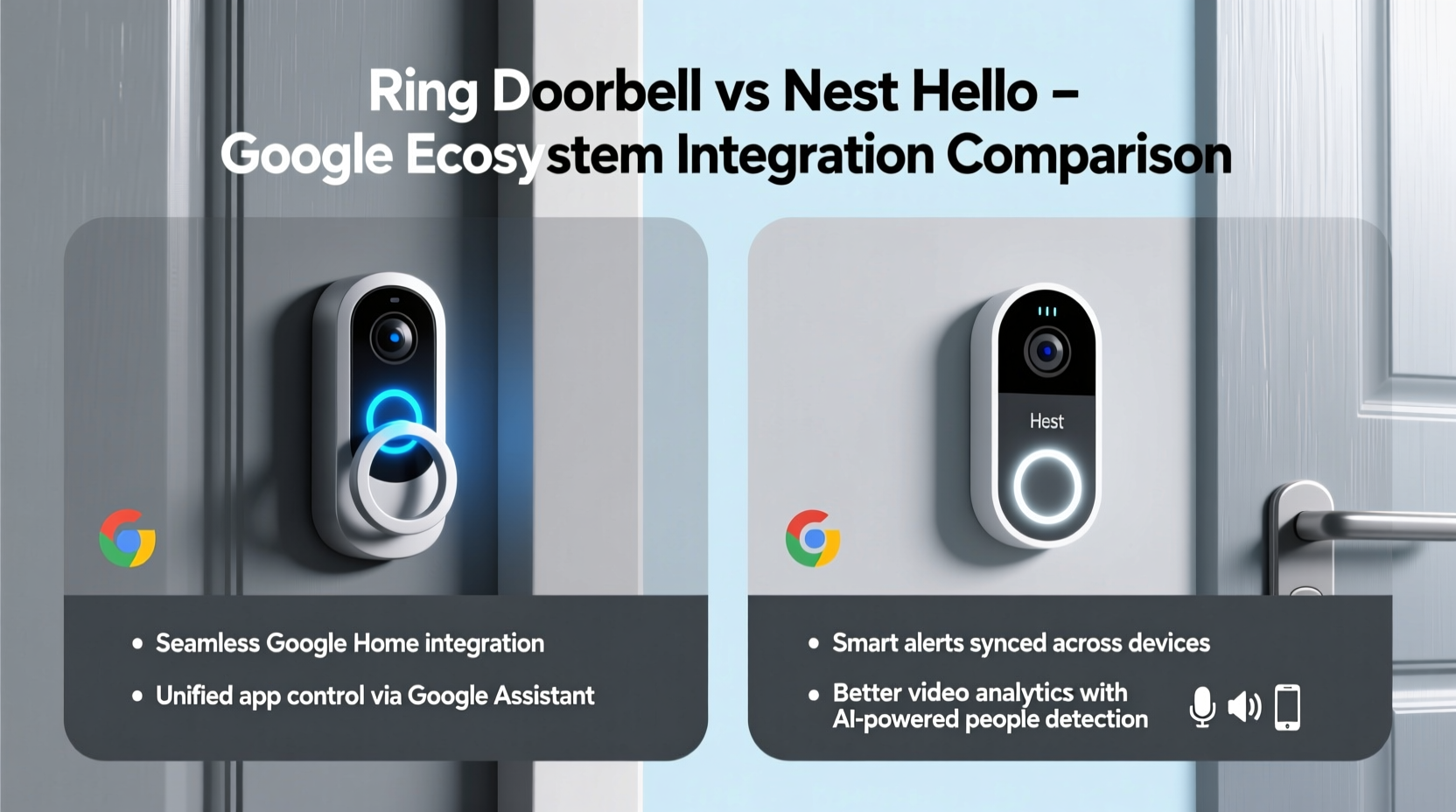
Physically, both devices are built for outdoor use with weather-resistant materials, but their design philosophies differ. The Ring Doorbell (especially the latest wired models) follows a minimalist rectangular shape with interchangeable faceplates. It’s easy to install, often requiring only a screwdriver and existing doorbell wiring or a rechargeable battery option for renters.
Nest Hello, meanwhile, has a sleeker, elongated oval design that some find more modern. However, installation is slightly more involved. It requires a constant power source—no battery option—and may necessitate a chime connector or transformer upgrade depending on your home’s existing setup. This can be a barrier for DIYers unfamiliar with electrical systems.
From a mounting perspective, Ring allows for adjustable positioning via its wedge kit, helping angle the camera toward package drop zones or walkways. Nest Hello includes a mounting bracket but offers less vertical adjustment, potentially limiting field-of-view customization.
Video Quality and Smart Detection Features
Both devices deliver 1080p HD video, but image clarity and processing differ due to software optimization. Nest Hello uses HDR (High Dynamic Range) imaging, which performs exceptionally well in backlit conditions—such as when someone approaches during sunrise or sunset. This results in clearer facial details even when the background is bright.
Ring has improved its night vision and low-light performance over generations, but still lags slightly behind Nest in dynamic range. That said, Ring compensates with broader motion detection zones and customizable activity areas, allowing users to define specific regions where alerts should trigger.
Nest Hello leverages Google’s AI to offer Familiar Face Detection—a feature that learns and identifies frequent visitors like family members or neighbors. While this sounds powerful, it raises privacy concerns and requires continuous subscription and data syncing with Google accounts. Ring does not offer facial recognition at all, prioritizing broader anonymity and simpler data handling.
“AI-driven identification features like Familiar Faces add convenience but come with trade-offs in privacy and data control.” — David Lin, Smart Home Security Analyst at TechWatch Labs
Ecosystem Integration: Google vs Amazon
This is where the central debate unfolds. Is Google’s ecosystem integration truly superior?
Nest Hello works natively with Google Assistant, Google Home, and other Nest devices. You can view live feeds on Nest Hub displays, receive voice announcements when someone rings the bell, and control settings through Google’s Home app. Because both hardware and software stem from the same parent company, integration feels cohesive and responsive.
For example, saying “Hey Google, show the front door” instantly streams footage to any compatible display. No third-party linking required. Additionally, Nest Hello integrates smoothly with other Google services—like saving clips directly to Google Photos (with proper permissions) or triggering routines based on visitor presence.
Ring, by contrast, operates primarily within Amazon’s ecosystem. It pairs seamlessly with Alexa-enabled devices such as Echo Show or Fire TV. Commands like “Alexa, answer the door” work reliably, and Ring events can trigger smart routines—turning on lights, announcing alerts, or arming security systems via Alexa Guard.
However, Ring also maintains broader third-party support. It connects with Apple HomeKit (via HomeBridge), Samsung SmartThings, and IFTTT, giving users more flexibility if they aren’t fully invested in Alexa. Nest, while technically supporting limited Matter protocol functionality, remains largely locked within Google’s walled garden.
Comparison Table: Ecosystem Compatibility
| Feature | Nest Hello | Ring Doorbell |
|---|---|---|
| Voice Assistant | Google Assistant only | Alexa (primary), limited Siri via HomeKit |
| Smart Displays | Nest Hub, Chromecast with Google TV | Echo Show, Fire Stick |
| Third-Party Integrations | Limited (Matter, Philips Hue) | Broad (SmartThings, IFTTT, August, Yale) |
| Home Automation Triggers | Google Routines | Alexa Routines, IFTTT Applets |
| Mobile App Experience | Google Home app (unified interface) | Ring app (dedicated, feature-rich) |
If you're already using multiple Google devices—Nest Thermostat, Nest Cam, Pixel phones—the continuity offered by Nest Hello makes it a natural fit. But if you value open connectivity or use non-Google platforms, Ring provides more versatility despite relying heavily on Amazon’s infrastructure.
Subscription Models and Long-Term Value
Neither device functions fully without a subscription. Both require paid plans for cloud video storage, advanced alerts, and historical footage access.
- Nest Aware starts at $8/month (individual camera) or $15/month (all-home plan), offering 30 days of event history, familiar face detection, and intelligent audio alerts (e.g., smoke alarm detection).
- Ring Protect begins at $4/month per device or $20/year for unlimited cameras, including video recording, snapshot capture, and emergency response options.
Nest’s pricing reflects its focus on AI-enhanced analytics, while Ring emphasizes affordability and scalability across multiple devices. For budget-conscious users, Ring offers better value. However, Nest’s longer retention period (30 days vs. Ring’s default 180-day rolling record with annual plan) may justify the cost for those needing extended evidence archives.
Real-World Example: A Suburban Household’s Choice
Consider the Thompson family in Denver, Colorado. They own a Google Nest Hub Max in the kitchen, a Nest thermostat, and several Chromecast devices. When upgrading their doorbell, they chose Nest Hello—not because it had the best camera specs, but because it integrated effortlessly into their routine.
Mrs. Thompson receives spoken alerts on her phone and kitchen display when the kids arrive home from school. Mr. Thompson set up a Google Routine that turns on the porch light automatically at dusk and enables person detection overnight. These automations happen natively, without complex configurations or third-party apps.
In contrast, their neighbor, Sarah, rents an apartment and uses a mix of Ring, Philips Hue lights, and an Apple iPhone. She opted for a Ring Video Doorbell because it worked out-of-the-box with her Echo Dot and allowed her to share access easily with her roommate via the Ring app. She appreciated being able to link it to IFTTT to get notifications on her iPad even when she wasn’t near her phone.
Their experiences highlight a key insight: the \"better\" ecosystem depends entirely on your existing tech stack and lifestyle priorities.
Actionable Checklist: Choosing Between Ring and Nest
Before making a decision, consider the following steps:
- Inventory your current smart devices: Are you using Google Home, Alexa, or Apple products?
- Determine your power setup: Do you have hardwired doorbell wiring? If not, avoid Nest Hello.
- Assess automation goals: Do you want facial recognition or just basic alerts?
- Compare subscription costs: Calculate annual fees for either Nest Aware or Ring Protect.
- Check third-party compatibility: Will you need to connect to SmartThings, HomeKit, or IFTTT?
- Evaluate privacy preferences: Are you comfortable with Google storing biometric data for face recognition?
- Test mobile app usability: Download both Google Home and Ring apps to see which interface you prefer.
Frequently Asked Questions
Can Nest Hello work with Alexa?
No, Nest Hello does not support Alexa. While some older Nest devices had limited Alexa compatibility, Google discontinued this feature in 2021. You must use Google Assistant to interact with Nest Hello.
Does Ring work with Google Home?
Yes, but with limitations. You can stream Ring video to Google Nest displays using Cast functionality, but full control still requires the Ring app. Two-factor authentication prompts can interrupt casting, reducing reliability compared to native Nest devices.
Which doorbell has better motion detection?
Ring wins on customization. Its adjustable motion zones and pre-roll video (4 seconds before motion starts) provide more context. Nest Hello uses machine learning to filter out irrelevant motion (like trees swaying), reducing false alerts—but lacks granular zone controls.
Final Verdict: Integration Matters—But So Does Flexibility
Google’s ecosystem integration with Nest Hello is indeed smoother and more deeply embedded than Ring’s connection to Alexa. If you’re entrenched in Google’s world—with Nest thermostats, cameras, and displays—the unified experience reduces friction and enhances daily utility. Features like automatic routines, voice announcements, and HDR video quality make Nest Hello feel like part of a cohesive system.
Yet, calling it “better” overall would ignore crucial nuances. Ring offers greater accessibility, easier installation, wider third-party support, and lower entry costs. For users who don’t want to commit to a single tech giant—or who rent, travel frequently, or manage shared households—Ring’s openness and simplicity are significant advantages.
Ultimately, the choice isn’t about which brand has superior technology, but which aligns with your life. Google’s integration is polished and efficient, but restrictive. Amazon’s approach with Ring is pragmatic and adaptable, though less refined in aesthetic cohesion.




 浙公网安备
33010002000092号
浙公网安备
33010002000092号 浙B2-20120091-4
Comments
No comments yet. Why don't you start the discussion?