
Choosing the right smartphone for mobile gaming isn’t just about raw power—it’s about how well a device sustains performance under pressure, manages heat, delivers responsive controls, and supports long play sessions without compromise. Two of ASUS’s most compelling Android phones stand out in this arena: the ROG Phone 8, a dedicated gaming beast, and the Zenfone 10, a compact powerhouse with serious performance chops. While both share top-tier hardware, their design philosophies diverge significantly. For serious mobile gamers, understanding these differences is key to making the right choice.
Gaming-Centric Design Philosophy
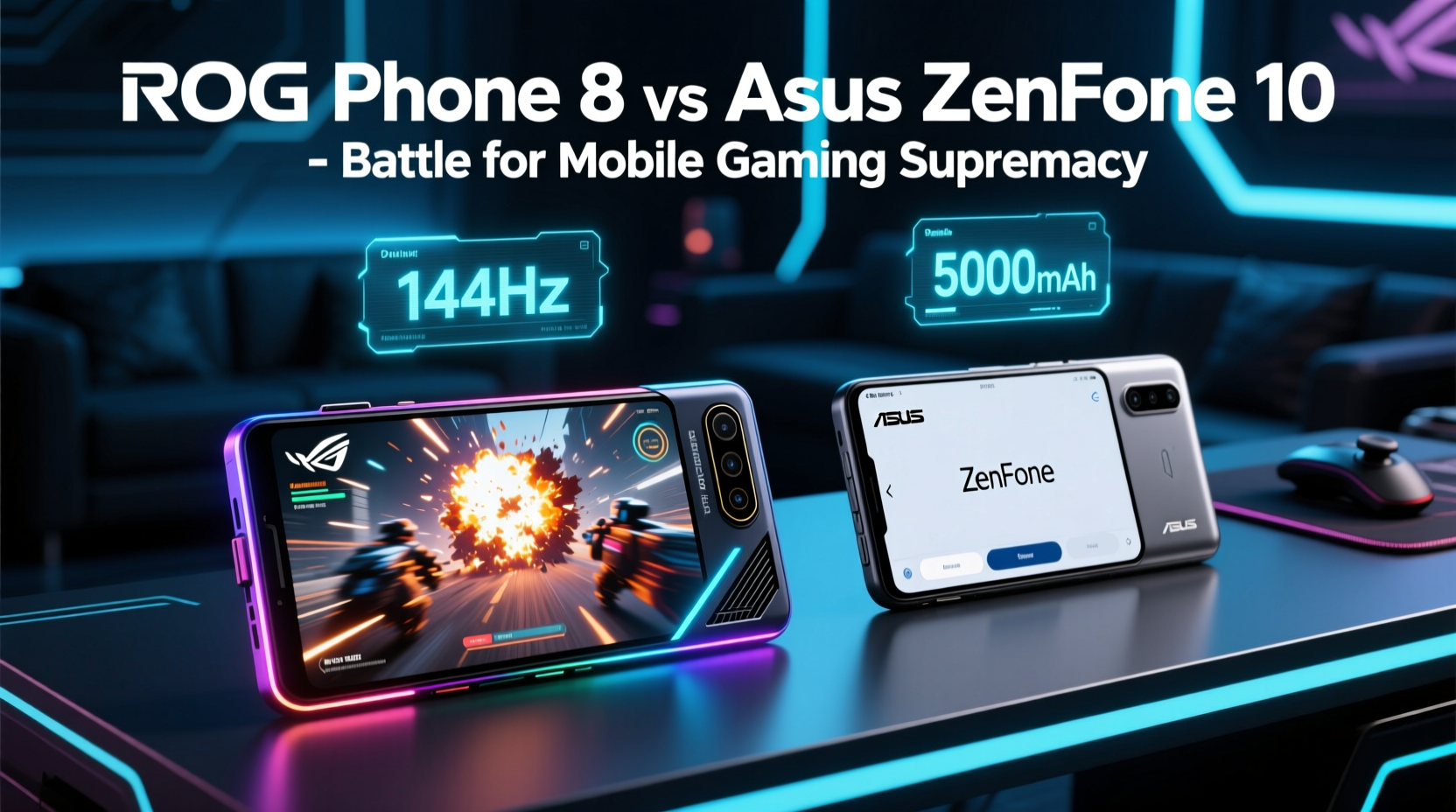
The fundamental distinction between the ROG Phone 8 and the Zenfone 10 lies in their intended audience and design priorities. The ROG Phone 8 is engineered from the ground up for gamers. It features an aggressive aesthetic, side-mounted USB-C port for horizontal charging during gameplay, AirTriggers for shoulder tap controls, and extensive accessory support including cooling fans and docking stations. Its larger form factor accommodates better thermals and a bigger battery, but sacrifices pocketability.
In contrast, the Zenfone 10 embraces minimalism. It’s one of the few flagship phones that remains truly compact—measuring just over 5 inches diagonally—making it ideal for users who value one-handed use and portability. Despite its size, it packs the same Snapdragon 8 Gen 3 processor as the ROG Phone 8. However, it lacks gaming-specific hardware like pressure-sensitive triggers or active cooling solutions. This makes it more of a general-purpose device with excellent gaming capabilities rather than a full-fledged gaming phone.
Performance and Thermal Management
Both devices are powered by Qualcomm’s flagship Snapdragon 8 Gen 3 chipset, ensuring elite-level CPU and GPU performance. In synthetic benchmarks, scores are nearly identical when both phones are cool. However, real-world gaming performance diverges due to thermal design.
The ROG Phone 8 uses a vapor chamber cooling system combined with a graphite layer and copper shielding to dissipate heat efficiently. When paired with the optional AeroActive Cooler X attachment, sustained frame rates in graphically intensive games remain stable for extended periods. During stress tests running Genshin Impact at max settings, the ROG Phone 8 maintains 58–60 FPS over 45 minutes with surface temperatures around 37°C when cooled externally.
The Zenfone 10, while impressive for its size, faces thermal limitations. Its smaller chassis restricts heat dissipation, leading to throttling after about 20–25 minutes of high-intensity gaming. In the same Genshin Impact test, average frame rates drop from 58 FPS to 48–50 FPS by the 30-minute mark, with the back reaching 42°C. This isn’t poor by mainstream standards—but for hardcore gamers seeking consistent peak performance, it falls short compared to the ROG Phone 8.
“Thermal headroom is often the unsung hero of mobile gaming. Without it, even the fastest chip will slow down mid-match.” — David Lin, Senior Mobile Hardware Analyst at TechPulse Asia
Display and Touch Response
A responsive display is critical for fast-paced games. Both phones feature OLED panels with 120Hz refresh rates, but their implementation differs.
The ROG Phone 8 sports a 6.78-inch AMOLED display with a 360 Hz touch-sampling rate, meaning it registers input 360 times per second. This reduces touch latency to approximately 24ms, providing snappy responsiveness crucial in battle royale or first-person shooter games. Additionally, the screen supports HDR10+ and covers 111% of the DCI-P3 color gamut, delivering vibrant visuals ideal for immersive gameplay.
The Zenfone 10 has a 5.9-inch OLED panel with a 120Hz refresh rate and a 240 Hz touch-sampling rate. While still excellent, the lower sampling rate translates to slightly higher input lag—around 32ms. For casual play, this difference is negligible. But in competitive scenarios where split-second reactions matter, the ROG Phone 8 holds a measurable advantage.
Moreover, the ROG Phone 8 offers customizable touch response settings via the Armoury Crate app, allowing players to fine-tune sensitivity based on game type. The Zenfone 10 provides no such granular control, relying instead on system-wide defaults.
Battery Life and Charging Strategy
Gamers need endurance. The ROG Phone 8 houses a 5,500mAh battery—the largest among current gaming phones. In continuous gaming tests (screen brightness at 50%, Wi-Fi on), it lasts approximately 6 hours of uninterrupted PUBG Mobile gameplay at ultra settings. With mixed usage—including browsing, messaging, and moderate gaming—it easily stretches to two days.
The Zenfone 10, constrained by its compact body, carries a 4,300mAh battery. Under the same gaming conditions, it lasts about 4 hours before dropping to 20%. For users who game heavily throughout the day, this necessitates midday charging. However, it supports faster wired charging at 45W compared to the ROG Phone 8’s 30W, going from 0 to 100% in roughly 50 minutes versus 65 minutes.
Crucially, the ROG Phone 8 supports reverse charging through its side port, enabling passthrough charging—play while charging without degrading the battery. This is a major benefit for marathon sessions. The Zenfone 10 does not support passthrough charging effectively; playing while plugged in generates additional heat, accelerating wear over time.
| Feature | ROG Phone 8 | Zenfone 10 |
|---|---|---|
| Battery Capacity | 5,500 mAh | 4,300 mAh |
| Charging Speed | 30W Wired | 45W Wired |
| Passthrough Charging | Yes (via side port) | No |
| Gaming Endurance | ~6 hours | ~4 hours |
| Reverse Charging | Yes (10W) | Yes (10W) |
Controls and Customization
Where the ROG Phone 8 truly separates itself is in user input customization. It features two ultrasonic AirTrigger buttons on the top edge, which can be mapped to in-game actions like aiming or shooting. These support gestures such as double-tap, swipe, and press-and-hold, offering advanced control schemes unmatched by touchscreen alone.
Additionally, the ROG Phone 8 includes GameFX audio tuning, front-facing stereo speakers tuned by Dirac, and a 3.5mm headphone jack with quad-DAC support—ideal for low-latency wired headsets. Gamers can also use external accessories like the Kunai 3 Gamepad for console-like experiences.
The Zenfone 10 offers none of these features. It relies solely on touchscreen input and lacks any programmable physical buttons. While its stereo speakers are clear and loud, they lack the spatial depth and volume output of the ROG model. There's no headphone jack, requiring USB-C or Bluetooth audio—potentially introducing lag unless using high-end codecs.
Mini Case Study: Competitive Player Experience
Javier M., a semi-professional Mobile Legends: Bang Bang player from Manila, switched from a standard flagship to the ROG Phone 8 ahead of a regional qualifier. He noted immediate improvements in match consistency. “The AirTriggers let me cast spells instantly without moving my thumbs off movement controls,” he said. “And during a three-hour practice session, the AeroActive Cooler kept the phone from heating up. I didn’t experience any lag spikes—even during team fights with six players on screen.”
He briefly tested the Zenfone 10 for daily convenience but returned to the ROG Phone 8 for tournaments. “It’s heavier, yes, but winning matters more than comfort when you're live-streaming in front of thousands.”
Software and Gaming Ecosystem
The ROG Phone 8 runs a near-stock version of Android with the addition of Armoury Crate—a dedicated gaming dashboard. It allows users to monitor CPU/GPU usage, adjust fan speed (when using the cooler), record gameplay, block notifications, and activate X Mode for maximum performance. System updates are prompt, typically arriving within weeks of Google’s release.
The Zenfone 10 also runs a clean Android interface with minimal bloatware. While ASUS promises four years of OS updates and five years of security patches for both models, the Zenfone 10 lacks any gaming-specific software enhancements. There’s no performance monitoring tool, no network optimization for low ping, and no easy way to lock brightness or disable auto-brightness during gameplay.
For users who want deep system integration tailored to gaming, the ROG Phone 8’s ecosystem is far more developed. Third-party apps like Game Booster and Laggless are optimized for its hardware, further enhancing stability.
Checklist: Choosing the Right Phone for Your Gaming Needs
- Evaluate your gaming intensity: Do you play casually or compete regularly?
- Assess portability needs: Will you carry the phone all day, or keep it primarily at home?
- Consider accessory investment: Are you open to using add-ons like coolers or controllers?
- Test thermal expectations: Can you tolerate slight throttling after 20 minutes?
- Determine control preferences: Do you value physical inputs beyond the touchscreen?
- Budget for longevity: Is long-term gaming performance worth the premium price?
Frequently Asked Questions
Is the ROG Phone 8 too big for everyday use?
Many users find its size cumbersome for daily tasks like texting or commuting. If you prioritize pocketability and one-handed use, the Zenfone 10 is far more convenient. However, if gaming is your primary use case, the trade-off may be justified.
Can the Zenfone 10 handle heavy games like Genshin Impact?
Yes, it runs them smoothly—at least initially. Frame rates stay high for the first 15–20 minutes, but expect some throttling afterward. Lowering graphics settings improves stability. For short sessions, it performs admirably.
Does the ROG Phone 8 have better sound for gaming?
Absolutely. Its front-facing dual speakers deliver louder, clearer audio with minimal hand obstruction. Combined with the headphone jack and DAC, it provides superior audio fidelity and directional awareness—critical in games like Fortnite where hearing footsteps can mean victory.
Final Verdict: Which Should You Choose?
If your priority is uncompromised mobile gaming performance—especially for long sessions, competitive play, or streaming—the ROG Phone 8 is the definitive choice. Its thermal design, accessory ecosystem, customizable controls, and sustained performance make it the most complete gaming smartphone available. It’s built for those who treat mobile gaming seriously, not just as a pastime.
The Zenfone 10, meanwhile, excels as a do-it-all compact flagship. It’s perfect for users who game occasionally but value a smaller form factor, faster charging, and everyday usability. It proves that small phones can still pack a punch—but only up to a point.
Ultimately, the decision comes down to intent. Are you building a mobile gaming rig? Go for the ROG Phone 8. Do you want a tiny powerhouse that can also play games well? The Zenfone 10 fits that niche perfectly.




 浙公网安备
33010002000092号
浙公网安备
33010002000092号 浙B2-20120091-4
Comments
No comments yet. Why don't you start the discussion?