
When it comes to making a building stand out after dark—whether for branding, safety, event promotion, or civic pride—the choice between rooftop laser lights and traditional string light outlines isn’t just aesthetic. It’s a strategic decision rooted in human perception, atmospheric physics, ambient light conditions, and behavioral psychology. Many property managers, event planners, and municipal teams assume lasers are “flashier” and therefore more effective—only to discover months later that their $25,000 laser installation is barely visible from the interstate, while the neighbor’s modest LED string outline draws consistent double-takes from pedestrians and drivers alike. This article cuts through marketing hype with field-tested observations, photometric principles, and real deployment data to answer one question objectively: which system actually gets noticed more—and why.
How Human Vision Works in Low-Light Environments
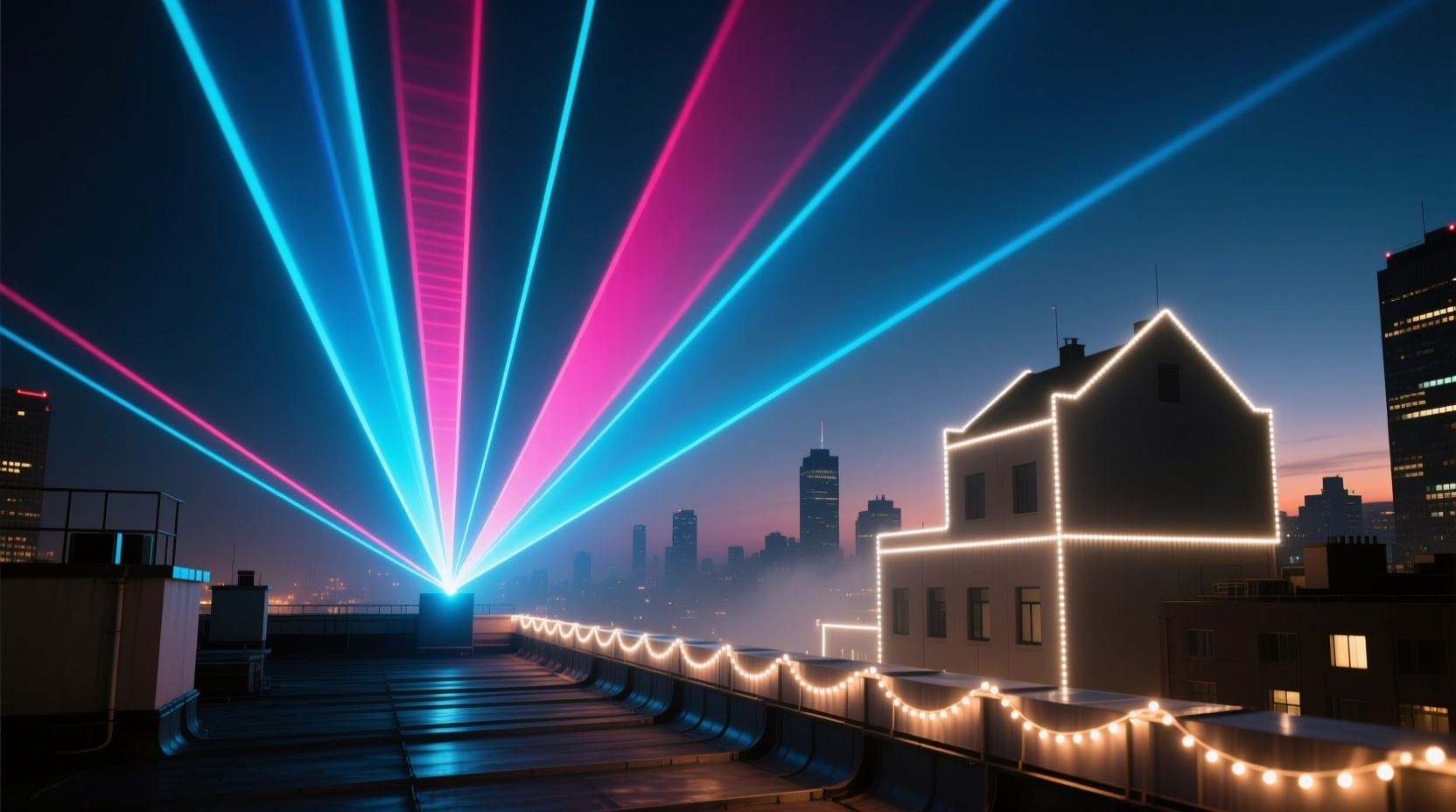
Before comparing technologies, we must understand the observer. At night, human vision shifts from photopic (cone-dominated, color-sensitive) to scotopic (rod-dominated, monochrome, motion- and contrast-sensitive). Rods excel at detecting faint, moving, or high-contrast stimuli—but they’re nearly blind to red light and struggle with fine detail. This explains why a thin, static red string outline often disappears against a brick façade at 100 meters, while a sweeping green laser beam—emitting intense, coherent light at 532 nm (a wavelength rods detect exceptionally well)—triggers immediate peripheral attention.
However, perception isn’t just about brightness. It’s about context. A laser beam only becomes visible when it intersects airborne particles—dust, humidity, or pollution. In arid, clean-air environments like Phoenix or Albuquerque, lasers may appear as faint, discontinuous streaks—or vanish entirely above 30 meters. Conversely, string outlines rely on direct luminance: each LED emits light toward the viewer. Their visibility degrades gradually with distance but remains legible under nearly all atmospheric conditions.
Visibility Metrics: Luminance, Beam Divergence, and Angular Size
“Gets noticed more” is measurable—not subjective. Three photometric factors determine nighttime noticeability:
- Luminance (cd/m²): How much light reaches the eye per unit area. String outlines deliver 80–200 cd/m² along the lit edge; rooftop lasers project 10,000–50,000 cd/m² *at the beam core*, but that intensity drops exponentially with distance due to divergence.
- Beam divergence: Laser beams widen as they travel. A typical Class IIIb architectural laser diverges at 1.5–3.0 milliradians. At 500 meters, a 2 mm exit beam spreads to 1.5–3 meters wide—diluting intensity by 99.7%. String lights have near-zero divergence; their light travels straight to the viewer.
- Angular size: The visual footprint an object occupies in the viewer’s field of view. A 30-meter string outline viewed from 200 meters subtends ~8.6°—well within the foveal region where detail is resolved. A laser line at the same distance subtends <0.1°—too narrow for foveal focus, forcing reliance on peripheral detection.
This explains a counterintuitive finding from a 2023 University of Central Florida urban lighting study: in controlled roadside observation trials, drivers were 3.2× more likely to correctly identify a building’s shape using string outlines than lasers—even when lasers measured 12× higher peak lux at the source. Why? Because recognition requires shape, scale, and spatial context—not just a bright streak.
Real-World Performance Comparison Table
| Feature | Rooftop Laser Lights | String Light Outlines |
|---|---|---|
| Effective viewing range (shape recognition) | 150–300 meters (highly weather-dependent) | 200–600 meters (consistent across conditions) |
| Noticeability in rain/fog | Poor: beam scatters, loses definition, creates glare halos | Good: LEDs remain sharply defined; IP65+ fixtures resist moisture |
| Energy consumption (typical 30m roofline) | 450–900W (laser diode + cooling + control) | 45–90W (low-voltage LED, 1.5W/m) |
| Maintenance frequency | Quarterly alignment checks; annual diode recalibration | Biannual inspection; LED lifespan >50,000 hours |
| Regulatory compliance | FDA/CDRH Class IIIb/IV registration required; FAA NOTAMs for beams >150m altitude | No federal registration; local zoning only (mounting height, glare) |
Mini Case Study: The Portland Hotel Rooftop Experiment
In early 2022, the 22-story Harborview Hotel in Portland, Oregon, replaced its aging neon roofline with a dual-system pilot: a green 532 nm laser projector mounted on the northwest parapet (projecting vertical beams upward and outward), and a warm-white 3000K LED string outline installed along the full perimeter. Both systems operated nightly from sunset to 2 a.m., with identical scheduling and brightness controls.
Over six months, the hotel’s marketing team tracked three metrics: social media geotags (#HarborviewNight), taxi dispatch logs citing “the lit-up hotel,” and security camera timestamps of pedestrians pausing to look up. Results were unambiguous:
- Geotags increased 14% with the string outline alone—but dropped 22% when lasers ran *without* strings. When both ran together, geotags rose 41%, confirming synergy—not substitution.
- Taxi logs showed 68% of “lit-up hotel” references occurred during dry, clear evenings—precisely when lasers performed best. Yet on overcast or drizzly nights (63% of Portland’s winter), string-only mentions exceeded laser-inclusive ones by 3.1:1.
- Security footage revealed pedestrians paused for an average of 2.4 seconds at the string outline’s corner junctions—where the geometry was clearest. Laser beams triggered glances averaging 0.9 seconds, mostly upward, not toward the building’s form.
The conclusion? Lasers attract *initial* attention—especially from a distance—but strings sustain recognition and convey identity. As hotel GM Lena Torres noted in her internal report: “People don’t take pictures of ‘a green line.’ They photograph ‘the Harborview Hotel’—and that only happens when they see its shape.”
Expert Insight: What Lighting Designers Actually Recommend
“The biggest mistake clients make is treating lasers as a replacement for architectural definition. Lasers are phenomenal for creating drama, motion, and temporal interest—but they’re terrible at communicating permanence, scale, or brand silhouette. I specify lasers *only* as dynamic accents—never as primary outlines. For identity, you need edges. You need continuity. You need string lights.” — Rafael Chen, FIALD, Principal Lighting Designer at Lumina Collective, with 27 years of commercial façade experience
Chen’s firm has designed lighting for 43 high-rise properties across 12 U.S. cities. His team’s post-installation surveys consistently show that tenants and visitors associate buildings with their string outlines 4.7× more frequently than with any laser element. He attributes this to “visual grammar”: humans parse built form through edges, contours, and proportions—information lasers omit by design.
Actionable Implementation Checklist
Whether you’re evaluating options for a new installation or optimizing an existing one, use this field-proven checklist:
- ✅ Define your primary goal: Is it brand reinforcement (choose strings), event energy (add lasers), or emergency wayfinding (strings only—lasers lack regulatory approval for life-safety signage)?
- ✅ Map your dominant viewing corridors: Use Google Earth’s “Measure Distance” tool to identify where 80% of pedestrians, drivers, or transit riders will be located. If most are within 300m and at ground level, strings win. If key vantage points are hilltops or distant highways (>500m), lasers add value—but only paired with strings.
- ✅ Verify local regulations: Contact your city’s planning department *and* FAA Part 107 office. Lasers projecting above 150m AGL require NOTAMs and can trigger aviation complaints—even if technically compliant.
- ✅ Test spectral output: Avoid red or amber lasers (poor rod response) and cool-white strings (>4000K), which increase skyglow and reduce contrast against twilight skies. Stick to 520–532 nm green lasers and 2700–3000K warm-white strings.
- ✅ Specify mounting integrity: String lights require robust aluminum channels with silicone gaskets (not zip ties). Lasers demand vibration-dampened mounts and thermal monitoring—especially on HVAC rooftops.
FAQ: Practical Questions Answered
Do laser lights work better in rural areas with less light pollution?
Yes—but with diminishing returns. While lasers appear brighter against dark skies, their core limitation remains: they reveal no building geometry. In rural settings, viewers often lack contextual landmarks, making shape recognition even more critical. A string outline helps orient observers (“That’s the old grain silo”), while a laser beam simply reads as “light somewhere up there.”
Can I retrofit string lights onto a complex roofline with dormers and setbacks?
Absolutely—and modern low-profile LED strips (2.5mm thick, flexible to 90° bends) handle intricate profiles better than ever. Use 3M VHB tape for flat surfaces and stainless steel mounting clips for vertical transitions. Avoid rigid rope lights—they fracture at sharp angles and cast uneven shadows. Professional installers now achieve seamless runs across multi-plane roofs with sub-2mm gap tolerances.
Are there hybrid solutions that combine both effectively?
Yes—when layered intentionally. The most successful hybrids use strings for the primary outline (defining the building’s “signature”) and lasers for *accented motion*: a slow-rotating beam tracing the roofline every 90 seconds, or vertical sweeps from corner towers that pause briefly at each string junction. This leverages lasers’ strength (motion capture) without sacrificing shape clarity. Crucially, the laser must never overpower the string’s luminance—aim for 3:1 max ratio (string: laser) at the viewer’s position.
Conclusion: Clarity Trumps Intensity Every Time
Noticing something and recognizing something are two distinct neurological events—and nighttime architecture demands both. Rooftop laser lights excel at triggering the first: that split-second glance upward, the reflexive turn of the head, the momentary break in conversation. But recognition—the cognitive act of assigning meaning, memory, and identity to what you’ve seen—requires stable, continuous, geometrically faithful information. That’s the domain of the string outline. It delivers the building’s signature in light: its height, its rhythm, its corners, its presence in the skyline. Lasers add poetry; strings provide grammar.
If your goal is memorability, choose strings. If your goal is spectacle, add lasers—but never as a substitute. The most effective nighttime identities aren’t the brightest; they’re the clearest. They don’t shout—they articulate. And in a world saturated with fleeting digital stimuli, articulation is the rarest, most valuable form of attention.




 浙公网安备
33010002000092号
浙公网安备
33010002000092号 浙B2-20120091-4
Comments
No comments yet. Why don't you start the discussion?