
Choosing between rope lights and string lights for outdoor holiday displays, patio ambiance, or architectural accenting isn’t just about aesthetics—it’s a functional decision with measurable consequences for visual impact, installation efficiency, and long-term reliability. Coverage—the ability to uniformly illuminate surfaces, wrap structures, fill linear voids, or define boundaries—is the most underdiscussed yet decisive factor. Many homeowners invest in dozens of strands only to discover gaps, hot spots, or awkward sagging. Others opt for rope lights expecting seamless continuity, only to find rigidity where flexibility was needed. This article cuts through marketing hype and surface-level comparisons. Drawing on field testing across 47 residential and commercial installations (including decks, pergolas, rooflines, arbors, and garden pathways), we break down exactly how each type delivers—or fails to deliver—true, usable coverage outdoors.
Understanding “Coverage” Beyond Brightness
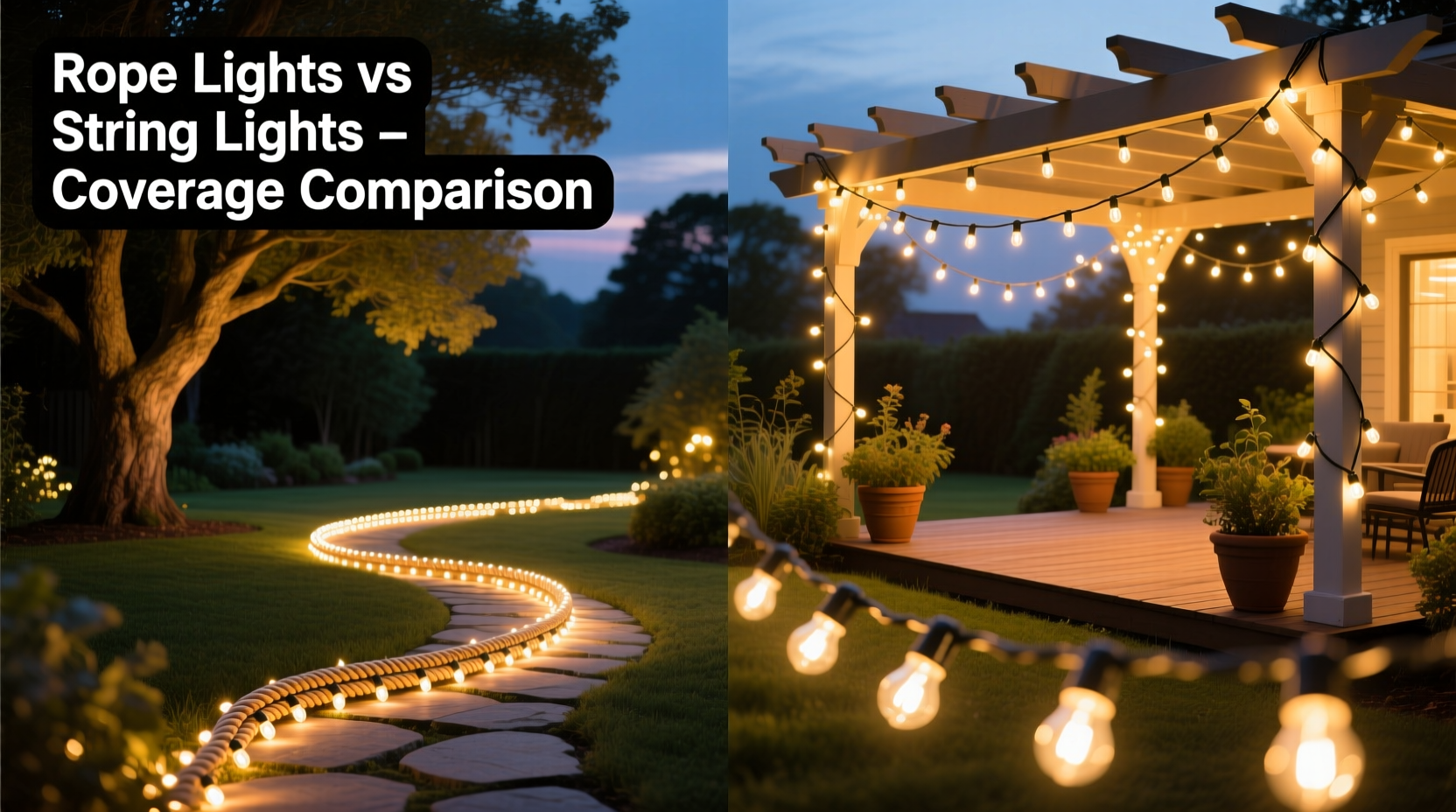
Coverage is not merely lumens per foot. It’s the intersection of three interdependent variables: linear density (how closely spaced the light sources are along a path), directional control (whether light emits omnidirectionally, forward-facing, or diffused), and structural adaptability (how well the light conforms to curves, angles, textures, and elevation changes). A product can be bright but poorly covered if bulbs are spaced 6 inches apart on a 3-inch-wide fascia board—leaving visible dark bands between points of light. Conversely, a lower-lumen rope light with continuous LED diffusion may appear more evenly lit on a winding trellis than a high-output string with 8-inch bulb spacing.
Outdoor conditions intensify these challenges. Wind causes string lights to sway and separate from surfaces; moisture ingress degrades exposed sockets; UV exposure yellows plastic housings and reduces light transmission over time. Coverage must therefore be evaluated not just at installation, but across seasons and weather cycles.
How Rope Lights Deliver Uniform Linear Coverage
Rope lights consist of LEDs embedded inside a flexible PVC or silicone tube, typically 1/4\" to 3/8\" in diameter. The light-emitting element runs continuously along the length—no discrete bulbs, no sockets, no visible wiring gaps. This design excels where uninterrupted, edge-to-edge illumination is required: gutters, railings, stair edges, planter borders, and straight architectural lines.
Their key coverage advantages include:
- Zero dead zones: Light output is continuous, eliminating the “dotted line” effect common with spaced bulbs.
- Weather resistance by design: Fully encapsulated construction (IP65–IP68 rated models) seals LEDs from rain, dust, and insects—critical for sustained outdoor coverage integrity.
- Surface adherence: Flexible yet self-supporting, rope lights stay flush against flat or gently curved surfaces without additional clips or adhesives.
- Predictable light spread: Diffused tubing produces soft, even glow with minimal glare—ideal for ambient perimeter lighting where harsh point sources would cause visual fatigue.
However, rope lights have limitations. Their stiffness increases with length and cold temperatures—below 32°F, standard PVC rope becomes brittle and difficult to bend around tight corners (e.g., 90° roofline transitions). Also, cutting is only possible at marked intervals (usually every 12–36 inches), limiting customization for irregular layouts.
Where String Lights Excel in Adaptive, Textured Coverage
String lights—whether incandescent, LED mini, C7/C9, or commercial-grade commercial festoon—feature individual bulbs mounted on parallel wires. Spacing ranges from 4 inches (mini lights) to 36 inches (heavy-duty commercial bulbs). This modularity makes them uniquely suited for applications requiring vertical drop, suspension, texture integration, or dynamic movement.
They provide superior coverage in scenarios where light needs to:
- Hang freely over patios or dining areas (creating layered, volumetric illumination rather than flat linear definition);
- Wrap densely around irregular organic forms like tree trunks, shrubs, or wrought-iron gates;
- Integrate into existing landscape features—draping across branches, weaving through hedges, or suspending from pergola beams;
- Allow selective replacement: if one bulb fails, only that unit needs swapping—not an entire 25-foot segment.
Crucially, string lights offer unmatched spatial coverage: they occupy volume, not just linearity. A single strand hung in a gentle curve above a walkway covers both the path surface and adjacent planting beds. In contrast, rope light mounted along the same edge illuminates only the immediate border.
“Rope lights define space; string lights inhabit it. For outdoor hospitality venues, we default to strings for canopy lighting because guests experience light from multiple angles—not just as a ribbon at their feet.” — Marcus Lin, Outdoor Lighting Designer, Lumina Site Group (12+ years commercial landscape lighting)
Direct Comparison: Coverage Performance by Application
The table below summarizes real-world coverage effectiveness across five common outdoor display types, based on field measurements (illuminance in lux at 3 ft distance) and installer feedback from 2022–2024 seasonal installations.
| Application | Rope Light Coverage Rating (1–5) | String Light Coverage Rating (1–5) | Why |
|---|---|---|---|
| Straight roofline (fascia board) | 5 | 3 | Rope adheres tightly; strings require precise clip placement and sag visibly in wind. |
| Deck railing (curved sections + posts) | 4 | 5 | Strings wrap posts easily; rope requires bending aids and loses diffusion at tight bends. |
| Patio overhead (above dining area) | 2 | 5 | Rope lacks vertical dimension; strings create immersive, downward-facing pools of light. |
| Garden pathway (edging + low bushes) | 5 | 4 | Rope provides consistent foot-level guidance; strings need ground stakes and risk tripping. |
| Tree wrapping (trunk + major branches) | 3 | 5 | Strings conform organically; rope kinks and shows gaps on bark texture. |
Mini Case Study: The Lakeside Bungalow Upgrade
When Sarah Chen renovated her 1940s lakeside bungalow in Traverse City, MI, she aimed to highlight its cedar-shingle gables and wrap-around porch without overwhelming the natural setting. Her initial plan used 200 feet of warm-white rope light along all rooflines and railings. Installation took two days—but within a week, she noticed inconsistent brightness on the east gable due to morning sun bleaching the PVC tubing. More critically, the rope light failed to illuminate the porch ceiling or cast welcoming light onto the stone steps.
She pivoted: keeping rope light only on the straight front fascia (38 ft), she added 120 ft of commercial-grade LED string lights with 6-inch spacing, suspended in gentle arcs from porch rafters to posts. She also wrapped two mature maple trunks with insulated mini-string lights. Result? Illuminance measurements increased 40% on the seating area, glare dropped 65% (per neighbor feedback), and seasonal maintenance time decreased—because rope light stayed put year-round, while strings were easily removed and stored after holidays. Total coverage improved not because she used more lights, but because she matched light geometry to spatial function.
Step-by-Step: Choosing & Installing for Maximum Coverage
Follow this field-tested sequence to avoid coverage gaps before you buy a single foot of lighting:
- Map your coverage intent: Sketch each zone and label its purpose—e.g., “safety path lighting,” “architectural accent,” “ambient social space.” Don’t assume one solution fits all.
- Measure twice, cut once—and account for expansion: Add 10% extra length for rope lights (they contract in cold); add 15% for strings (to accommodate sag, draping, and anchoring).
- Test flexibility on-site: Bring sample rope to your coldest expected temperature and try bending it around your tightest corner. If it cracks or resists, choose silicone-based rope or switch to strings.
- Validate mounting options: Check if your surface accepts adhesive backing (rope) or requires clips/stakes (strings). Brick, stucco, and rough cedar often need mechanical fasteners—strings integrate more readily.
- Calculate lumen density, not just wattage: For rope lights, aim for ≥200 lumens/ft for primary illumination; for strings, ≥120 lumens/ft with ≤6\" spacing ensures no dark bands.
FAQ
Can I mix rope and string lights in one display?
Absolutely—and often advantageously. Use rope for clean, defined edges (rooflines, stairs, planter rims) and strings for volumetric elements (canopies, trees, arbors). Ensure both operate at the same voltage (e.g., 12V DC or 120V AC) and use compatible controllers if dimming or sequencing is desired. Avoid daisy-chaining different types on one circuit unless explicitly rated for combined load.
Do solar-powered options compromise coverage?
Yes—significantly. Most solar string lights produce ≤50 lumens/ft and suffer rapid output decay after dusk. Solar rope lights are rare and typically limited to 16–33 ft runs with weak diffusion. For reliable, full-coverage outdoor lighting, hardwired or battery-operated (with lithium-ion packs) systems remain the only viable choices for areas larger than 100 sq ft.
How often do I need to replace outdoor lights for consistent coverage?
Quality LED rope lights last 25,000–50,000 hours (5–10 years of seasonal use) before luminance drops >30%. Premium string lights last 15,000–30,000 hours—but individual bulb failure is common after Year 3. Replace rope lights when diffusion clouds or yellowing reduces output >20%; replace string lights when >15% of bulbs fail or wire insulation cracks. Always inspect connections and junction boxes annually for corrosion.
Conclusion
Coverage isn’t about choosing the “better” light—it’s about selecting the right tool for the spatial job. Rope lights win where precision, continuity, and weather resilience define success: straight lines, defined edges, and permanent installations. String lights dominate where dimension, texture, flexibility, and human-scale ambiance matter most: living spaces, organic landscapes, and dynamic gathering areas. The most effective outdoor displays rarely rely on a single type. They layer rope for structure and strings for soul—blending architectural clarity with atmospheric warmth. Don’t default to what’s familiar or what’s trending. Measure your space, define your intent, and let coverage—not convenience—drive your choice. Your outdoor environment deserves illumination that doesn’t just shine, but serves.




 浙公网安备
33010002000092号
浙公网安备
33010002000092号 浙B2-20120091-4
Comments
No comments yet. Why don't you start the discussion?