
Selecting the right footwear is one of the most overlooked yet critical decisions in fitness. Whether you're logging miles on the pavement or lifting weights in the gym, your shoes play a foundational role in performance and safety. Many people assume athletic shoes are interchangeable—after all, they look similar and are marketed for active lifestyles. But running shoes and training shoes are engineered for fundamentally different movements. Using the wrong type doesn’t just reduce efficiency; it significantly raises the risk of injury.
Misusing footwear may seem harmless at first. You might wear your running shoes to the weight room because they’re comfortable, or use your cross-trainers for a 5K without noticing immediate discomfort. However, over time, these mismatches strain joints, destabilize movement patterns, and contribute to chronic conditions like plantar fasciitis, shin splints, or knee tendinitis. Understanding the biomechanical distinctions between running and training shoes—and respecting their intended uses—can protect your body and extend your active years.
The Fundamental Difference: Motion Patterns and Shoe Design
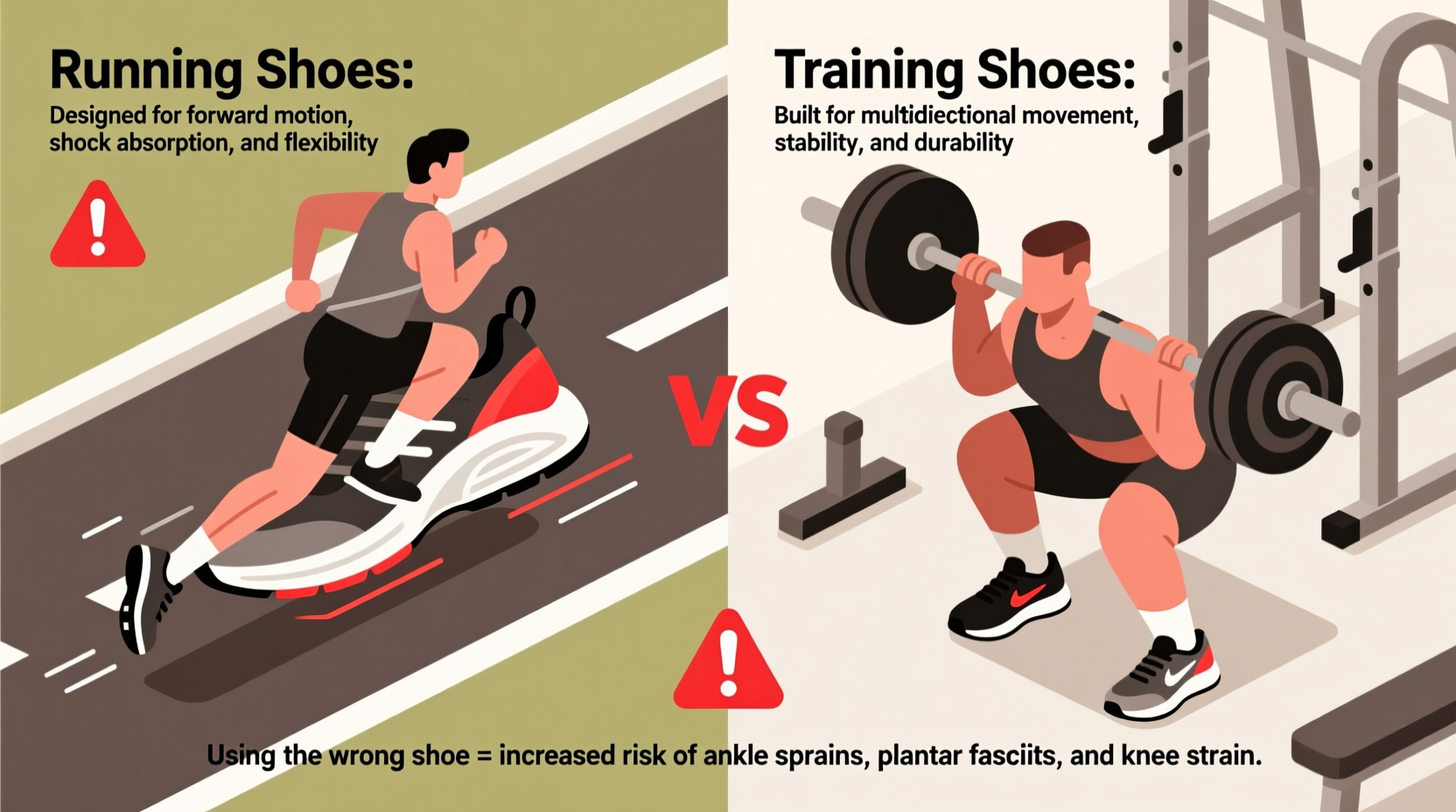
Running is a repetitive, linear motion. Each stride follows a predictable heel-to-toe sequence with substantial vertical impact. Running shoes are built to absorb that force through advanced cushioning systems in the midsole (like EVA foam or gel pods), elevated heels for smooth transitions, and flexible forefeet to encourage natural roll-off. The structure is often more rigid laterally to prevent excessive side-to-side movement during gait.
In contrast, training involves multidirectional movement—lateral shuffles, jumps, squats, lunges, and quick directional changes. Training shoes prioritize stability over cushioning. They feature flat, firm soles for better ground contact, reinforced lateral support for side-to-side agility, and a lower heel-to-toe drop to maintain balance during lifts. Flexibility is limited compared to running shoes, especially in the forefoot, to resist bending under heavy loads.
When you wear running shoes for strength training, the soft, elevated heel compresses unpredictably under barbell pressure, compromising form and increasing stress on knees and lower back. Conversely, wearing stiff training shoes for long runs reduces shock absorption, transferring impact directly into joints and soft tissues.
How Mismatched Footwear Leads to Injury
The human body adapts to stress—but only up to a point. When footwear fails to support the specific demands of an activity, compensatory mechanics emerge. These subtle shifts accumulate over time, leading to overuse injuries.
Common Injuries from Using Running Shoes in the Gym
- Ankle sprains: Excessive cushioning and high heels reduce proprioception (awareness of foot position), making it harder to stabilize during lateral moves.
- Knee pain: An elevated heel alters squat mechanics, pushing the knees too far forward and increasing patellar tendon strain.
- Lower back strain: Unstable bases during deadlifts or overhead presses force the spine to compensate, especially when the heel collapses under load.
- Metatarsal stress: Over-flexible forefoot in running shoes can cause painful pressure points during plyometric drills.
Common Injuries from Using Training Shoes for Running
- Shin splints: Minimal cushioning transmits repeated impact to the tibia, especially on hard surfaces.
- Plantar fasciitis: Lack of arch support and shock absorption increases tension on the plantar fascia.
- Achilles tendinitis: A lower heel drop strains the Achilles during heel strike, particularly if you're used to higher offsets.
- Iliotibial (IT) band syndrome: Poor shock absorption amplifies lateral forces on the knee during prolonged strides.
“Footwear mismatch is one of the top three modifiable risk factors for exercise-related overuse injuries.” — Dr. Lena Patel, Sports Medicine Physician, Cleveland Clinic
Comparison Table: Running Shoes vs. Training Shoes
| Feature | Running Shoes | Training Shoes |
|---|---|---|
| Sole Cushioning | High – Designed to absorb repeated impact | Low to moderate – Prioritizes ground feel |
| Heel-to-Toe Drop | 8–12mm – Promotes heel-strike transition | 4–6mm – Keeps body balanced over feet |
| Lateral Support | Limited – Focus is on forward motion | High – Reinforced sidewalls prevent rolling |
| Flexibility | High in forefoot – Encourages toe-off | Controlled – Resists bending during lifts |
| Weight | Lighter – Reduces fatigue over distance | Slightly heavier – Adds stability |
| Best For | Running, jogging, treadmill walking | Weightlifting, HIIT, circuit training, agility drills |
| Worst For | Heavy lifting, lateral movements | Long-distance running, road workouts |
Real-World Example: The CrossFit Enthusiast Who Switched Shoes
Jamal, a 32-year-old software engineer, joined a CrossFit program eager to improve his fitness. He wore his daily running shoes—a popular model with plush cushioning—to every session. Within six weeks, he developed persistent pain on the outside of his left knee. His coach noticed he wobbled during box jumps and struggled to maintain balance in overhead squats.
After consulting a physical therapist, Jamal learned his running shoes were compressing unevenly during lateral cuts and collapsing under barbell weight. The instability caused his knee to track improperly, leading to IT band irritation. Switching to a dedicated training shoe with a firmer sole and better lateral containment resolved his symptoms within three weeks. “I didn’t realize my shoes were sabotaging my form,” he said. “Now I wouldn’t dream of lifting in anything but my trainers.”
How to Choose the Right Shoe: A Step-by-Step Guide
Selecting appropriate footwear isn’t about brand loyalty or aesthetics—it’s about matching design to function. Follow this process to make informed choices:
- Assess Your Primary Activity
Determine whether you spend more time running, lifting, or doing mixed workouts. If running exceeds 70% of your routine, start with running shoes as your base. - Evaluate Your Movement Patterns
Do you sprint, jump, cut, or lift heavy? Lateral and multidirectional activities demand training shoes. Straight-line endurance favors running shoes. - Check the Sole Firmness
Press your thumb into the midsole. If it sinks deeply, it’s likely too soft for lifting. A firm sole provides a stable platform for power transfer. - Test the Heel Height
Place the shoe on a flat surface. View it from the side. A pronounced slope from heel to toe indicates a running shoe. A flatter profile suits training. - Try Before You Buy
Visit a specialty store and simulate movements: squat in the shoes, do a side shuffle, or mimic a lunge. Notice any instability or pinching. - Consider Dual-Pair Strategy
If your routine includes both running and gym work, own two pairs. Rotate based on the day’s focus. This extends shoe life and protects your body.
Expert Checklist: Are You Wearing the Right Shoe?
Use this checklist before each workout to avoid mismatched footwear:
- ✅ Am I performing repetitive forward motion (e.g., running, treadmill)? → Choose running shoes.
- ✅ Am I lifting weights, doing plyometrics, or changing directions quickly? → Choose training shoes.
- ✅ Does my shoe feel unstable when I squat or lunge? → It’s likely too cushioned.
- ✅ Do my feet ache after short runs in my gym shoes? → Lack of cushioning may be the culprit.
- ✅ Is the outsole worn unevenly? → Could indicate poor fit or incorrect usage.
- ✅ Have I used this pair for over 6 months with frequent training? → Consider replacement.
Frequently Asked Questions
Can I use cross-training shoes for running?
Cross-trainers are hybrids designed for moderate cardio and gym work, but they’re not ideal for runs longer than 2–3 miles. Their limited cushioning increases joint stress over distance. For regular runners, dedicated running shoes are safer and more effective.
Are minimalist shoes suitable for both activities?
Minimalist shoes promote natural foot mechanics but lack protection for high-impact or heavy-load scenarios. They require strong foot and ankle stabilizers. Most experts advise against using them for intense training or long runs unless you’ve gradually adapted to them over months.
What if my gym routine includes both running and lifting?
This is common—and precisely why owning two pairs makes sense. Use running shoes for the treadmill or outdoor intervals, then switch to training shoes for strength circuits. Some athletes keep a shoe bag at the gym to make transitions easier.
Final Thoughts: Protect Your Foundation
Your feet are the foundation of every movement you make. Just as you wouldn’t drive a sports car on a construction site or use a hammer to paint a wall, you shouldn’t rely on one type of athletic shoe for every activity. Running and training place distinct demands on your body, and modern footwear reflects those needs through specialized engineering.
Ignoring the difference might save money upfront, but it costs more in lost training time, medical bills, and long-term joint health. By choosing the right shoe for the job, you enhance performance, improve biomechanics, and dramatically reduce injury risk. Treat your footwear with the same seriousness as your nutrition or workout programming—because it’s just as vital to sustainable fitness.




 浙公网安备
33010002000092号
浙公网安备
33010002000092号 浙B2-20120091-4
Comments
No comments yet. Why don't you start the discussion?