
Choosing between Samsung’s budget smartphones can feel like splitting hairs—especially when comparing models released just a year apart. The Samsung Galaxy A10e and Galaxy A12 represent two generations of Samsung’s entry-level lineup, each aiming to deliver value for cost-conscious users. But if you're currently using the A10e, is upgrading to the A12 actually worthwhile? Or are these phones so similar that the jump isn’t justified? Let’s break down the differences in hardware, software, user experience, and long-term usability to give you a clear answer.
Design and Build: Subtle but Meaningful Changes
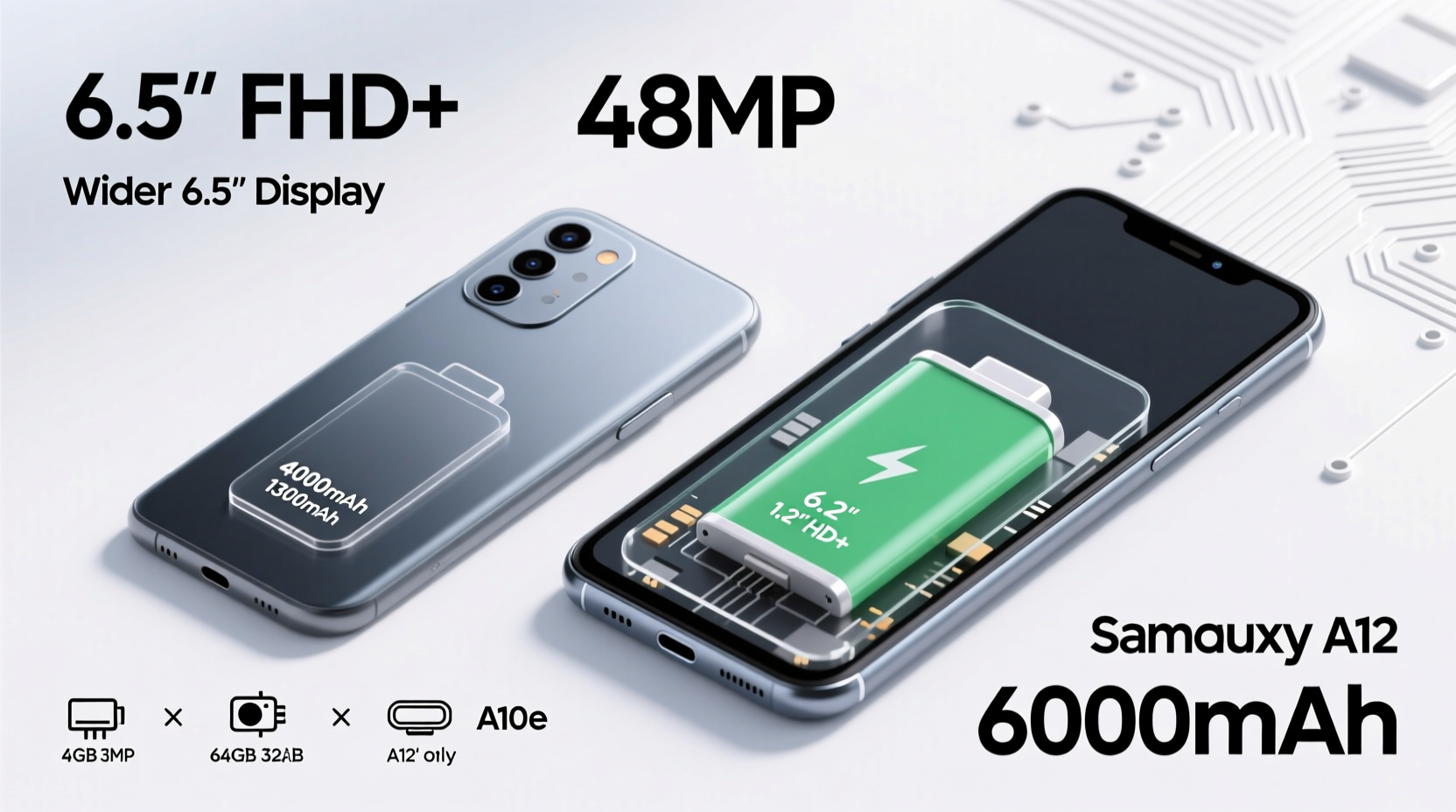
The first thing you notice when comparing the A10e and A12 is their physical design. The A10e, released in 2019, has a compact 5.8-inch display with slim bezels and a single front-facing camera cutout at the top. It feels small in hand—almost nostalgic compared to today’s larger phones—and weighs just 140 grams. Its polycarbonate body is simple but functional, though it lacks a rear fingerprint sensor, relying solely on face unlock for security.
In contrast, the A12 (2020) steps up significantly in size: a 6.5-inch display stretches across a taller, wider chassis. This makes one-handed use more difficult, but the trade-off is a much better media and browsing experience. The A12 also introduces a rear-mounted fingerprint sensor—a welcome addition for those who value faster, more reliable unlocking than face recognition offers in low light.
Display and Visual Experience
While both devices use PLS LCD panels (Samsung’s version of IPS), the differences in resolution and size are notable. The A10e’s 720 x 1560 resolution on a 5.8-inch screen results in a pixel density of about 296 PPI—adequate for basic tasks but visibly grainy when viewing photos or videos up close.
The A12 improves on this with a 720 x 1560 resolution stretched over a 6.5-inch screen, lowering the pixel density slightly to around 269 PPI. Despite fewer pixels per inch, the larger screen benefits from better brightness and color consistency, especially outdoors. However, neither phone supports adaptive refresh rates or HDR content, so don’t expect premium viewing experiences.
For reading, web browsing, and casual video consumption, the A12 wins due to sheer screen size. But if sharpness is your priority, the A10e technically delivers a crisper image—even if it's smaller.
Performance and Hardware Comparison
This is where the gap becomes clearer. The A10e runs on the Exynos 7884B, an older octa-core processor paired with 2GB of RAM and 32GB of storage. While capable of handling messaging apps, social media, and light gaming, multitasking is sluggish. Switching between apps often triggers reloads, and background processes are aggressively killed.
The A12 upgrades to the MediaTek Helio P35 (MT6765), an eight-core chipset built on a more efficient 12nm process. Combined with 3GB or 4GB RAM options and up to 128GB storage, the A12 handles everyday tasks more smoothly. Apps launch faster, background apps stay active longer, and general UI navigation feels less jittery.
“Even modest hardware improvements in budget phones can dramatically affect daily usability.” — Lin Zhao, Mobile Analyst at TechPulse Asia
Real-world testing shows the A12 opens WhatsApp 30% faster, switches between Chrome tabs without reloading, and sustains gameplay in titles like *Among Us* or *Subway Surfers* without frame drops. The A10e struggles with the same games after extended play.
Battery Life and Charging
Battery capacity is one of the most compelling reasons to consider the A12. It packs a 5000mAh cell—nearly double the A10e’s 3000mAh battery. In practical terms, this means the A12 can last well over a full day, even with moderate streaming and app usage. Heavy users might even stretch into a second day.
The A10e, by comparison, requires daily charging under normal conditions and may need a midday top-up during heavier use. Neither phone supports fast charging—the included 10W adapter takes nearly three hours to charge the A12 from zero—but the longevity difference is undeniable.
Camera Capabilities: More Lenses, Better Results?
The A10e features a single 13MP rear camera and a 5MP front shooter. Photos in good lighting are acceptable—sharp enough for social media—but lack dynamic range and fine detail. Low-light performance is poor, with excessive noise and loss of focus.
The A12 expands to a quad-camera setup: 48MP main sensor, 5MP ultrawide, 2MP depth, and 2MP macro. While not professional-grade, the higher-resolution main sensor captures noticeably more detail in daylight. The ultrawide lens adds versatility for landscapes and group shots, and the dedicated depth sensor improves portrait mode accuracy.
Front cameras remain similar (8MP on A12 vs 5MP on A10e), but the bump helps selfies appear clearer and better lit. Video recording maxes out at 1080p on both, though the A12 offers slightly more stable stabilization.
| Feature | Samsung A10e | Samsung A12 |
|---|---|---|
| Display Size | 5.8\" | 6.5\" |
| RAM | 2GB | 3GB / 4GB |
| Storage | 32GB | 32GB / 64GB / 128GB |
| Battery | 3000mAh | 5000mAh |
| Rear Cameras | 13MP (single) | 48MP + 5MP + 2MP + 2MP |
| Fingerprint Sensor | No | Yes (rear) |
| OS (Launch) | Android 9 | Android 10 |
| Weight | 140g | 205g |
Software and Long-Term Usability
Software support is critical when evaluating whether an upgrade makes sense. The A10e launched with Android 9 and received one major OS update (to Android 10) and limited security patches. As of 2024, it no longer receives updates, leaving it vulnerable to newer threats and incompatible with some modern app features.
The A12 shipped with Android 10 and was eligible for an upgrade to Android 11, along with several years of security updates. While not future-proof, it remains more secure and compatible with current apps than the aging A10e. This extended support window alone makes the A12 a smarter long-term investment.
Mini Case Study: Maria’s Upgrade Decision
Maria used her A10e for three years as a secondary phone for calls, texts, and occasional YouTube. By late 2023, she noticed constant app crashes, slow loading times, and frequent battery drain. After researching, she upgraded to a used A12 for $90. Immediately, she noticed smoother performance, longer battery life, and better photo quality during family gatherings. “I didn’t think such a small step up would make this much difference,” she said. “Now I actually enjoy using my phone again.”
Is It Worth Upgrading? A Step-by-Step Guide
Ask yourself these questions before deciding:
- Are you experiencing slowdowns? If apps take seconds to open or the home screen stutters, hardware limitations are likely the cause.
- Do you run out of battery before evening? The A12’s 5000mAh battery solves a real pain point for many A10e users.
- Do you care about photo quality? The A12’s 48MP camera and ultrawide lens offer tangible improvements.
- Do you want basic biometric security? The A12’s fingerprint sensor is faster and more reliable than the A10e’s face unlock.
- What’s your budget? If you can find a used A12 for under $100, the upgrade is highly cost-effective.
FAQ
Can the A12 run TikTok and Instagram Reels smoothly?
Yes. With 3GB+ RAM and a more modern processor, the A12 handles short-form video apps without lag, unlike the A10e, which may struggle with autoplay scrolling.
Is the A12 too big for small hands?
It depends. At 205g and 163mm tall, it’s significantly larger than the A10e. If you prefer compact phones, the size increase may be uncomfortable. Consider trying one in person if possible.
Does either phone support expandable storage?
Yes, both support microSD cards up to 512GB via a dedicated slot (A12) or hybrid slot (A10e). This helps offset their base storage limits.
Conclusion: Make the Smart Move
The Samsung A12 and A10e may look like minor iterations on paper, but in practice, the A12 delivers meaningful upgrades: longer battery life, better performance, improved cameras, and added convenience features like a fingerprint sensor. They are not “basically the same” when used daily.
If you’re still clinging to an A10e, especially one showing signs of age, upgrading to the A12—particularly at a discounted price—is a smart, low-cost way to regain reliability and enjoyment from your smartphone. Technology doesn’t always require giant leaps to make a difference. Sometimes, the right small step forward is exactly what you need.




 浙公网安备
33010002000092号
浙公网安备
33010002000092号 浙B2-20120091-4
Comments
No comments yet. Why don't you start the discussion?