
When Samsung releases a new model in its A-series lineup, the upgrade path often feels inevitable—especially when the names differ by just one digit. The Samsung Galaxy A12 and A11 are close siblings in the budget smartphone world, but how much has actually changed between them? For users clinging to their A11 wondering whether the A12 deserves their attention (and money), this comparison cuts through the marketing noise to reveal what’s genuinely better—and what’s simply repackaged.
The answer isn’t always straightforward. While both phones target cost-conscious consumers, subtle improvements in hardware, software, and user experience can add up over time. But do they justify the price jump for someone already satisfied with the A11?
Battery Life: Bigger Isn’t Always Better
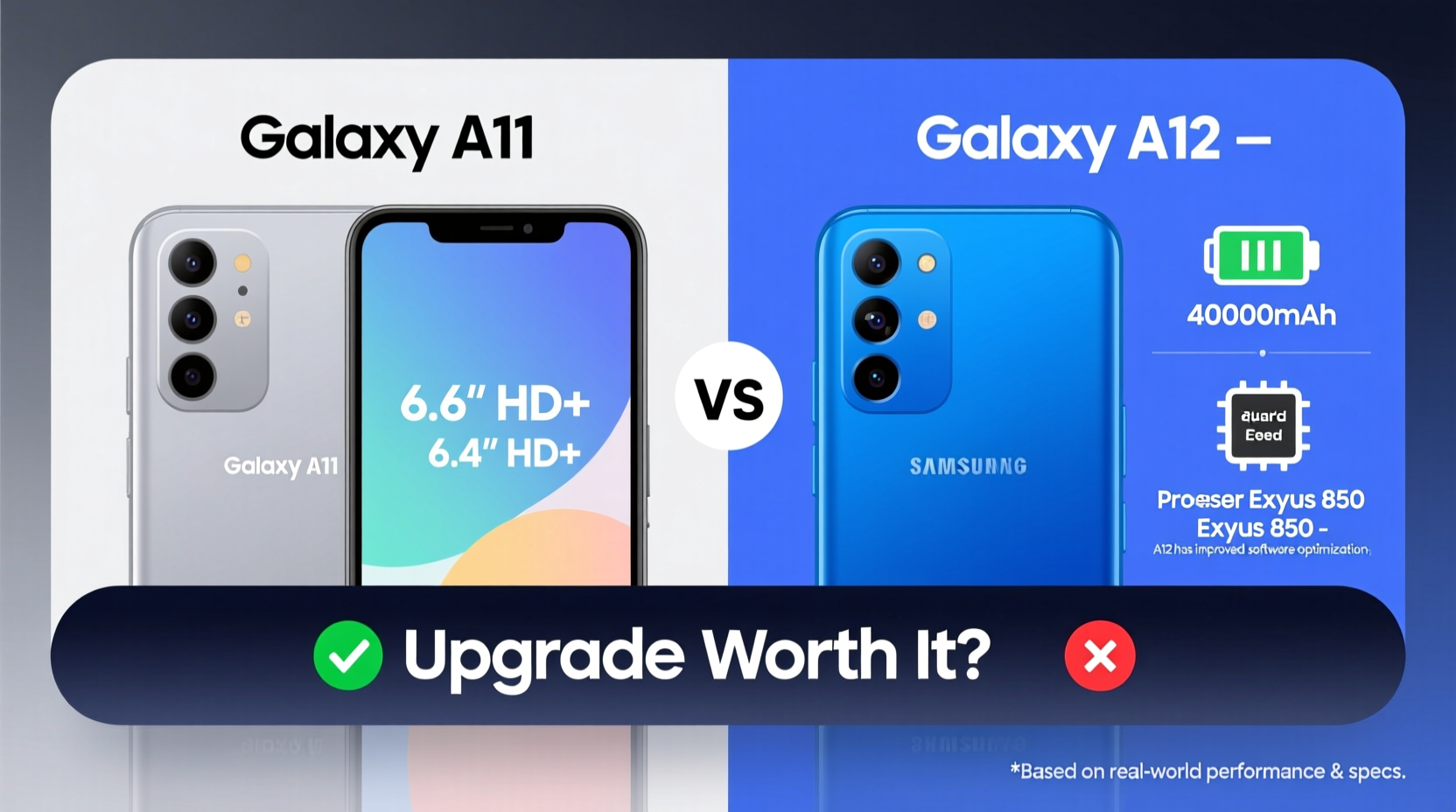
One of the most advertised upgrades from the A11 to the A12 is the increase in battery capacity—from 5,000mAh to 6,000mAh. On paper, that’s a 20% boost. In practice, the difference is more nuanced.
The A12’s larger battery does extend screen-on time by about 1.5 to 2 hours under typical usage, such as social media browsing, messaging, and video streaming. However, the A11 already offered excellent endurance, routinely lasting two full days on a single charge for light users. The A12 pushes that to two and a half days under similar conditions.
What's often overlooked is efficiency. The A12 runs on a slightly more power-efficient MediaTek processor compared to the A11’s older Exynos 850. This means less heat generation and slower drain during background tasks. Still, neither phone supports fast charging, capping at 15W, so refueling takes nearly three hours regardless of model.
Performance: Incremental Gains, Not Leaps
Under the hood, the shift from the Exynos 850 (A11) to the MediaTek Helio P35 (A12) brings modest gains. Benchmarks show a 10–15% improvement in CPU performance and slightly better GPU handling for casual gaming.
In daily use, both devices run Android Go Edition (originally shipped with Android 10), optimized for entry-level hardware. Apps like WhatsApp, YouTube, and Chrome open quickly on both, though the A12 handles multitasking with slightly less lag when switching between four or more apps.
Gaming remains limited. Titles like *PUBG Mobile* or *Genshin Impact* struggle on low settings due to thermal throttling and RAM constraints (both have 3GB). The A12 holds frame rates slightly longer before stuttering, but the experience is still far from smooth.
“Budget phones rarely deliver true performance upgrades—they optimize within tight limits. The A12 squeezes out marginal gains, but don’t expect flagship-like responsiveness.” — David Lin, Mobile Hardware Analyst at TechEdge Weekly
Camera Comparison: More Lenses, Same Quality?
Samsung markets the A12 as having an “upgraded quad-camera system,” but specifications can be misleading. Here’s a side-by-side breakdown:
| Feature | Samsung A11 | Samsung A12 |
|---|---|---|
| Main Camera | 13 MP, f/1.8 | 48 MP, f/2.0 |
| Ultra-Wide | Not available | 5 MP, f/2.2 |
| Macro | 2 MP, f/2.4 | 2 MP, f/2.4 |
| Depth Sensor | 2 MP, f/2.4 | 2 MP, f/2.4 |
| Front Camera | 5 MP, f/2.0 | 8 MP, f/2.0 |
The headline-grabbing 48MP sensor on the A12 sounds impressive, but it uses pixel-binning to output 12MP photos. In real-world lighting, image quality is comparable to the A11’s 13MP shooter. Low-light performance remains grainy, dynamic range is narrow, and autofocus is slow.
The addition of an ultra-wide lens adds versatility for landscape shots or group selfies, but the lens suffers from distortion and soft edges. It’s functional, not fantastic.
The front camera upgrade to 8MP results in sharper selfies and slightly better skin tone rendering, noticeable only when viewed on larger screens.
Display and Build: Familiar Feel, Slight Refinement
Both phones feature 6.5-inch PLS LCD displays with HD+ resolution (720 x 1600). The screen experience is nearly identical: decent brightness outdoors, limited color accuracy, and noticeable pixelation when viewed up close.
The A12 introduces a small but welcome change: a water-repellent coating on the display, reducing smudges and improving usability in humid conditions. The back panel remains glossy plastic on both models, prone to fingerprints and scratches.
Ergonomically, the A12 is slightly heavier (205g vs. 177g) due to the larger battery. Some users report it feels less balanced in one hand. The placement of the rear fingerprint sensor (introduced on the A12) is more convenient than the A11’s side-mounted power button solution, offering faster unlock times and better reliability.
Software and Long-Term Value
Both devices launched with Android 10 and Samsung’s One UI Core overlay. The A12 received an official update to Android 12, while the A11 was capped at Android 11. This gives the A12 a slight edge in security patch longevity and access to newer features like improved privacy controls and dark mode enhancements.
Samsung promises two years of major OS updates and three years of security patches for the A12—meaning it may receive its final security update in 2023. The A11 stopped receiving patches in 2022, making it potentially vulnerable to unpatched exploits today.
If long-term usability and app compatibility matter to you—especially as developers optimize for newer Android versions—the A12 offers a safer investment.
Mini Case Study: Maria’s Upgrade Dilemma
Maria has used her Galaxy A11 since 2020. It still powers on fine, but she’s frustrated by slow app launches, frequent crashes in WhatsApp, and poor photo quality when sharing moments with family. After seeing ads for the A12, she considered upgrading.
She visited a local store and tested both devices side by side. The A12 felt snappier, especially in the camera app, and the ultra-wide lens let her capture more of her daughter’s birthday party. Battery life was noticeably better after a full day of use.
Still, she hesitated. Her A11 worked well enough. Was the $120 price difference justified?
After consulting online reviews and comparing specs, she decided to wait. Instead, she cleared cached data, uninstalled unused apps, and replaced the battery ($20 repair). Her A11 now performs acceptably again—proving that sometimes maintenance beats replacement.
Checklist: Should You Upgrade?
Use this checklist to determine if moving from the A11 to the A12 makes sense for your needs:
- ✅ Is your A11 experiencing frequent crashes or slowdowns?
- ✅ Do you need longer battery life beyond two days?
- ✅ Are you missing an ultra-wide camera for travel or group shots?
- ✅ Do you want access to newer Android features and security updates?
- ✅ Can you get the A12 at a discounted price (used/refurbished)?
- ❌ Are you satisfied with current performance and photo quality?
- ❌ Is the upgrade cost over $100 without trade-in?
If most checked items are positives, upgrading could enhance your experience. If negatives dominate, hold off—your A11 likely has more life left.
Frequently Asked Questions
Is the Samsung A12 waterproof?
No, neither the A12 nor A11 has an official IP rating for water or dust resistance. While the A12 has a splash-resistant coating on the screen, it should not be submerged or exposed to heavy rain.
Can the A12 run Netflix in HD?
No. Due to Google’s Widevine L3 DRM certification on this device tier, video playback on Netflix, Prime Video, and Disney+ is limited to standard definition (SD), even on larger screens.
Does the A12 support expandable storage?
Yes, both phones support microSD cards up to 512GB via a dedicated slot, allowing you to expand storage without sacrificing dual SIM functionality.
Conclusion: Upgrade or Skip?
The Samsung Galaxy A12 improves upon the A11 in measurable ways—larger battery, better processor, extra camera lens, and longer software support. But these changes are evolutionary, not revolutionary. For users still happy with their A11, the upgrade isn’t urgent or essential.
However, if you’re buying used or replacing a failing A11, the A12 offers better future-proofing and a more consistent experience. At a price difference under $50, it’s a sensible step forward. Above that, you’re paying for marginal benefits wrapped in marketing language.




 浙公网安备
33010002000092号
浙公网安备
33010002000092号 浙B2-20120091-4
Comments
No comments yet. Why don't you start the discussion?