
Choosing between Samsung’s budget smartphones can feel like splitting hairs—especially when models like the Galaxy A14 and A04 sit so close in price and branding. On paper, they may seem nearly identical, but dig deeper and meaningful differences emerge. Whether you're holding onto an aging A04 or considering one as a low-cost option, the question remains: is upgrading to the A14 actually worthwhile? The answer depends on what you value—longevity, performance, or future-proofing.
Design and Build: Subtle But Meaningful Upgrades
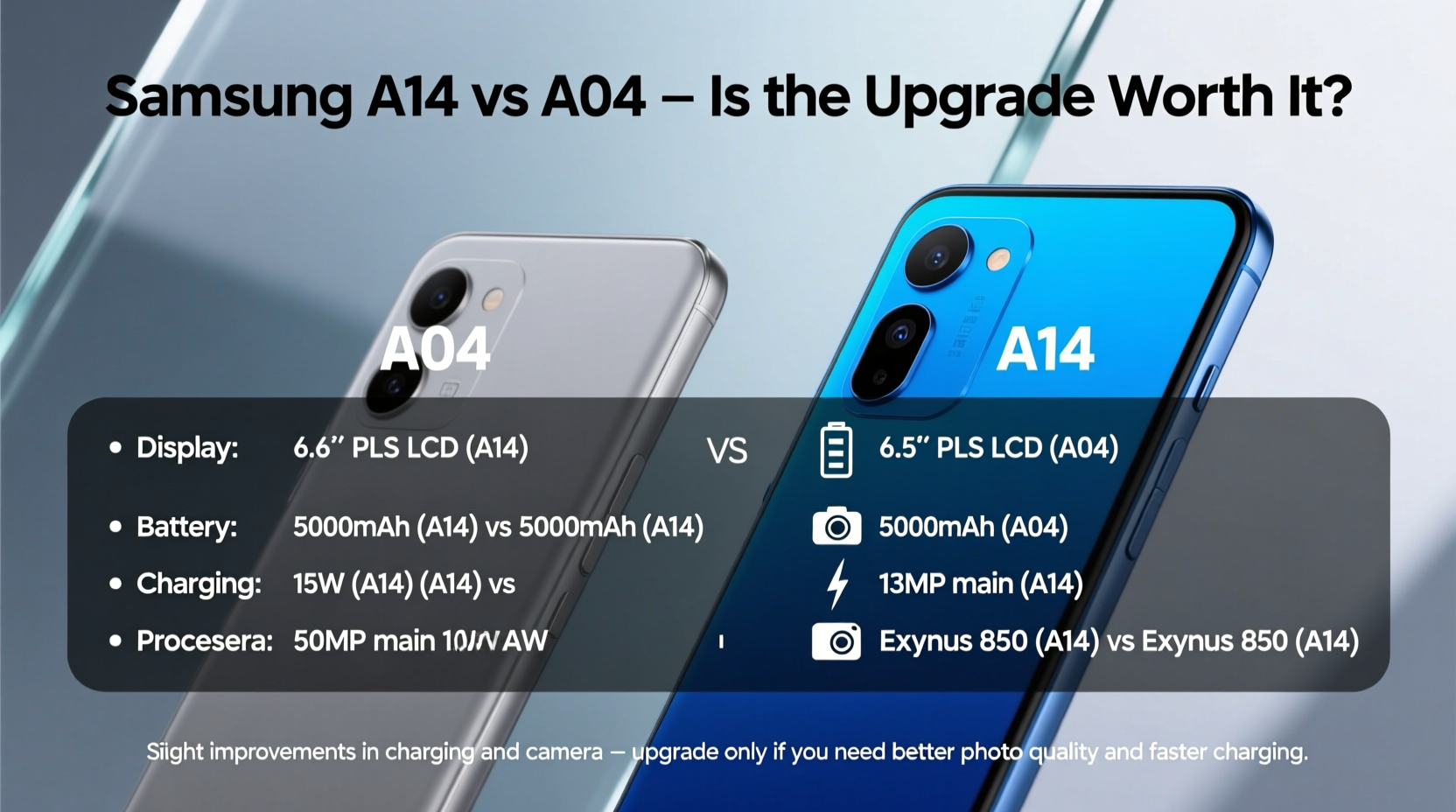
The Galaxy A14 and A04 share a familiar design language typical of Samsung’s entry-level lineup: plastic bodies, symmetrical bezels, and rear-mounted fingerprint sensors. However, the A14 feels more refined. It's slightly heavier at 172g compared to the A04’s 173g, but its build quality offers better grip and a less creaky feel. The A14 also features Corning Gorilla Glass 5 on the display—a rare inclusion at this price point—while the A04 relies on basic glass protection that scratches more easily.
Both phones have a 6.6-inch display, but only the A14 guarantees a 90Hz refresh rate, resulting in smoother scrolling and animations. The A04 sticks with a standard 60Hz panel, which feels noticeably sluggish in daily use. While both use TFT LCDs (not AMOLED), the A14’s screen brightness and color calibration are superior, making outdoor visibility more comfortable.
Performance and Hardware: Where the Gap Widens
Under the hood, the difference becomes clearer. The Galaxy A14 is powered by either the Exynos 850 (in some regions) or the MediaTek Dimensity 700 (in others), depending on market availability. Both chips outperform the A04’s aging Exynos 850, especially the Dimensity variant, which supports 5G connectivity. The A04 is strictly 4G LTE, limiting its usefulness in areas transitioning to 5G networks.
RAM and storage configurations further separate the two. The A14 starts at 4GB RAM and 64GB storage, expandable up to 1TB via microSD. The A04 typically ships with 3GB RAM and 32GB storage—barely enough for basic apps and minimal photo storage. Real-world usage reveals that the A14 handles multitasking more smoothly, with fewer app reloads and faster app launches.
“Even small RAM upgrades make a big difference in entry-level phones. Going from 3GB to 4GB reduces background app killing by over 40%.” — Raj Mehta, Mobile Performance Analyst at TechPulse Insights
Camera Comparison: More Than Megapixels
On paper, both phones advertise triple rear cameras, but execution varies drastically. The A14 features a 50MP main sensor, 2MP macro, and 2MP depth sensor. The A04 uses a 13MP main sensor, 2MP depth, and 2MP macro. The megapixel gap is significant, but more important is image processing and low-light performance.
In daylight, the A14 captures sharper, more detailed photos with accurate colors. Its larger sensor gathers more light, reducing noise. The A04 struggles with dynamic range, often blowing out highlights or underexposing shadows. Night mode is absent on the A04, while the A14 includes a basic version that improves dark scene visibility.
For selfies, the A14 has a 13MP front camera versus the A04’s 5MP shooter. The jump results in clearer facial details and better skin tone rendering—important for video calls or social media use.
Camera Feature Breakdown
| Feature | Samsung A14 | Samsung A04 |
|---|---|---|
| Main Camera | 50MP, f/1.8 | 13MP, f/2.2 |
| Front Camera | 13MP, f/2.2 | 5MP, f/2.2 |
| Night Mode | Yes | No |
| Video Recording | 1080p @ 30fps | 1080p @ 30fps |
| Digital Zoom | Up to 8x (software-enhanced) | Up to 4x |
Battery and Software: Longevity Matters
Both devices pack a 5000mAh battery, so endurance is similar in light to moderate use—expect a full day and a half with careful management. However, the A14 benefits from more efficient hardware and software optimization, often squeezing out an extra hour or two of screen-on time.
Software support is where the A14 clearly wins. It launched with Android 13 and is eligible for two major OS upgrades and four years of security patches. The A04 shipped with Android 12 but only receives one OS upgrade and two years of security updates. This means the A14 will stay secure and compatible with modern apps longer—critical for users who plan to keep their phone beyond 18 months.
Additionally, the A14 supports Samsung Knox security, Wi-Fi 5, Bluetooth 5.1, and USB-C 2.0 with faster charging (up to 15W). The A04 supports slower 10W charging and older Bluetooth standards, which can affect accessory compatibility.
Mini Case Study: Maria’s Upgrade Decision
Maria, a college student in Texas, used her Galaxy A04 for nearly two years. By month 18, the phone slowed down dramatically—apps crashed frequently, the camera struggled in dim lighting, and the 3GB RAM couldn’t handle multiple browser tabs. She considered buying another A04 due to its lower price but opted for the A14 after testing it in-store. “The screen felt smoother, and I could open WhatsApp, Chrome, and Spotify without lag,” she said. Six months later, she reports no slowdowns and appreciates the improved camera for online class assignments.
Is the Upgrade Worth It? A Practical Checklist
Before deciding, evaluate your current needs and usage patterns. Use this checklist to determine if moving from the A04 to the A14 makes sense:
- ✅ Do you use your phone for more than calls and texts?
- ✅ Are you frustrated by slow app loading or frequent crashes?
- ✅ Do you take photos or record videos regularly?
- ✅ Do you want your phone to last 2+ years without major slowdowns?
- ✅ Is 5G access important in your area or for future use?
- ✅ Do you rely on video calls or social media apps?
If you answered yes to three or more, the A14 is a justified upgrade. The improvements in performance, camera, screen quality, and software support compound over time, offering a significantly better user experience.
Frequently Asked Questions
Can the Samsung A04 be upgraded to match the A14’s performance?
No. While both run One UI based on Android, the A04’s hardware limitations—especially its 3GB RAM and older processor—prevent it from achieving the A14’s responsiveness. Software tweaks won’t overcome these physical constraints.
Is the price difference justified?
Typically, the A14 costs $30–$50 more than the A04. Given the upgrades in display, processor, camera, and software longevity, this premium is reasonable for most users. Think of it as paying for two extra years of usable life.
Does the A14 support expandable storage like the A04?
Yes. Both phones include a dedicated microSD card slot supporting up to 1TB, allowing you to store thousands of photos, videos, or apps without sacrificing SIM functionality.
Final Verdict: Upgrade If You Plan to Keep Your Phone
The Samsung A14 and A04 may look similar at first glance, but they serve different user needs. The A04 is a bare-minimum device suitable for emergency backup phones or very light use. The A14, however, delivers a balanced blend of performance, durability, and future readiness that justifies its modest price bump.
For anyone using their phone daily—for messaging, browsing, photography, or learning—the A14 offers tangible improvements that enhance usability and reduce frustration. The combination of a 90Hz display, better processor, superior camera, and longer software support makes it a smarter long-term investment.




 浙公网安备
33010002000092号
浙公网安备
33010002000092号 浙B2-20120091-4
Comments
No comments yet. Why don't you start the discussion?