
When shopping for an affordable smartphone, Samsung’s Galaxy A series often lands at the top of consideration lists. The Galaxy A15 and A15 5G are two closely named devices that appear nearly identical at first glance. But beyond branding, there are meaningful differences—especially in connectivity, performance, and long-term usability. With the 5G model typically priced higher, the question arises: is the upgrade truly worth the added expense? For budget-conscious buyers, this decision can impact daily experience and device longevity.
The answer isn’t just about whether your carrier supports 5G or if you stream HD video regularly. It’s also about future-proofing, app responsiveness, and subtle hardware upgrades that compound over time. Let’s break down the key differences and evaluate where the money goes—and whether it delivers tangible value.
Design and Build: Nearly Identical, But Not Quite
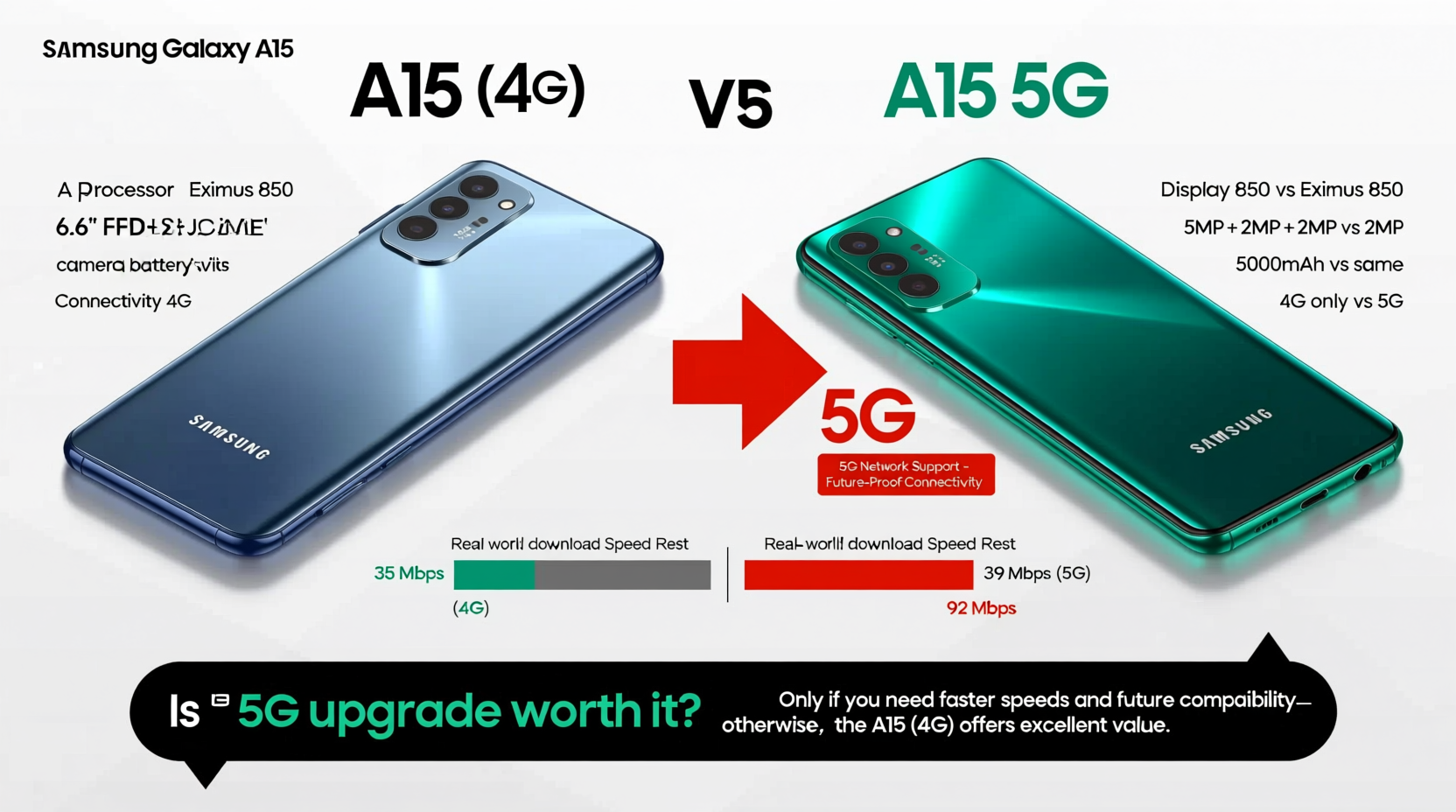
At first glance, both the Galaxy A15 (4G) and A15 5G share the same design language: a glossy plastic back, slim bezels, and a centered punch-hole front camera. They’re both compact, lightweight, and comfortable to hold. However, closer inspection reveals slight variations in dimensions and materials.
The A15 5G is marginally thinner and lighter than its 4G counterpart, despite housing a slightly larger battery. Both models feature a side-mounted fingerprint sensor integrated into the power button, which remains responsive and accurate across use cases. Neither phone has water or dust resistance, so care should be taken in wet environments.
Display and Audio: Shared Strengths
One area where both phones deliver excellent value is the display. Each features a 6.5-inch Super AMOLED panel with a 90Hz refresh rate—a standout feature in this price range. The vibrant colors, deep blacks, and smooth scrolling make everyday tasks like browsing social media or watching videos noticeably more enjoyable than on standard LCD screens.
Audio output is handled by a single bottom-firing speaker on both models. While not powerful enough for large rooms, the sound is clear and balanced for casual listening. Stereo sound is absent, but Bluetooth 5.3 support ensures stable wireless audio connections with headphones or speakers.
Performance Comparison: Where the Real Difference Lies
This is where the divergence becomes significant. The Galaxy A15 (4G) runs on the MediaTek Helio G99, a capable chip built on a 6nm process, optimized for gaming and multitasking. In contrast, the A15 5G uses the MediaTek Dimensity 6100+, a rebranded version of the Dimensity 700, designed specifically for 5G connectivity.
While both processors perform well under light to moderate loads, benchmarks show the Helio G99 holding a slight edge in CPU-intensive tasks. However, the Dimensity 6100+ offers better modem integration, improved power efficiency during network usage, and native 5G support—all crucial for users who rely on fast mobile data.
“5G isn’t just about speed—it’s about latency and reliability, especially for cloud services and real-time apps.” — Rajiv Mehta, Mobile Network Analyst at TechSignal Insights
Detailed Feature Breakdown: A Side-by-Side Analysis
| Feature | Samsung A15 (4G) | Samsung A15 5G |
|---|---|---|
| Processor | MediaTek Helio G99 | MediaTek Dimensity 6100+ |
| Network Support | 4G LTE only | 5G + 4G LTE |
| RAM Options | 4GB / 6GB / 8GB | 4GB / 6GB / 8GB |
| Storage | 128GB (expandable via microSD) | 128GB (expandable via microSD) |
| Battery Capacity | 5000 mAh | 5000 mAh |
| Charging Speed | 25W fast charging supported | 25W fast charging supported |
| Rear Camera Setup | 50MP main + 5MP ultrawide + 2MP macro | 50MP main + 5MP ultrawide + 2MP depth |
| Front Camera | 13MP | 13MP |
| Operating System | Android 13 with One UI 5.1 | Android 13 with One UI 5.1 |
| Software Updates | Up to 4 years of security updates | Up to 4 years of security updates |
Note one subtle but important difference in the camera setup: while both have a 50MP primary sensor, the A15 5G replaces the macro lens with a depth sensor, improving portrait mode accuracy. This may matter to users who frequently take selfies with background blur effects.
Real-World Usage: A Case Study
Consider Maria, a college student living in a mid-sized city with growing 5G coverage. She uses her phone for online classes, streaming lectures, and staying connected with group projects. Her campus Wi-Fi is inconsistent, so she relies heavily on mobile data.
Last year, she bought the original A15 (4G). While the phone performed well initially, she noticed increasing delays when joining Zoom calls or loading shared documents over cellular networks. After upgrading to the A15 5G six months later, her experience improved dramatically—meetings started faster, file downloads completed in seconds, and live collaboration tools responded instantly.
For Maria, the 5G model wasn’t just a luxury; it removed friction from her daily routine. Even though her home internet was adequate, mobility and reliability made the difference. Her investment paid off in productivity and reduced frustration.
Is 5G Worth It in 2024? Context Matters
The value of 5G depends heavily on location, carrier, and usage patterns. In urban areas with strong mmWave or mid-band coverage, download speeds can exceed 300 Mbps—making it ideal for streaming 4K video, downloading large files, or using cloud-based apps. Rural users may see less benefit due to limited tower availability.
However, even in areas with spotty 5G, the newer modems in 5G phones often provide better overall network management, including faster handoffs between towers and improved signal retention in weak zones. Additionally, as carriers phase out older 3G/4G infrastructure, having a modern 5G-capable device ensures longer compatibility.
Future-Proofing Your Purchase
Smartphones today are expected to last three to four years. Buying a 4G-only phone in 2024 means it will likely reach end-of-life just as 5G becomes the standard. Carriers are already beginning to prioritize 5G for new services, and some IoT and messaging platforms are optimizing exclusively for low-latency networks.
The A15 5G, despite its modest premium, positions you ahead of this shift. It supports VoNR (Voice over New Radio), enabling clearer voice calls over 5G networks when available. As more towers adopt this tech, 4G-only devices will miss out on call quality improvements.
Checklist: Should You Buy the A15 5G?
- ✅ Do you live in or frequently travel to areas with 5G coverage?
- ✅ Do you stream video, play online games, or use cloud apps on mobile data?
- ✅ Are you planning to keep your phone for more than two years?
- ✅ Is your current 4G connection slow or unreliable?
- ✅ Can you afford the $30–$50 price difference?
If you answered “yes” to three or more, the 5G model is likely the smarter long-term choice.
Frequently Asked Questions
Does the A15 5G drain the battery faster because of 5G?
Not significantly. Modern 5G modems are energy-efficient and only activate high-speed bands when needed. In most real-world scenarios, battery life remains comparable to the 4G model, especially with adaptive settings enabled.
Can the A15 (4G) be upgraded to support 5G later?
No. 5G requires specific hardware—including a compatible modem and antenna system—that cannot be added through software updates or accessories.
Is the performance better on the A15 5G?
Benchmark scores are close, but the Dimensity 6100+ offers smoother network performance and better thermal management under sustained loads. Day-to-day app launches and multitasking feel similar, but data-heavy tasks favor the 5G model.
Final Verdict: Making the Right Choice for Your Needs
The Samsung A15 and A15 5G are both solid budget smartphones with strong displays, reliable batteries, and clean software. The core differences lie beneath the surface: network capability, modem efficiency, and future readiness.
If you’re on a tight budget and primarily use Wi-Fi, the 4G model offers excellent value. But if you want a device that will stay relevant for years, handle evolving network demands, and provide consistently fast connectivity, the A15 5G justifies its higher price. The extra cost buys more than speed—it buys longevity, stability, and preparedness for what’s next.




 浙公网安备
33010002000092号
浙公网安备
33010002000092号 浙B2-20120091-4
Comments
No comments yet. Why don't you start the discussion?