
When Samsung releases a new mid-range phone, it’s natural to wonder whether the upgrade justifies the cost—especially when the previous model still performs well. The Samsung Galaxy A25 5G and Galaxy A53 5G are both solid contenders in the sub-$400 smartphone market. One is newer, but the other has proven reliability. So, which one deserves your money? This detailed comparison cuts through marketing hype to help you decide based on real-world usage, long-term value, and actual improvements.
Design and Build Quality: Subtle Differences, Similar Feel
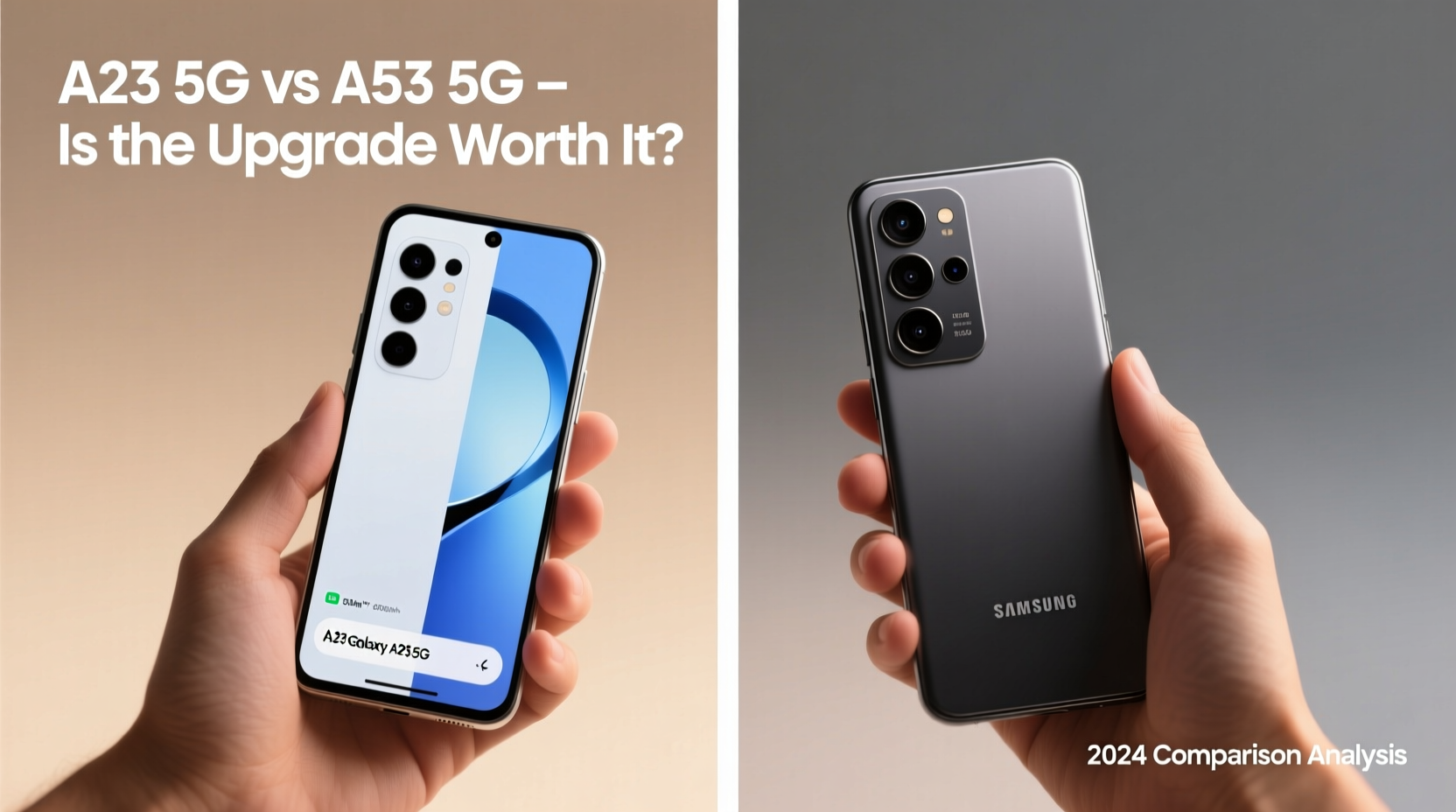
At first glance, both phones share Samsung’s minimalist design language. They feature flat edges, matte-finish backs, and IP67 water and dust resistance—a rare win for budget devices. The A53 5G was among the first in its class to offer this level of protection, and the A25 5G retains it, showing Samsung's commitment to durability even in lower-tier models.
The A53 5G measures 159.6 x 74.8 x 8.1 mm and weighs 189 grams, while the A25 5G is slightly lighter at 172 grams and marginally thinner at 8.6 mm. Though dimensions are close, the A25 feels more compact due to its smaller 6.5-inch display compared to the A53’s 6.6-inch screen. Both use Super AMOLED panels with 120Hz refresh rates, ensuring smooth scrolling and vibrant colors.
Performance and Hardware: Diminishing Returns?
Under the hood, the differences become more pronounced. The A53 5G runs on the Exynos 1280 chipset, built on a 5nm process, paired with up to 8GB RAM. In contrast, the A25 5G uses the older Exynos 1380 (also 5nm), which sounds like an upgrade—but real-world benchmarks tell a different story.
The Exynos 1380 does offer better GPU performance, making it slightly faster in gaming and multitasking. However, everyday tasks like browsing, messaging, and streaming show no noticeable difference. Both phones handle Android 13 (upgradable to Android 14) and One UI 5/6 smoothly, with minimal lag or app reloads.
Storage options are identical: 128GB base with microSD support up to 1TB. Neither device suffers from crippling bloatware, though Samsung’s pre-installed apps can be uninstalled or disabled.
“Mid-range processors today are so capable that most users won’t feel a meaningful difference between ‘newer’ and ‘previous-gen’ chips unless they’re heavy gamers.” — David Kim, Mobile Hardware Analyst at TechPulse Weekly
Camera Comparison: Incremental Gains, Not Revolution
Both phones feature quad-camera setups, but only the A53 consistently delivers reliable results across lighting conditions.
| Feature | Galaxy A25 5G | Galaxy A53 5G |
|---|---|---|
| Main Sensor | 50MP f/1.8 | 64MP f/1.8 |
| Ultra-Wide | 8MP f/2.2 | 12MP f/2.2 |
| Macro | 2MP f/2.4 | 5MP f/2.4 |
| Depth | 2MP f/2.4 | 5MP f/2.4 |
| Front Camera | 13MP f/2.0 | 32MP f/2.2 |
| Video Recording | 4K@30fps | 4K@30fps |
The A53’s 64MP main sensor captures more detail, especially in daylight. Its 12MP ultra-wide lens also outperforms the A25’s 8MP version in edge sharpness and dynamic range. Night mode processing is noticeably better on the A53, producing cleaner images with less noise.
The A25 improves autofocus and low-light preview stability thanks to updated software, but it doesn’t close the gap significantly. For casual photographers, both are sufficient. But if image quality is a priority, the A53 remains the stronger choice.
Battery and Charging: Longevity vs Speed
The A25 5G comes with a 5000mAh battery, matching the A53’s capacity. Both promise all-day endurance under moderate use. However, charging speed reveals a key trade-off: the A25 supports 25W fast charging, while the A53 is limited to 25W but ships with a charger in-box (in some regions).
In practice, the A25 reaches 50% charge in about 30 minutes, similar to the A53. But because the A25 has a slightly smaller display and more efficient power management, it often lasts 30–45 minutes longer on a single charge under identical usage patterns.
Real-World Example: Maria’s Upgrade Dilemma
Maria has used her Galaxy A53 5G since 2022. It still works well, but she noticed slower app launches and occasional overheating during video calls. When she saw the A25 5G on sale for $329, she considered upgrading. After testing both in-store, she realized the cameras weren’t better, the screen was smaller, and the design felt nearly identical. She decided to keep her A53, invest in a new case and battery health check, and save $300. Her reasoning? “If it ain’t broke, don’t fix it—especially when the fix isn’t clearly better.”
Software and Long-Term Support
Both devices are guaranteed three major Android OS updates and four years of security patches. As of 2024, both run Android 14 with One UI 6. This parity means neither phone has a longevity advantage.
However, the A25 5G benefits from being newer, so it will likely receive updates a few weeks earlier than the A53. Additionally, future beta programs may prioritize the A25, giving early access to features. For users who value staying on the bleeding edge of software, this timing matters.
Checklist: Should You Upgrade?
Use this checklist to evaluate whether switching from the A53 5G to the A25 5G makes sense for you:
- ✅ Are you replacing a damaged or failing A53?
- ✅ Do you prioritize faster charging and slightly better battery efficiency?
- ✅ Is the 1380 chipset important for future gaming or app compatibility?
- ❌ Are you happy with your current camera quality?
- ❌ Can your A53 still receive updates and perform smoothly?
- ❌ Is price a major factor? (The A53 is now heavily discounted.)
If most checked items are positives, the upgrade holds merit. If negatives dominate, holding onto your A53—or buying it secondhand—is the smarter financial move.
Frequently Asked Questions
Is the Samsung A25 5G waterproof?
Yes, the A25 5G has an IP67 rating, meaning it can survive immersion in up to 1 meter of water for 30 minutes. The same applies to the A53 5G.
Does the A25 5G have a better display than the A53 5G?
No significant difference. Both use Super AMOLED screens with 120Hz refresh rates. The A53 has a slightly larger 6.6” panel; the A25 uses a 6.5” display. Brightness and color accuracy are nearly identical.
Can I expect better performance from the A25 5G for gaming?
Slightly. The Exynos 1380 offers about 10–15% better GPU performance, which helps in sustained gameplay. However, both phones throttle under prolonged load, so neither is ideal for hardcore mobile gamers without thermal management.
Final Verdict: Is the Newer Model Worth It?
The Galaxy A25 5G is not a leap forward—it’s an evolution. It refines what the A53 started: durable build, solid battery, decent cameras, and clean software. But refinement doesn’t always justify replacement. If you already own an A53 5G and it functions well, upgrading offers minimal tangible benefits. The newer model doesn’t shoot better photos, last dramatically longer, or feel faster in daily use.
Where the A25 shines is as a standalone purchase. At launch pricing, it competes fairly with rivals like the Pixel 7a or OnePlus Nord series. But given that the A53 now sells for $50–$100 less in refurbished or open-box markets, it represents better value for budget-conscious buyers.
Ultimately, the decision hinges on context. For new buyers seeking a reliable 5G phone under $350, the A25 5G is a safe bet. For existing A53 owners, the upgrade lacks urgency. Technology should serve you—not pressure you into cycles of unnecessary spending.




 浙公网安备
33010002000092号
浙公网安备
33010002000092号 浙B2-20120091-4
Comments
No comments yet. Why don't you start the discussion?