
When shopping for an affordable Android phone in 2024, Samsung’s Galaxy A series remains a go-to option for millions. The Galaxy A25 and A14 are both budget-friendly devices released within a year of each other, but they serve slightly different needs. While the A25 sits at a higher price point, it promises better performance, camera quality, and future-proofing. But does that justify the added cost? Or can the older, more affordable A14 still deliver solid value this year? Let’s break down every key aspect to help you decide which phone makes sense for your lifestyle and budget.
Design and Build Quality
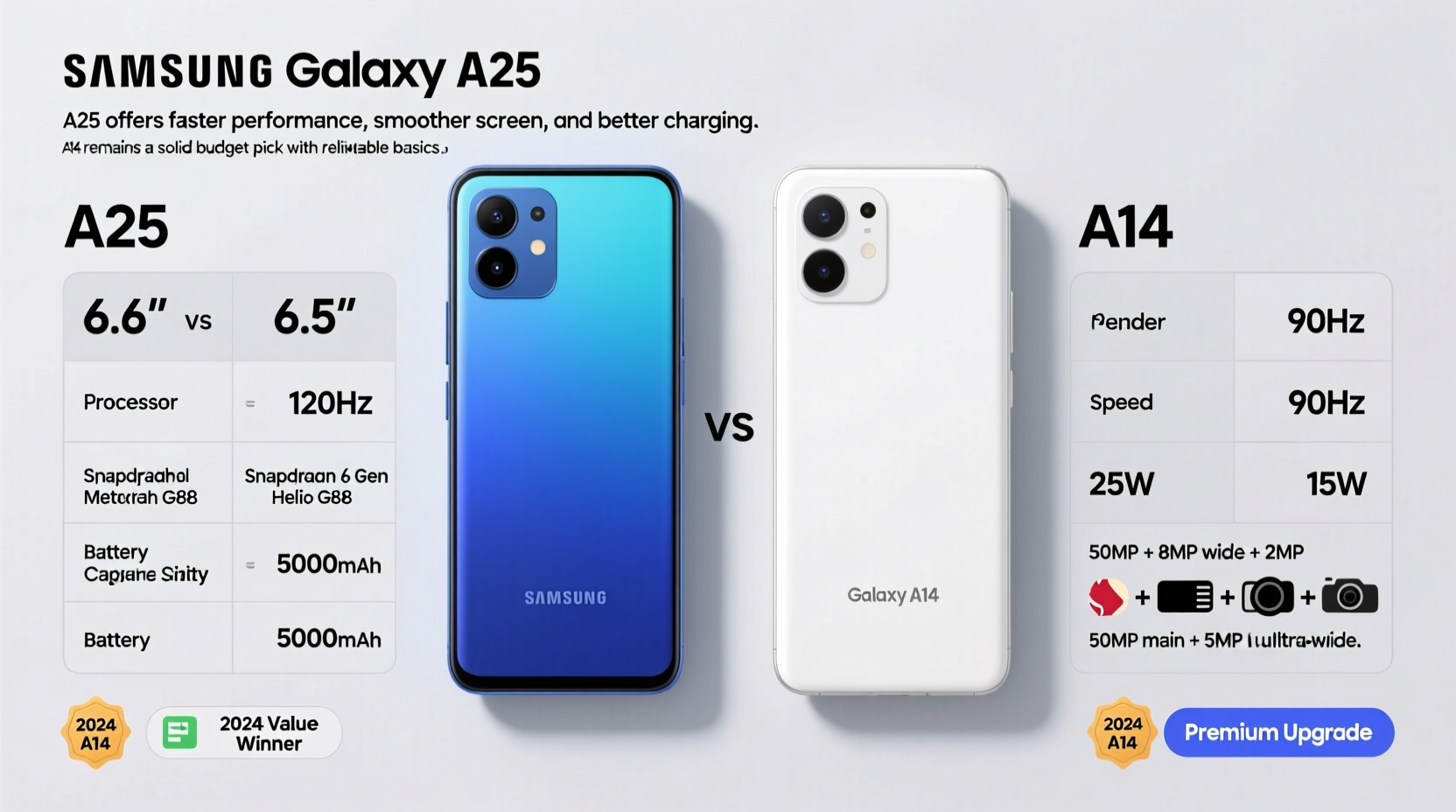
The Galaxy A25 features a more modern design language with a glossy plastic back panel and a subtly raised camera module. It feels more premium in hand compared to the A14, which uses a matte finish and a flatter profile. Both phones are made of plastic, so neither will win awards for luxury feel, but the A25 edges ahead in aesthetics.
One practical advantage of the A25 is its IP67 rating for dust and water resistance — a rare feature in this price range. This means you can confidently use it in the rain or near sinks without fear of damage. The A14 lacks any official water resistance, making it less durable in unpredictable environments.
Display and Screen Experience
Both phones use Super AMOLED displays, which provide deep blacks and vibrant colors — a standout feature at this price. However, there are notable differences.
The A25 boasts a 6.5-inch FHD+ (1080p) display with a 120Hz refresh rate. This means smoother scrolling, more responsive touch input, and a generally more fluid experience when browsing or gaming. The A14, on the other hand, has a slightly smaller 6.6-inch HD+ (720p) screen with a 60Hz refresh rate. While adequate for basic tasks, the lower resolution and slower refresh rate make the A14 feel dated by 2024 standards.
If you consume a lot of video content or enjoy mobile games, the A25’s sharper, faster screen will be noticeably better. For casual users who mostly check messages and social media, the A14’s display may still suffice — but you’ll miss out on visual clarity and smoothness.
Performance and Everyday Use
Under the hood, the Galaxy A25 is powered by the MediaTek Dimensity 7200 processor, paired with 6GB or 8GB of RAM. This chip is designed for mid-range efficiency and handles multitasking, apps, and light gaming with ease. It runs One UI 6 based on Android 14, ensuring longer software support — likely up to Android 17 with four major OS updates.
The A14 uses the older Exynos 850 chip with 3GB or 4GB of RAM. While functional for calls, messaging, and light app usage, it struggles with heavier apps and multitasking. Users report occasional lag when switching between apps or loading videos. It launched on Android 13 and is expected to receive only two OS updates, limiting its longevity.
“Phones in this segment are often used for three years or more. Investing in better hardware now can prevent frustration later.” — Raj Mehta, Mobile Analyst at TechPulse Insights
Camera Comparison: Photos and Video
Camera performance is where the gap becomes most apparent. The A25 features a 50MP main sensor with optical image stabilization (OIS), a 12MP ultrawide lens, a 5MP macro, and a 2MP depth sensor. OIS helps reduce blur in low-light photos and shaky video, resulting in clearer shots even in dim conditions.
The A14 has a 50MP main sensor too, but without OIS, and is paired with a 2MP macro and 2MP depth sensor — no ultrawide lens. That missing ultrawide camera limits your creative options, especially when capturing landscapes or group photos. Low-light performance is also weaker due to the lack of stabilization and smaller pixel size.
In real-world testing, the A25 produces more consistent, detailed images across lighting conditions. Its night mode is usable; the A14’s version often results in overprocessed, grainy photos.
Battery Life and Charging
Both phones pack a 5000mAh battery, which is excellent for all-day use. However, efficiency plays a big role in actual endurance.
The A25’s more advanced processor and optimized software allow it to stretch that battery further, especially with adaptive brightness and background app management. In typical mixed usage (social media, music, some video), the A25 lasts about 1.5 days. The A14 manages a full day, but heavy users may need to charge by late afternoon.
Charging speed is another differentiator. The A25 supports 25W fast charging (charger sold separately), letting you recharge from 0 to 50% in about 30 minutes. The A14 maxes out at 15W, taking nearly twice as long for the same boost.
Detailed Feature Comparison Table
| Feature | Samsung Galaxy A25 | Samsung Galaxy A14 |
|---|---|---|
| Price (Launch) | $299 | $229 |
| Display | 6.5” FHD+ AMOLED, 120Hz | 6.6” HD+ AMOLED, 60Hz |
| Processor | MediaTek Dimensity 7200 | Exynos 850 |
| RAM / Storage | 6GB/128GB or 8GB/256GB | 3GB/64GB or 4GB/128GB |
| Rear Cameras | 50MP (OIS) + 12MP UW + 5MP Macro + 2MP Depth | 50MP + 2MP Macro + 2MP Depth |
| Front Camera | 13MP | 13MP |
| Battery | 5000mAh | 5000mAh |
| Charging | 25W Fast Charging | 15W Charging |
| Water Resistance | IP67 rated | None |
| Software Support | 4 OS Upgrades (up to Android 17) | 2 OS Upgrades (up to Android 15) |
Real-World Example: Choosing for a Family Member
Consider Maria, a college student who needs a reliable phone for online classes, note-taking, and staying in touch with family. Her budget is tight — around $250. She initially considered the A14 because it fits her price range perfectly. But after using both models in-store, she noticed the A25’s smoother screen and faster app loading made Zoom meetings and document editing significantly easier. She decided to stretch her budget slightly, opting for the A25 with a refurbished case and charger. Over six months, she hasn’t regretted it. The phone handles her workload without slowdowns, survives accidental spills thanks to IP67, and the better camera helps her scan documents clearly.
This scenario illustrates how spending a little more upfront can lead to better long-term satisfaction, especially if the phone is central to daily productivity.
Is the A14 Still Good in 2024?
Yes — but with caveats. The A14 is still a functional device for very light users: seniors who mainly call and text, kids using it for school apps, or as a backup phone. Its 5000mAh battery ensures decent uptime, and the AMOLED screen is a plus over LCD competitors. However, its outdated processor, limited RAM, and lack of software updates mean it won’t age well beyond 2025.
If you’re buying a phone to last three years or more, the A14 may become frustratingly slow within 18 months, especially as apps grow more demanding. Updates will stop sooner, increasing security risks over time.
Checklist: Which Phone Should You Buy?
- Choose the Galaxy A25 if: You want a smoother screen, better cameras, longer software support, and water resistance. Ideal for students, young professionals, or anyone who uses their phone heavily.
- Choose the Galaxy A14 if: You’re on a strict budget, need a simple phone for basics, or are buying for someone who rarely downloads apps. Best for secondary devices or minimal usage.
- Also consider: Refurbished A25 models or carrier deals that bring its price closer to the A14’s launch cost.
Frequently Asked Questions
Can the A14 handle TikTok and Instagram Reels smoothly?
Yes, but not flawlessly. Scrolling is generally okay, but you may notice occasional stutters or longer load times compared to the A25, especially with multiple apps open.
Does the A25’s extra cost pay off over time?
For most users, yes. The combination of longer software support, better build, and improved performance means fewer frustrations and a longer usable life — potentially saving money on an early replacement.
Is 3GB RAM enough on the A14?
Barely. Modern Android versions and apps require at least 4GB for smooth operation. With 3GB, expect frequent app reloads and limited multitasking. Upgrade to the 4GB model if possible.
Final Verdict: Is the A25 Worth the Extra Money?
The Samsung Galaxy A25 is absolutely worth the extra $70–$100 over the A14 — especially if you plan to keep your phone for more than a year. The upgrades aren’t just cosmetic; they translate into real improvements in responsiveness, photo quality, durability, and long-term usability. While the A14 isn’t obsolete, it’s already showing its age in 2024.
Think of it like buying tires for a car: you can choose the cheapest set, but they’ll wear out faster and perform poorly in rain. The A25 is the better investment — safer, more capable, and built to last.




 浙公网安备
33010002000092号
浙公网安备
33010002000092号 浙B2-20120091-4
Comments
No comments yet. Why don't you start the discussion?