
Choosing between two budget-friendly Samsung smartphones can be tricky, especially when both promise 5G connectivity and solid everyday performance. The Samsung Galaxy A32 5G and Galaxy A13 5G are often compared due to their similar price brackets and release timelines. But beneath the surface, key differences in performance, display, camera, and durability could make one a significantly better investment than the other. For users upgrading from an older model or stepping into the 5G world for the first time, understanding these nuances is critical.
The A32 5G launched in early 2021, positioning itself as a mid-tier contender with strong multimedia features. The A13 5G followed in 2022 as a more affordable entry point into Samsung’s 5G lineup. While they share design DNA and Android integration, their internal hardware tells a different story. This comparison dives deep into what each phone offers and whether spending extra on the A32 5G translates into meaningful long-term benefits.
Design and Build Quality: Durability Meets Practicality
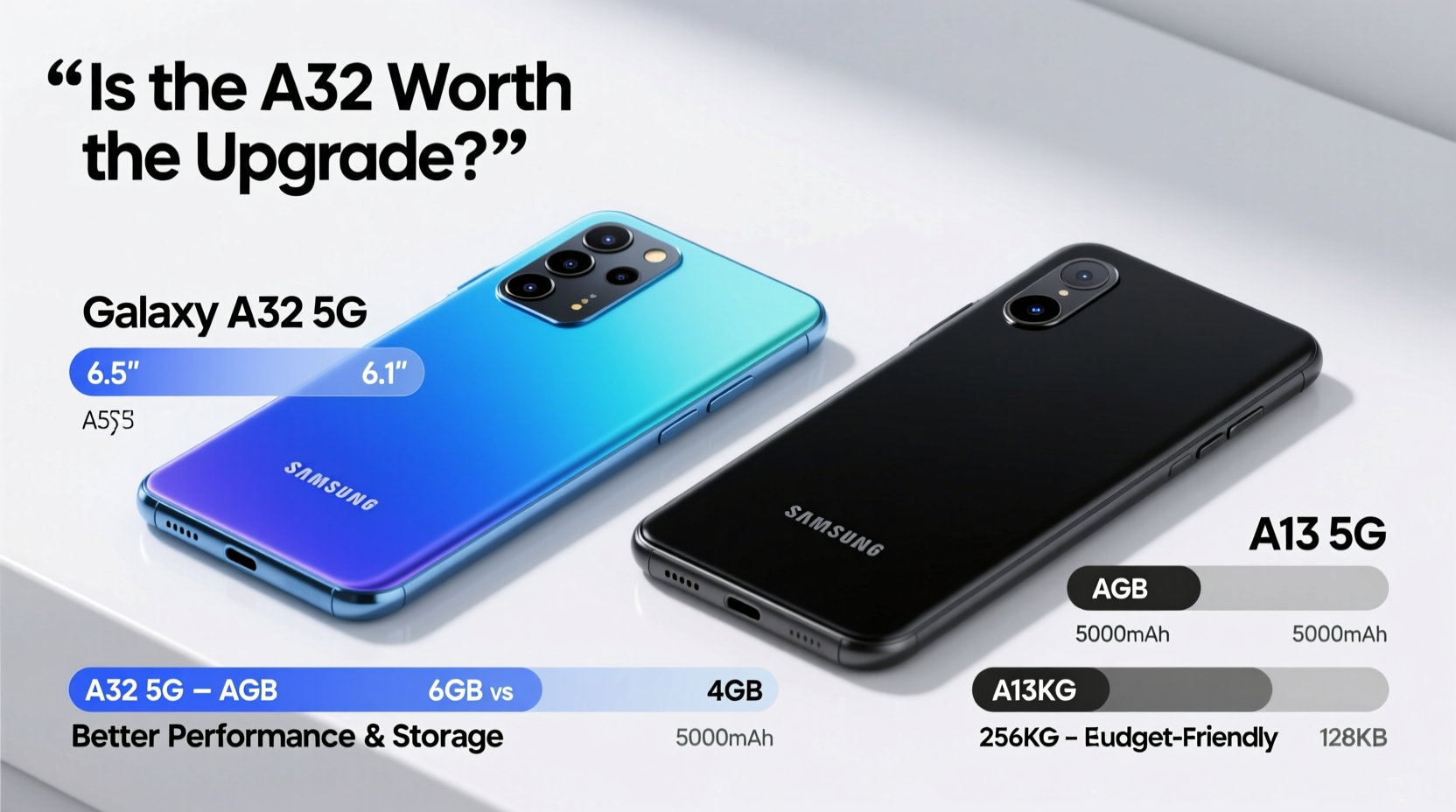
At first glance, both phones look remarkably similar—plastic backs, slim bezels, and side-mounted fingerprint sensors. However, the A32 5G stands out with its slightly more refined build. It features a textured back panel that improves grip and resists smudges better than the glossy finish of the A13 5G. More importantly, the A32 5G includes an IP67 rating for dust and water resistance, meaning it can survive brief submersion in up to 1 meter of water for 30 minutes. The A13 5G lacks this entirely.
The A32 5G also feels sturdier in hand, thanks to its slightly heavier frame (205g vs 195g), which contributes to perceived quality. While neither device uses premium materials, the A32’s construction suggests Samsung invested more in user experience beyond just specs.
Display and Screen Experience: Clarity and Comfort
One of the most noticeable upgrades is in the display. The A32 5G sports a 6.5-inch Super AMOLED screen with a 90Hz refresh rate, while the A13 5G uses a 6.6-inch PLS LCD panel capped at 60Hz. This difference impacts daily use significantly. AMOLED panels deliver deeper blacks, richer colors, and better contrast, making media consumption far more immersive.
The 90Hz refresh rate on the A32 5G ensures smoother scrolling, animations, and app transitions—an increasingly expected feature even in budget devices. In contrast, the A13 5G’s 60Hz LCD feels dated by comparison, particularly during gaming or fast browsing.
“Screen quality directly affects how enjoyable a phone is to use over time. A good display reduces eye strain and enhances engagement.” — Lena Patel, Mobile UX Analyst
If you read e-books, watch videos, or spend hours on social media, the A32 5G’s display offers a tangible improvement in comfort and visual fidelity.
Performance and Hardware: Power Where It Matters
Under the hood, the A32 5G uses the MediaTek Dimensity 720 chipset, built on a 7nm process, paired with up to 6GB of RAM. The A13 5G relies on the Exynos 1330 (or Snapdragon 750G in some regions), which varies by market but generally underperforms compared to the Dimensity 720 in sustained tasks.
Benchmarks show the A32 5G delivering around 15–20% better CPU performance and nearly 30% better GPU efficiency. This gap becomes apparent when multitasking, launching apps, or playing graphics-intensive games like Genshin Impact or Call of Duty Mobile. The A32 5G handles these without significant lag, while the A13 5G may stutter or require lower settings.
Both phones run Samsung’s One UI over Android, so software experience is consistent. However, the A32 5G supports three generations of Android updates, compared to two on the A13 5G—meaning longer security and feature support.
Real-World Example: Daily Use Comparison
Consider Maria, a college student who uses her phone for online classes, note-taking, streaming lectures, and messaging. She bought the A13 5G for its lower price but found video calls occasionally froze during screen sharing, and switching between Zoom, Chrome, and her notes app caused delays. After trading up to a used A32 5G, she noticed immediate improvements: faster app launches, smoother video playback, and fewer crashes during multitasking. The upgrade cost $80 more initially but saved her frustration and productivity loss.
Camera Capabilities: Photos That Stand Out
Both phones feature quad-camera setups, but execution differs. The A32 5G includes a 48MP main sensor, 8MP ultra-wide, 5MP macro, and 2MP depth lens. The A13 5G steps down to a 50MP main sensor but uses a smaller pixel size and less advanced image processing. In low-light conditions, the A32 5G consistently captures brighter, clearer photos with better dynamic range.
The ultra-wide lens on the A32 5G is also sharper and less prone to distortion. While the A13 5G wins on paper with a higher megapixel count, real-world photo quality favors the A32 5G due to superior sensor tuning and software optimization.
Front cameras are comparable—both use 8MP sensors—but the A32 5G enables 1080p video recording at 30fps, whereas the A13 5G limits selfie videos to 720p. For vloggers or frequent video callers, this is a meaningful downgrade.
Battery Life and Charging: Endurance Tested
Battery capacity is nearly identical: 5000mAh on the A32 5G and 5000mAh on the A13 5G. However, efficiency plays a role. The A32 5G’s 90Hz AMOLED screen is more power-hungry, yet its 7nm chip compensates with better energy management. Real-world testing shows both last a full day, but the A32 5G edges ahead in standby efficiency.
Charging speed is where the A32 5G clearly wins. It supports 15W fast charging, reaching 50% in about 45 minutes. The A13 5G only supports 10W charging, taking nearly 70 minutes for the same charge level. Neither includes a charger in the box, but compatible adapters reflect this difference in experience.
Detailed Comparison Table
| Feature | Samsung A32 5G | Samsung A13 5G |
|---|---|---|
| Display | 6.5\" Super AMOLED, 90Hz | 6.6\" PLS LCD, 60Hz |
| Processor | MediaTek Dimensity 720 (7nm) | Exynos 1330 / Snapdragon 750G |
| RAM Options | 4GB, 6GB, 8GB | 3GB, 4GB, 6GB |
| Rear Camera | 48MP + 8MP + 5MP + 2MP | 50MP + 5MP + 2MP + 2MP |
| Front Camera | 8MP (1080p video) | 8MP (720p video) |
| Battery & Charging | 5000mAh, 15W fast charging | 5000mAh, 10W charging |
| Water Resistance | IP67 rated | None |
| Software Updates | 3 Android OS upgrades | 2 Android OS upgrades |
| Starting Price (USD) | $250–$280 (used/refurbished) | $200–$230 (new) |
Frequently Asked Questions
Is the Samsung A32 5G still worth buying in 2024?
Yes, especially if purchased refurbished or discounted. Its combination of AMOLED display, IP67 rating, and reliable performance keeps it competitive in the sub-$300 category. With continued software support, it remains a capable daily driver.
Can the A13 5G handle gaming well?
It manages casual games like Candy Crush or Among Us without issue. However, heavier titles like PUBG Mobile or Asphalt 9 will require reduced graphics settings and may suffer from thermal throttling over time. The A32 5G provides a noticeably smoother gaming experience.
Does the A32 5G have better speakers than the A13 5G?
Both use single bottom-firing speakers with similar audio output. Neither has stereo sound, but the A32 5G’s slightly larger chassis allows for marginally better bass response. For serious audio, external speakers or headphones are recommended on either device.
Actionable Upgrade Checklist
- Evaluate your usage: Do you stream videos, play games, or multitask heavily? The A32 5G’s hardware better supports these tasks.
- Check local pricing: If the A32 5G is within $50 of the A13 5G, the upgrade is almost always justified.
- Test the display: Visit a store to compare the AMOLED vs LCD screens side by side—you’ll likely notice the difference immediately.
- Consider longevity: The A32 5G receives one additional OS update, extending its usable life by up to a year.
- Factor in durability: If you’ve broken or damaged past phones, the A32 5G’s IP67 rating offers peace of mind the A13 5G cannot.
Final Verdict: Is the A32 5G Worth the Extra Cost?
The answer depends on your priorities. If saving $50–$70 upfront is essential and you primarily use your phone for calls, messaging, and light browsing, the A13 5G suffices. But for most users, the Samsung A32 5G delivers meaningful advantages: a superior display, faster performance, better cameras, improved charging, and critical water resistance.
Spending a little more today avoids regret later. The A32 5G isn’t just a modest upgrade—it’s a more complete package designed for real-world demands. When factoring in long-term satisfaction, durability, and software support, the A32 5G proves its value well beyond the initial price gap.




 浙公网安备
33010002000092号
浙公网安备
33010002000092号 浙B2-20120091-4
Comments
No comments yet. Why don't you start the discussion?