
Choosing between Samsung’s mid-range smartphones can be tricky, especially when a newer model like the Galaxy A36 is rumored to launch soon. Meanwhile, the Galaxy A25 remains available and competitively priced. For users balancing budget, performance, and future-proofing, the decision isn’t just about specs—it’s about real-world value. This breakdown compares both devices across key categories, evaluates what’s changing in the upgrade, and helps you decide whether holding out for the A36 makes sense—or if the A25 still delivers where it counts.
Design and Build Quality
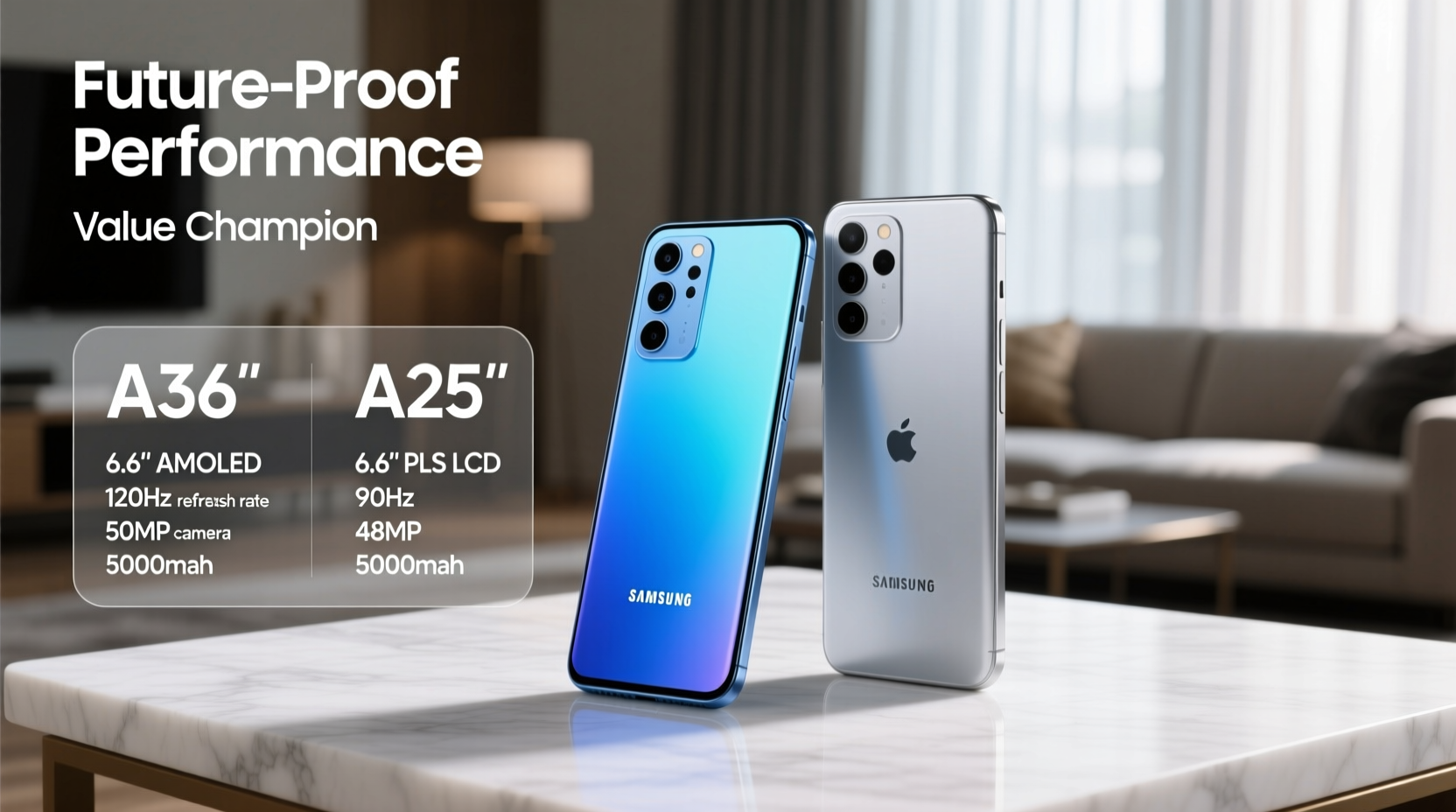
The Galaxy A25 features a sleek, minimalist design with a plastic back and frame, typical of its price range. It’s lightweight at 179g and has an IP67 rating for dust and water resistance—rare at this tier and a major plus for durability. The 6.5-inch Super AMOLED display offers vibrant colors and deep blacks, with a 90Hz refresh rate that improves scrolling smoothness over standard 60Hz panels.
Rumored leaks suggest the A36 will maintain a similar aesthetic but may adopt a slightly more premium feel with a matte-finish back and refined camera housing. While still using plastic construction, early renders indicate slimmer bezels and a centered punch-hole cutout, aligning more closely with flagship design language. The screen is expected to grow to 6.6 inches with a jump to a 120Hz refresh rate, which would make everyday interactions noticeably smoother.
Performance and Hardware Comparison
Under the hood, the A25 runs on the Exynos 1280 chip—a capable octa-core processor built on a 5nm process. Paired with 4GB or 6GB of RAM and up to 128GB storage, it handles daily tasks like social media, streaming, and light gaming without issue. However, demanding games or multitasking with multiple apps open can expose its limitations.
The A36 is expected to upgrade to the newer Exynos 1380 or possibly a Snapdragon alternative, depending on region. This SoC brings better CPU and GPU performance, improved power efficiency, and support for faster LPDDR5 RAM. Early benchmarks suggest a 25–30% improvement in processing speed, which translates to quicker app launches, smoother animations, and better thermal management during extended use.
“Mid-range phones today are expected to last at least three years. That means not just adequate performance now, but headroom for future updates.” — David Lin, Mobile Analyst at TechPulse Asia
Camera Capabilities: Real-World Results
Both models feature quad-camera setups, but differences emerge in sensor quality and software tuning. The A25 uses a 50MP main sensor (f/1.8), 5MP ultrawide, 2MP macro, and 2MP depth sensor. While the primary lens captures decent daylight shots, low-light performance is inconsistent, often producing grainy images with poor dynamic range.
The A36 is rumored to retain the same megapixel count but upgrade to a larger 1/1.56” sensor with pixel binning and OIS (Optical Image Stabilization)—a significant leap. This should result in sharper night shots, reduced blur from hand movement, and better video stabilization. The ultrawide lens may also see a bump to 8MP, improving detail retention at the edges.
In practical terms, if photography matters to you—especially capturing moments in dim lighting or recording stable videos—the A36 could offer meaningful improvements. Casual shooters who mainly use their phone for social media may find the A25 sufficient.
Detailed Feature Comparison
| Feature | Samsung Galaxy A25 | Samsung Galaxy A36 (Expected) |
|---|---|---|
| Display | 6.5\" FHD+ Super AMOLED, 90Hz | 6.6\" FHD+ Super AMOLED, 120Hz |
| Processor | Exynos 1280 (5nm) | Exynos 1380 / Snapdragon 7 Gen 1 |
| RAM & Storage | 4/6GB + 128GB (expandable) | 6/8GB + 128/256GB (expandable) |
| Rear Cameras | 50MP (main), 5MP UW, 2MP Macro, 2MP Depth | 50MP (OIS), 8MP UW, 2MP Macro, 2MP Depth |
| Front Camera | 13MP | 13MP with improved AI focus |
| Battery | 5000mAh, 25W charging | 5000mAh, 30W fast charging |
| OS & Updates | Android 13, 4 OS upgrades | Android 14, 4 OS upgrades |
| Water Resistance | IP67 | IP67 |
| Price (Launch) | $279 | Expected $329 |
Is the Upgrade Worth the Wait?
The core question isn’t just about technical gains—it’s about value per dollar. The A25 currently sells for around $279, offering strong battery life, a great display, and IP67 protection. For students, secondary phone users, or those on a tight budget, it remains an excellent choice.
The A36, projected at $329, asks for a $50 premium. In return, you’d get a faster processor, smoother 120Hz display, better cameras with OIS, and likely longer software support due to newer hardware. Over two to three years, these upgrades compound: faster app response, better photo quality, and less lag after system updates.
However, supply and timing matter. If the A36 launches in late Q3 or early Q4, waiting could mean going without a reliable phone for months. And if you need a device now—especially if buying used or refurbished—the A25 represents immediate savings and proven reliability.
Real-World Example: Maria’s Dilemma
Maria, a freelance photographer assistant, needed a durable, affordable phone for client coordination and quick photo reviews. Her old phone died unexpectedly, and she faced a choice: buy the A25 on sale for $249 or wait three months for the A36.
She opted for the A25. While she missed OIS and 120Hz, the Super AMOLED screen made reviewing photos accurate, and the IP67 rating saved her phone during a sudden downpour at an outdoor shoot. After six months, she reported no slowdowns and praised the battery life lasting full workdays. For her needs, the A25 wasn’t just “good enough”—it was practical, resilient, and cost-effective.
What You Should Do: A Decision Checklist
- Evaluate urgency: Do you need a phone immediately, or can you wait 2–3 months?
- Assess usage: Are you a heavy gamer or multitasker? The A36’s stronger chipset will serve you better long-term.
- Prioritize camera needs: If low-light or video quality is important, the A36’s OIS is a game-changer.
- Check local pricing: Regional variations can make one model significantly cheaper than anticipated.
- Consider resale value: Newer models typically depreciate slower and hold value better over 18–24 months.
Frequently Asked Questions
Will the Samsung A36 have better software support than the A25?
Both phones are expected to receive four Android OS upgrades and five years of security patches. However, because the A36 will launch with Android 14, it will remain supported until 2029—six months longer than the A25, which launched with Android 13.
Can the A25 handle gaming like PUBG or Genshin Impact?
Yes, but with caveats. The A25 runs these games at medium settings with occasional frame drops. For consistent high-performance gaming, the A36’s upgraded GPU and cooling are better suited.
Is the 120Hz display worth the extra cost?
If you notice motion smoothness—like when scrolling through feeds or playing fast-paced games—then yes. The difference is subtle but cumulative. Over time, a 120Hz screen feels more responsive and modern.
Final Verdict: Make the Choice That Fits Your Life
The Samsung Galaxy A25 is still a compelling device. It offers a premium display, solid build, and essential features at a budget-friendly price. If you need a phone now, don’t overlook it—especially if you find it discounted.
But if you can wait and plan to keep your phone for three years or more, the A36 promises tangible improvements: faster performance, better cameras, and a smoother display. The $50 difference buys meaningful upgrades that enhance daily usability and longevity.




 浙公网安备
33010002000092号
浙公网安备
33010002000092号 浙B2-20120091-4
Comments
No comments yet. Why don't you start the discussion?