
When Samsung releases new models in its A-series lineup, consumers often face a tough choice: stick with what works or upgrade for marginal improvements. The Samsung Galaxy A51 and Galaxy A32 represent two generations of mid-range smartphones that share similar design philosophies but differ in key areas. For users currently on the A51 wondering whether the A32 is worth switching to—or those choosing between them secondhand—understanding the real-world differences is essential. This breakdown goes beyond specs to assess actual user experience, longevity, and value.
Design and Build: Subtle Changes, Same Feel
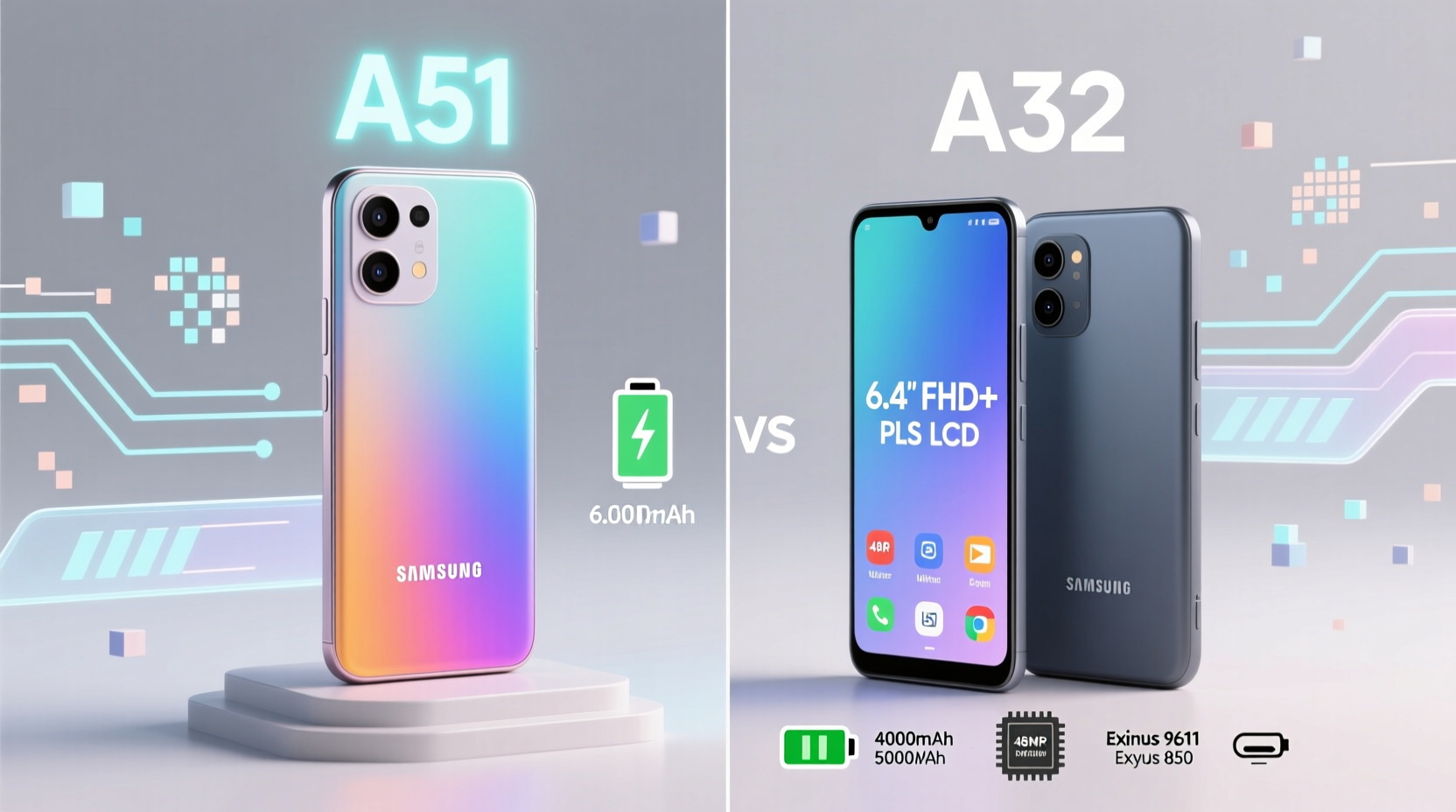
At first glance, both phones look nearly identical. They feature plastic backs, glossy finishes, and slim bezels with centered punch-hole front cameras. The A51 measures 158.5 x 73.6 x 7.9 mm and weighs 172g, while the A32 is slightly bulkier at 158.9 x 74.5 x 8.4 mm and 184g. That extra weight comes from a larger battery and a marginally thicker chassis.
The A32 improves grip with a textured matte finish on some variants, reducing fingerprint smudges compared to the A51’s slippery gloss. Both lack IP ratings for water resistance, so neither should survive accidental spills or rain exposure without caution.
Display Quality: Brighter and More Reliable
The A51 sports a 6.5-inch Super AMOLED display with a resolution of 1080x2400 pixels. It delivers deep blacks, vibrant colors, and excellent viewing angles—typical strengths of AMOLED technology. However, peak brightness caps around 420 nits, making outdoor visibility acceptable but not stellar.
The A32 upgrades to a 6.5-inch Super AMOLED display as well, but with a higher refresh rate option (up to 90Hz on some regional variants). While resolution remains Full HD+, the smoother scrolling and more responsive touch input make daily use feel significantly more fluid. Peak brightness also increases to about 500 nits, improving legibility under direct sunlight.
It's worth noting that not all A32 models support 90Hz; check your region’s specifications before purchasing. Still, even the base version benefits from better panel consistency and reduced blue light emission thanks to improved software calibration.
Performance Comparison: Chipset Matters
Under the hood, the differences become more pronounced. The A51 runs on Samsung’s Exynos 9611—a 10nm octa-core processor paired with Mali-G72 MP3 graphics. While capable for basic tasks like browsing, messaging, and social media, it struggles with heavier multitasking and modern mobile games.
In contrast, the A32 uses either the MediaTek Helio G70 (4G) or Dimensity 720 (5G), depending on the variant. The Helio G70 offers better GPU performance than the Exynos 9611, especially in sustained loads. Gamers will notice fewer frame drops in titles like PUBG Mobile or Call of Duty: Mobile at medium settings.
| Feature | Samsung A51 | Samsung A32 |
|---|---|---|
| Processor | Exynos 9611 | Helio G70 / Dimensity 720 |
| RAM Options | 4GB / 6GB / 8GB | 4GB / 6GB / 8GB |
| Storage | 64GB / 128GB (expandable) | 64GB / 128GB (expandable) |
| Battery | 4000 mAh | 5000 mAh |
| Charging Speed | 15W | 15W (4G), 25W (select markets) |
| Display Refresh Rate | 60Hz | 90Hz (on supported models) |
Real-world usage shows the A32 handles app launches faster and maintains stability over time. Users upgrading from the A51 report less lag when switching between apps and quicker response times in navigation-heavy applications like Google Maps.
“Mid-tier processors have evolved rapidly—the G70 may not be flagship-grade, but it outperforms older Exynos chips in efficiency and thermal management.” — David Lin, Mobile Hardware Analyst at TechPulse Asia
Battery Life and Charging: A Clear Winner
This is where the A32 pulls decisively ahead. With a 5000mAh battery versus the A51’s 4000mAh, the newer model lasts up to 30% longer on average use. Streaming video, GPS navigation, and moderate gaming can stretch across a full day and into a second without needing a recharge.
Both support 15W fast charging, though certain A32 variants (particularly in Europe and India) include 25W chargers in-box. Even at 15W, the larger capacity means longer intervals between charges—an underrated quality-of-life improvement.
Mini Case Study: Daily Commuter Usage
Consider Maria, a teacher using her phone for lesson planning, messaging parents, and streaming audiobooks during her commute. On the A51, she needed to charge midday by 3 PM after six hours of screen time. After switching to the A32, her same routine now ends the day at 8 PM with 20% battery remaining. No change in habits—just better endurance.
Camera Capabilities: Incremental Improvements
Both devices come with quad-camera setups, but execution varies. The A51 features a 48MP main sensor (f/2.0), 12MP ultrawide, 5MP macro, and 5MP depth lens. Image processing tends to oversharpen details and produce inconsistent white balance in mixed lighting.
The A32 upgrades to a 64MP main sensor (f/1.8), keeping the same secondary lenses. The wider aperture captures more light, resulting in cleaner low-light photos. Edge detection in portrait mode is more accurate, and autofocus responds faster thanks to improved ISP integration in the Helio chipset.
Front cameras are comparable: 32MP on both. Selfie quality remains strong indoors, though noise appears in darker environments. Video recording maxes out at 1080p@30fps on both models, lacking stabilization beyond digital cropping.
Software and Longevity: Future-Proofing Considerations
The A51 launched with Android 10 and received updates up to Android 12 with One UI 4.1. Support has ended, meaning no further security patches or OS upgrades. This increases vulnerability over time and limits compatibility with future apps.
The A32 shipped with Android 11 and qualifies for two major OS updates, reaching Android 13, and four years of security updates (until 2024 or 2025, depending on release date). This extended support window makes it a safer long-term investment, especially for users who keep phones beyond two years.
Checklist: Should You Upgrade?
- ✅ Need longer battery life? → A32 wins clearly
- ✅ Want smoother interface performance? → A32 with 90Hz helps
- ✅ Play mobile games regularly? → A32’s GPU is better suited
- ✅ Prioritize future software updates? → A32 has longer support
- ✅ Already satisfied with A51 for calls/texts? → Upgrade isn’t urgent
Frequently Asked Questions
Is the Samsung A32 faster than the A51?
Yes, particularly in multitasking and gaming. The MediaTek Helio G70 provides better CPU efficiency and superior GPU performance compared to the aging Exynos 9611.
Does the A32 have a better display than the A51?
Objectively, yes. While both use Super AMOLED panels, the A32 offers higher peak brightness and optional 90Hz refresh rate, which enhances smoothness during scrolling and animations.
Can I expect good resale value from either phone?
Currently, used A51 units sell for $70–$100 depending on condition. The A32 commands $100–$140 due to newer hardware and longer update cycle. However, prices are declining as newer A-series models enter the market.
Final Verdict: Worth Upgrading?
The Samsung A51 was a solid performer in its time, offering premium design and decent features at a competitive price. But three years later, its limitations in battery, performance, and software support show. The A32 isn’t revolutionary—it doesn’t introduce groundbreaking tech—but it refines the formula with meaningful upgrades.
If you're still using an A51 and experiencing slowdowns, short battery life, or app crashes, moving to the A32 will feel like a genuine step forward. The combination of longer endurance, sharper display, and continued software support justifies the upgrade for most users.
However, if your A51 still meets your needs—especially if you primarily use it for calls, messaging, and light browsing—the practical gains may not outweigh the cost. In that case, consider waiting for a more significant leap, such as the A54 or newer models with 5G, better cameras, and longer warranties.




 浙公网安备
33010002000092号
浙公网安备
33010002000092号 浙B2-20120091-4
Comments
No comments yet. Why don't you start the discussion?