
When it comes to choosing between the Samsung Galaxy A51 and the Galaxy Note 8, the decision isn’t as straightforward as assuming “newer equals better.” While the A51 was released in early 2020 and represents Samsung’s mid-range innovation at the time, the Note 8 debuted in 2017 as a flagship powerhouse. Today, both phones are available at budget-friendly prices on the secondhand or refurbished market. So which one offers better real-world value for users who don’t want to spend top dollar?
The answer depends on what you prioritize—cutting-edge software support and modern design, or raw performance, premium build, and that iconic S Pen functionality.
Design and Build Quality: Plastic vs Premium
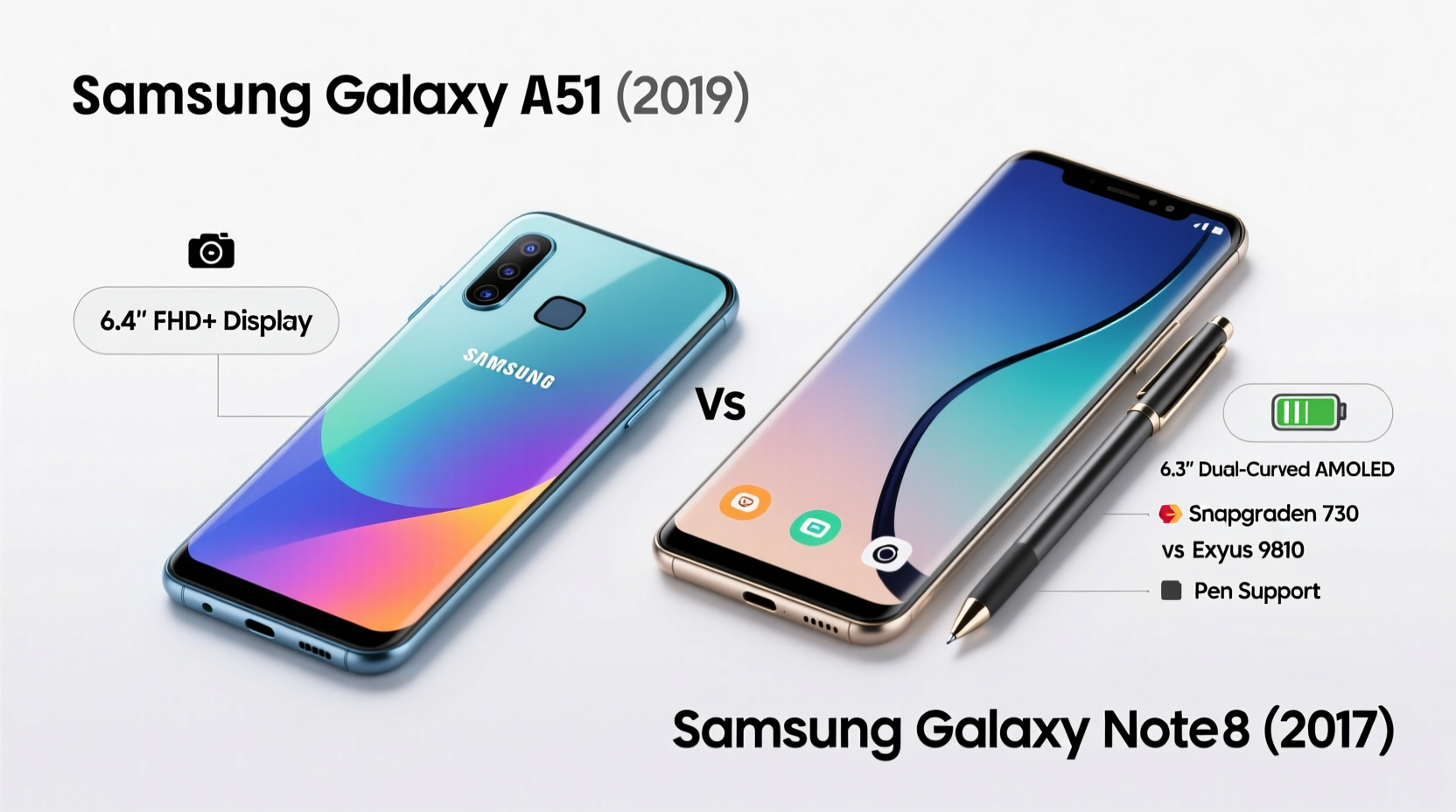
The Galaxy A51 features a sleek, minimalist design with a glass-like plastic back and slim bezels. It's lightweight at 172g and comfortable to hold, with an in-display fingerprint sensor adding to its modern appeal. However, the use of plastic gives it a less premium feel compared to higher-end models.
In contrast, the Note 8 boasts a metal frame and glass back, delivering a solid, high-end handfeel despite being slightly heavier at 195g. Its design reflects the premium positioning Samsung gave its Note series during that era. Though it lacks an in-display fingerprint sensor (using a rear-mounted one instead), the overall construction feels more durable and refined.
Performance and Hardware Comparison
Under the hood, the differences become more nuanced. The Note 8 runs on either the Qualcomm Snapdragon 835 or Exynos 8895 (depending on region), paired with 6GB of RAM. This was top-tier hardware in 2017 and still handles multitasking and most apps smoothly today, especially lighter games and productivity tools.
The A51 uses Samsung’s Exynos 9611 chipset with 4GB or 6GB RAM options. While this processor is more modern and optimized for efficiency, it doesn't match the raw power of the Snapdragon 835 in CPU-intensive tasks. Benchmarks show the Note 8 often outperforming the A51 in single-core operations, though the A51 holds up better in sustained usage due to improved thermal management.
One major downside for the Note 8: it launched with Android 7 and received updates only up to Android 9. The A51 shipped with Android 10 and supports up to Android 12, meaning it benefits from longer security patch cycles and better app compatibility moving forward.
“Flagship chips from just a few years ago can still outperform today’s mid-range processors in certain workloads.” — David Kim, Mobile Hardware Analyst at TechPulse Asia
Camera Capabilities: Modern AI vs Optical Excellence
The A51 features a quad-camera setup: 48MP main, 12MP ultrawide, 5MP macro, and 5MP depth sensor. This gives it versatility for different shooting scenarios, including wide-angle landscapes and portrait effects. Samsung’s AI scene optimizer enhances color accuracy and exposure in various environments.
The Note 8, while limited to dual 12MP rear cameras (wide and telephoto), includes optical image stabilization (OIS) on both lenses—a rarity even among current mid-range devices. Its 2x optical zoom allows lossless close-ups, making it superior for distant subjects without digital degradation.
In low-light conditions, the Note 8 produces cleaner images with less noise due to larger pixel sizes and better processing algorithms of its time. The A51 tends to oversharpen and over-saturate in dark settings, despite its higher megapixel count.
For selfies, the A51’s 32MP front camera captures more detail, but again, skin tones can appear unnatural. The Note 8’s 8MP shooter delivers balanced, consistent results ideal for video calls and casual snaps.
Battery Life and Charging: Efficiency vs Capacity
The A51 packs a 4000mAh battery, slightly larger than the Note 8’s 3300mAh unit. Combined with the Exynos 9611’s energy-efficient architecture, this translates to longer screen-on time—often lasting a full day and a half under moderate use.
The Note 8 struggles here. Despite fast charging support (and wireless charging), its smaller battery typically requires daily recharging, sometimes twice if used heavily. Power users will notice this limitation quickly.
However, both phones lack official waterproof ratings (IP68 on Note 8 was rumored but not certified), so caution around moisture is advised regardless of age.
| Feature | Samsung A51 | Samsung Note 8 |
|---|---|---|
| Release Year | 2020 | 2017 |
| OS (Latest) | Android 12 | Android 9 |
| Processor | Exynos 9611 | Snapdragon 835 / Exynos 8895 |
| RAM | 4GB / 6GB | 6GB |
| Battery | 4000mAh | 3300mAh |
| Charging | 15W Fast Charging | Fast & Wireless Charging |
| Rear Cameras | 48MP + 12MP + 5MP + 5MP | Dual 12MP (OIS x2) |
| Front Camera | 32MP | 8MP |
| S Pen | No | Yes |
| Fingerprint Sensor | In-display | Rear-mounted |
The S Pen Factor: Why It Still Matters
This is where the Note 8 pulls ahead decisively for certain users. The S Pen isn’t just a stylus—it enables precise note-taking, screenshot annotation, remote camera control, and gesture-based commands. Students, professionals, and creatives who rely on handwritten input or quick doodles find immense utility in this feature.
The A51 offers no stylus support whatsoever. Even third-party capacitive pens pale in comparison to the pressure sensitivity and latency of the S Pen. If your workflow involves sketching, marking up PDFs, or taking lecture notes, the Note 8 remains relevant despite its age.
Real-World Example: Maria’s Upgrade Dilemma
Maria, a college student majoring in architecture, needed a reliable phone for her classes. She considered the A51 for its modern look and long battery life but ultimately chose a refurbished Note 8 after testing both. “I take hundreds of sketches during studio sessions,” she explained. “The S Pen lets me draw directly on screenshots of blueprints, add dimensions, and save them instantly. The A51’s camera might be flashier, but I’d lose functionality I actually use every day.”
Her choice highlights a key principle: specs don’t always reflect real-world usefulness.
Software Support and Security Outlook
Here, the A51 clearly wins. With official support ending later and access to newer Android versions, it enjoys better app compatibility and enhanced security features like improved biometric authentication and Google Play Protect integration.
The Note 8 stopped receiving major OS updates in 2019 and security patches tapered off by 2020. Using it in 2024 means accepting known vulnerabilities unless rooted with custom ROMs—an option not suitable for average users.
If you plan to use banking apps, mobile wallets, or cloud services regularly, the A51’s updated ecosystem provides peace of mind.
Checklist: Choosing Between A51 and Note 8
- ✅ Need S Pen functionality? → Lean toward Note 8
- ✅ Prioritize long-term software updates? → Choose A51
- ✅ Want better low-light photos with OIS? → Note 8 has the edge
- ✅ Need all-day battery life? → A51 performs better
- ✅ Prefer lightweight, modern design? → Go for A51
- ✅ Value premium build and metal/glass feel? → Consider Note 8
- ✅ Use phone for creative or academic note-taking? → Note 8 excels
Frequently Asked Questions
Can the Samsung A51 run demanding games smoothly?
Yes, but with limitations. The Exynos 9611 handles games like PUBG Mobile and Genshin Impact on medium settings, though prolonged play may cause throttling. The Note 8, with its superior cooling and stronger GPU, can sometimes deliver smoother frame rates in older titles.
Is the Note 8 too old to use safely in 2024?
It depends on usage. For basic calling, messaging, and offline tasks, yes—it’s functional. But for online banking, shopping, or accessing sensitive accounts, the lack of current security patches poses risks. Avoid storing critical data on it without additional protection layers.
Does the A51 support expandable storage like the Note 8?
Yes, both phones include microSD card slots supporting up to 512GB, allowing ample room for media, documents, or backups.
Final Verdict: Newer Isn’t Always Better—But It Often Lasts Longer
The Samsung Galaxy A51 and Galaxy Note 8 represent two philosophies in smartphone design: one focused on broad accessibility and future-proofing, the other on peak performance and specialized tools. Neither is objectively “better.”
The Note 8 remains a compelling option for users who value the S Pen, excellent dual-camera optics, and flagship-grade internals—even if battery life and software support have aged poorly. Meanwhile, the A51 offers dependable daily performance, superior battery, and modern Android features that ensure smoother integration with today’s digital ecosystem.
Ultimately, if you’re buying secondhand or on a tight budget, ask yourself: do you need cutting-edge convenience, or timeless functionality? For many, the answer might surprise them.




 浙公网安备
33010002000092号
浙公网安备
33010002000092号 浙B2-20120091-4
Comments
No comments yet. Why don't you start the discussion?