
For millions of Samsung users, the decision to upgrade isn't just about new features—it's about getting meaningful improvements without overspending. The Samsung Galaxy A51 was a standout mid-range device in 2020, offering solid performance and a sleek design at an accessible price. But when the Galaxy S20 FE launched the same year as a \"fan edition\" flagship, it promised near-top-tier specs with a more digestible cost. Now, years later, many A51 owners are wondering: does the S20 FE still justify the jump?
The answer depends on your priorities—whether you value camera quality, processing speed, or long-term software support. While both phones are now several generations old, the S20 FE maintains advantages that could still matter in 2024, especially for users seeking better longevity or multimedia performance.
Performance: Chipset and Real-World Speed
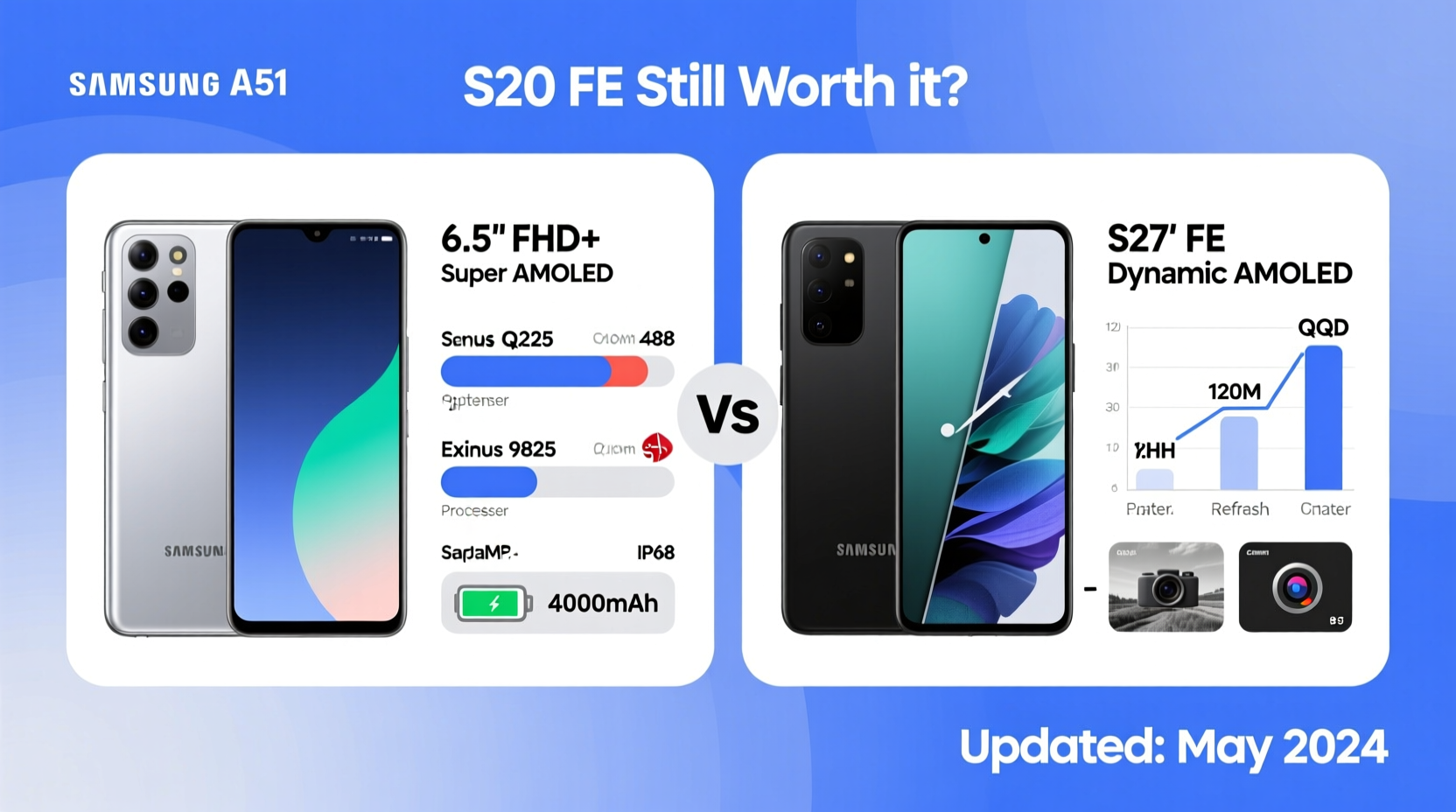
The core difference between these two devices lies in their processors. The Galaxy A51 runs on Samsung’s Exynos 9611 (or Snapdragon 730 in select regions), a capable mid-range chip for everyday tasks like browsing, messaging, and streaming. However, it struggles under heavy multitasking or demanding games.
In contrast, the S20 FE shipped with either the Qualcomm Snapdragon 865 or Exynos 990, depending on region—both of which are true flagship-grade processors from 2020. This means significantly faster app launches, smoother gaming at high settings, and better future-proofing for apps that demand more power.
Benchmarks from the time show the S20 FE scoring nearly double the A51 in CPU performance and triple in GPU output. In real-world use, this translates to quicker photo editing, faster file transfers, and less lag when switching between apps.
Display and Design: Quality Over Quantity
Both phones feature 6.5-inch displays, but the differences in quality are immediately noticeable. The A51 uses a Super AMOLED panel with a resolution of 1080 x 2400 pixels and a standard 60Hz refresh rate. It’s bright and vibrant for its class, but scrolling feels less fluid compared to modern standards.
The S20 FE steps up with a 120Hz refresh rate on its 6.5-inch Super AMOLED display. Even if the resolution is identical, the higher refresh rate makes every interaction—swiping, scrolling, gaming—feel dramatically smoother. This isn’t just a spec bump; it changes how the phone feels in daily use.
Design-wise, both have plastic backs and aluminum frames, but the S20 FE feels more premium with tighter build tolerances and IP68 water and dust resistance—a feature absent on the A51. That added durability matters for users who commute, travel, or live in rainy climates.
“High refresh rate screens aren’t just for gamers—they make the entire user experience feel more responsive and refined.” — David Kim, Mobile UX Analyst at TechPulse Insights
Camera Comparison: More Than Megapixels
On paper, both phones have 48MP main sensors, but sensor size, software tuning, and additional lenses make all the difference.
The A51’s quad-camera setup includes a 48MP main, 12MP ultra-wide, 5MP macro, and 5MP depth sensor. While versatile, the smaller sensor and older image processing result in softer details, especially in low light. Night mode exists but delivers inconsistent results.
The S20 FE features a 12MP main sensor with larger pixel size (1.8µm vs 0.8µm), optical image stabilization (OIS), and a 12MP ultra-wide lens. It also includes an 8MP telephoto lens with 3x hybrid zoom—something the A51 lacks entirely. This enables clearer zoomed shots and better dynamic range.
| Feature | Galaxy A51 | Galaxy S20 FE |
|---|---|---|
| Main Camera | 48MP (f/2.0) | 12MP OIS (f/1.8) |
| Ultra-Wide | 12MP (f/2.2) | 12MP (f/2.2) |
| Telephoto | None | 8MP 3x Hybrid Zoom |
| Night Mode | Basic | Advanced with OIS |
| Video Recording | 4K@30fps | 4K@60fps + HDR10+ |
The S20 FE also supports HDR10+ video recording and has better stabilization for handheld footage. For vloggers or social media creators, this remains a significant advantage even today.
Battery and Software Longevity
Both devices pack 4,500mAh batteries, so raw capacity is equal. However, the S20 FE’s more efficient chipset and adaptive refresh rate (switching between 60Hz and 120Hz) often lead to longer screen-on time. Users report consistently getting a full day and a half under moderate use, whereas the A51 tends to require daily charging.
Software support is where the gap widens. The A51 launched with Android 10 and received updates up to Android 12 with One UI 4.1. Its security patches ended in 2023. The S20 FE, being a flagship model, launched with Android 10 but was eligible for three major OS upgrades, reaching Android 13 (One UI 5.1), and some variants even got Android 14. Security updates continued into early 2024.
This extended support means the S20 FE can run newer apps more reliably and benefits from improved privacy controls and performance optimizations unavailable on the A51.
Mini Case Study: Maria’s Upgrade Experience
Maria, a freelance photographer based in Lisbon, used her A51 for over three years. She loved its compact size but grew frustrated with slow gallery loading times and blurry indoor shots. After trading up to a used S20 FE for €220, she noticed immediate improvements: faster photo processing, sharper images in dim cafes, and smoother editing in Lightroom. “I didn’t realize how much the 120Hz screen would change my experience,” she said. “And being able to shoot in 4K at 60fps made my reels look way more professional.”
Is the S20 FE Still Worth It in 2024?
If you're still using an A51 in 2024, upgrading to an S20 FE—even secondhand—can deliver tangible benefits:
- Faster performance for modern apps and multitasking
- Smoother display with 120Hz refresh rate
- Better cameras, especially in low light and zoom scenarios
- IP68 rating for peace of mind around water
- Longer software support and security updates
However, consider this: the S20 FE is no longer receiving major updates, and newer mid-range phones like the Galaxy A54 or Pixel 7a now outperform it in software longevity and efficiency. If you’re paying more than €200–€250 for an S20 FE, you might be better off investing in a newer model.
Upgrade Checklist: What to Evaluate Before Switching
- Assess current pain points: Is your A51 slow, crashing, or failing to update apps?
- Determine budget: Can you spend €200+ on a used S20 FE, or should you save for a newer model?
- Check battery health: Request a diagnostic report if buying secondhand.
- Evaluate camera needs: Do you regularly take photos in low light or need zoom capability?
- Consider future use: Will this phone last another 18–24 months without becoming obsolete?
FAQ
Can the S20 FE run modern games smoothly?
Yes. Thanks to the Snapdragon 865, the S20 FE handles games like Genshin Impact or Call of Duty Mobile at medium to high settings without major frame drops. Thermal throttling can occur during extended sessions, but overall performance remains strong for a 2020 device.
Does the S20 FE support wireless charging?
Yes, the S20 FE supports 15W wireless charging and reverse wireless charging, allowing you to power accessories like earbuds. The A51 lacks any wireless charging capability.
Is the S20 FE waterproof?
It has an IP68 rating, meaning it can survive submersion in up to 1.5 meters of water for 30 minutes. The A51 has no official water resistance rating, making the S20 FE safer for accidental spills or rain exposure.
Final Verdict: Should You Make the Move?
The Galaxy S20 FE was designed to offer flagship experiences at a lower cost—and years later, it still delivers on that promise. Compared to the A51, it brings meaningful upgrades in display smoothness, camera versatility, processing power, and durability. If you find one in good condition for under €250, it’s absolutely worth the upgrade, especially if you rely on your phone for photography, productivity, or content creation.
But remember: technology moves fast. While the S20 FE outclasses the A51, it’s no longer at the cutting edge. Consider it a transitional upgrade rather than a long-term solution. If you can stretch your budget slightly, newer models offer better battery efficiency, improved software support, and enhanced AI capabilities that will serve you better beyond 2025.




 浙公网安备
33010002000092号
浙公网安备
33010002000092号 浙B2-20120091-4
Comments
No comments yet. Why don't you start the discussion?