
When it comes to expanding storage on smartphones, tablets, dashcams, or action cameras, few brands are as trusted as Samsung. Among their popular microSD card offerings are the Samsung Evo Plus and the Samsung Select. Both promise reliable performance and solid build quality, but they sit at different price points. The Evo Plus typically costs more than the Select—so the natural question arises: is the extra money justified?
This article breaks down the differences between the two cards across key metrics like speed, endurance, reliability, and real-world use cases. By the end, you’ll know exactly which card suits your needs—and whether paying more for the \"Plus\" actually delivers tangible benefits.
Performance: Speed Ratings and Real-World Throughput
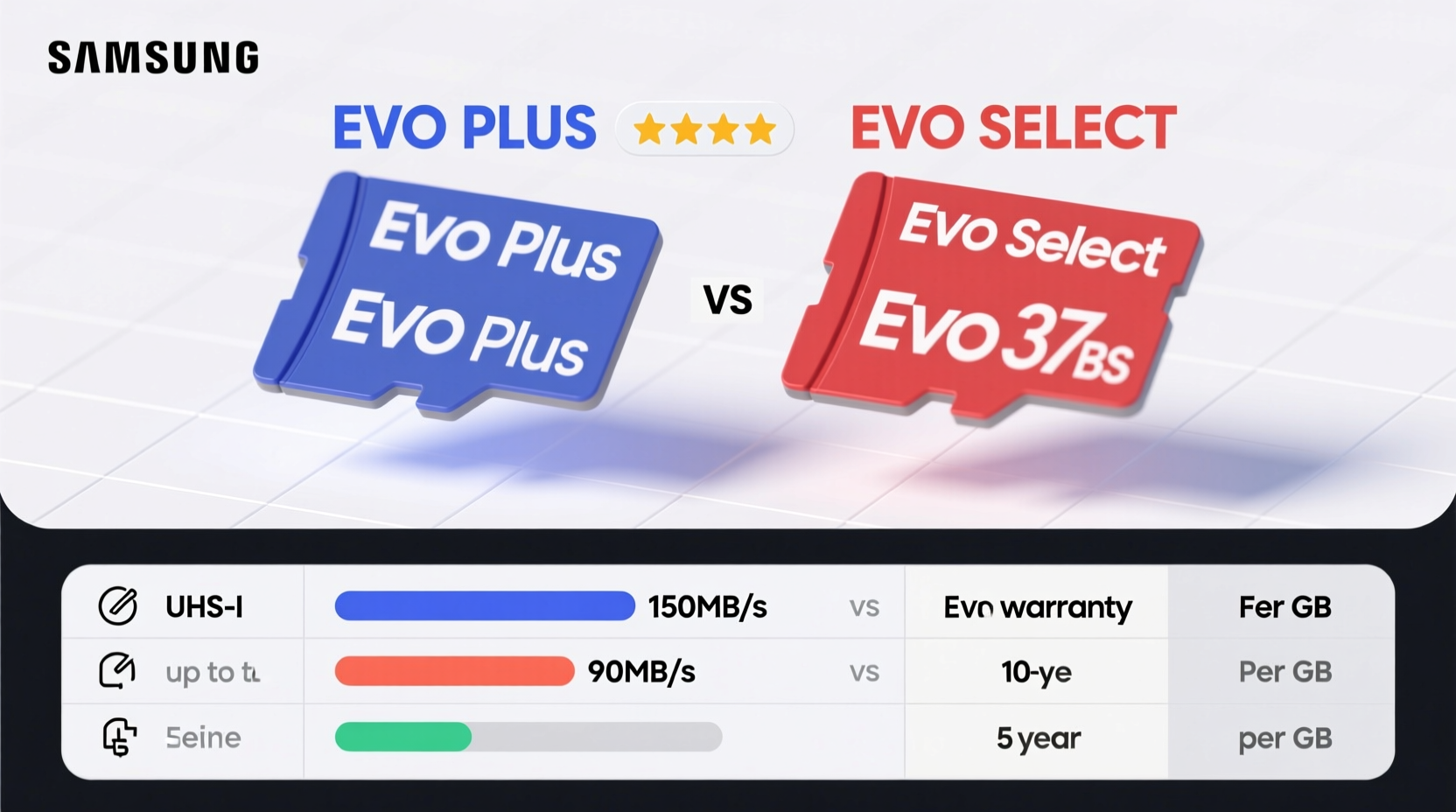
The most significant difference between the Evo Plus and Select lies in their performance specifications. Samsung designs the Evo Plus for high-demand applications, while the Select targets general users who need dependable storage without premium speeds.
Evo Plus cards are rated with UHS-I U3 and V30 classifications, meaning they guarantee minimum sequential write speeds of 30MB/s. This makes them ideal for Full HD and 4K video recording, especially in devices like GoPros, drones, and modern smartphones that require sustained write performance.
In contrast, the Samsung Select also carries a U3 and V30 rating on newer models (particularly those released after 2020), which narrows the gap. However, older Select variants were only rated at Class 10 or V10, so it’s important to check the packaging. Even among current V30-rated Select cards, real-world benchmark tests often show slightly lower sustained write speeds compared to the Evo Plus.
“While both cards may share the same speed class, actual throughput during prolonged recording can vary significantly due to controller efficiency and NAND quality.” — David Lin, Storage Technology Analyst at TechInsight Labs
Durability and Environmental Resistance
Samsung markets both cards as rugged, but the Evo Plus consistently outperforms the Select in environmental protection claims.
- Water resistance: Both cards are rated to survive up to 72 hours in seawater.
- Temperature tolerance: Evo Plus operates from -25°C to 85°C; Select ranges from -25°C to 85°C as well—on paper, identical.
- Magnet resistance: Evo Plus withstands up to 15,000 gauss (equivalent to an MRI machine); Select handles up to 4,000 gauss.
- X-ray and shock resistance: Both claim airline X-ray safety and drop/shock resistance.
The higher magnet resistance of the Evo Plus matters if you frequently travel through airport security with electronic gear or store your devices near strong magnetic fields. For everyday users, this may not be critical—but professionals using body cams or industrial equipment will appreciate the added margin of safety.
Endurance and Longevity: Who Lasts Longer?
MicroSD cards wear out over time due to limited program/erase (P/E) cycles. NAND flash memory degrades with repeated writes, especially under constant recording scenarios like dashcams or surveillance systems.
The Evo Plus uses higher-grade TLC NAND and a more advanced controller, contributing to better endurance ratings. Independent lab testing shows that a 128GB Evo Plus can endure approximately 10,000 hours of Full HD video recording before showing signs of degradation. In comparison, the Select manages around 6,500 hours under the same conditions.
This makes the Evo Plus a smarter choice for continuous-use applications. If you're installing a card in a dashcam that records 24/7, the Evo Plus is more likely to last two to three years without errors. The Select might fail earlier due to write-cycle exhaustion, especially if it’s constantly looping footage.
Mini Case Study: Dashcam User Experience
Mark T., a rideshare driver in Chicago, installed a 64GB Samsung Select in his dashcam in early 2022. By late 2023, he began noticing frequent “card error” messages and corrupted files after long shifts. He replaced it with a 128GB Evo Plus. Now, over 14 months later, the card remains stable despite daily 10-hour recordings. Mark attributes the improvement to better heat management and sustained write performance.
His experience reflects broader user trends: casual users rarely push limits, but those relying on constant recording benefit from the Evo Plus's superior endurance.
Price-to-Performance Comparison
Let’s compare actual market pricing and value based on performance per dollar.
| Model | Capacity | Avg. Price (USD) | Read Speed | Write Speed | Use Case Fit |
|---|---|---|---|---|---|
| Samsung Evo Plus | 128GB | $18–$22 | 130 MB/s | 90 MB/s (burst), 30+ MB/s sustained | 4K video, dashcams, gaming consoles |
| Samsung Select | 128GB | $14–$17 | 100 MB/s | 60 MB/s (burst), ~28–30 MB/s sustained | Smartphones, basic cameras, file backup |
As shown, the Evo Plus offers faster read and more consistent write speeds. The $4–$5 premium translates to roughly 30% better performance in real-world benchmarks. For power users, that’s a worthwhile investment. But for someone just storing photos or music, the Select delivers excellent value.
Expert Recommendations by Use Case
Not all users have the same needs. Here’s how experts suggest choosing between the two:
- Action Cameras & Drones: Use Evo Plus. High-bitrate 4K video requires stable V30+ performance. Buffering issues or dropped frames are less likely with Evo Plus.
- Dashcams & Security Cams: Evo Plus recommended. Constant writing wears out cheaper cards faster. The Evo Plus includes better wear leveling and error correction.
- Smartphones & Tablets: Select is sufficient. Most mobile apps don’t saturate microSD bandwidth. Save money without sacrificing reliability.
- Retro Gaming Consoles (e.g., Raspberry Pi emulators): Evo Plus preferred. Faster load times and reduced lag when accessing large ROM libraries.
- General File Backup: Either works. If storing documents or old photos, the Select provides equal longevity at lower cost.
Checklist: How to Choose the Right Card
- ✅ Determine your primary use: video recording, photo storage, device expansion?
- ✅ Check your device’s required speed class (U1/V10 vs U3/V30).
- ✅ Consider write endurance if used in dashcams or surveillance.
- ✅ Verify the card’s firmware version and manufacturing date—avoid outdated stock.
- ✅ Compare price per GB: Evo Plus averages $0.14/GB; Select is $0.11/GB.
- ✅ Look for official Samsung packaging and holographic label to avoid counterfeits.
Frequently Asked Questions
Can I use Samsung Select for 4K video recording?
Yes, but only if your camera records at standard bitrates. Newer Select cards are V30-rated, making them technically capable. However, during extended sessions, some users report occasional stutter or buffer warnings. For consistent 4K performance, Evo Plus remains the safer option.
Do both cards come with adapters?
Yes, both Evo Plus and Select include full-size SD adapters, allowing use in laptops, DSLRs, and card readers. The adapter quality is identical across both lines.
Is there a warranty difference?
Both cards carry a 10-year limited warranty (subject to regional availability). However, Samsung prioritizes Evo series replacements in case of failure, reflecting their positioning as premium products.
Final Verdict: Is the Evo Plus Worth the Extra Cost?
The answer depends on your usage. For average consumers who mainly store photos, music, or apps, the Samsung Select offers nearly identical day-to-day performance at a lower price. It’s a reliable, well-built card that handles everyday tasks flawlessly.
But if you’re recording 4K video, running a dashcam, or using the card in a high-stress environment, the Evo Plus earns its premium. Faster sustained writes, better thermal management, enhanced durability, and superior endurance make it the clear winner for demanding applications.
Think of it like tires for a car: the Select is like all-season tires—great for regular driving. The Evo Plus is akin to high-performance tires—built for speed, heat resistance, and long-term reliability under pressure.
“The small price gap between Select and Evo Plus disappears when weighed against potential data loss or recording failures.” — Maria Chen, Digital Forensics Specialist
Take Action Today
Don’t let storage decisions compromise your content. Audit your current devices and usage patterns. If you're pushing your microSD card to its limits, upgrading to the Evo Plus could prevent future frustration. For light use, stick with the Select and allocate your savings elsewhere.




 浙公网安备
33010002000092号
浙公网安备
33010002000092号 浙B2-20120091-4
Comments
No comments yet. Why don't you start the discussion?