
When Samsung released the Galaxy Z Flip 4, it marked a turning point for foldable phones—offering better battery life, a refined design, and improved durability. But with the simultaneous release of the Galaxy S23, a powerhouse in Samsung’s traditional flagship line, consumers faced a real dilemma: pay more for a novel folding experience or stick with proven performance and reliability?
Two years later, that question remains relevant. The Flip 4 has become more affordable on the secondary market, while the S23 continues to deliver top-tier specs at a competitive price. So which device truly offers better value today? The answer depends on how you use your phone, what kind of experience you prioritize, and whether innovation outweighs raw functionality.
Design and Form Factor: Foldable Novelty vs Familiar Powerhouse
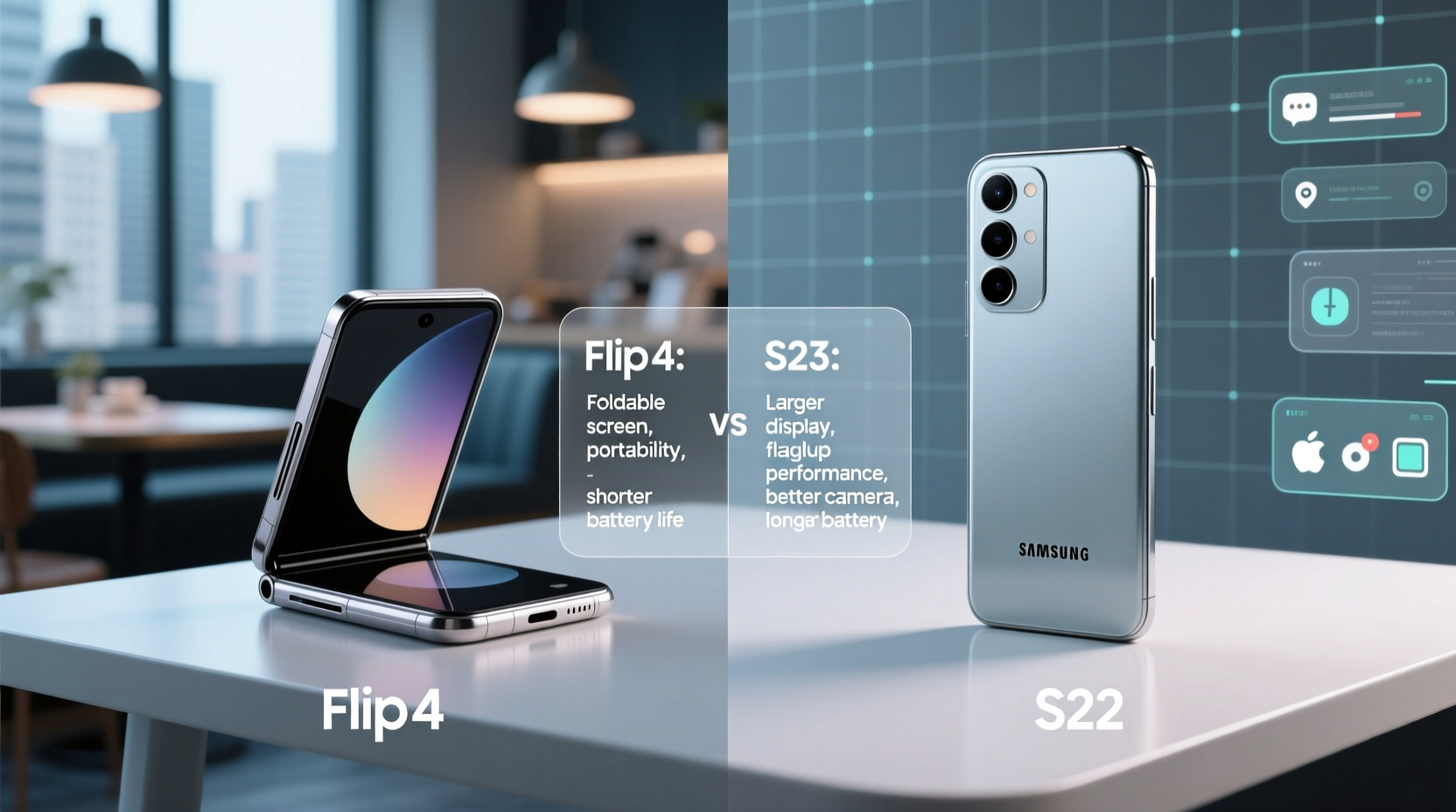
The most obvious difference between the Flip 4 and the S23 lies in their form. The Flip 4 folds vertically like a clamshell, transforming from a compact 6.7-inch smartphone into a sleek, pocket-sized rectangle when closed. This makes it ideal for users who value portability and style. It slips easily into small pockets or clutches, and its unique shape turns heads in a way few conventional phones can.
In contrast, the S23 follows the classic slab design—tall, narrow, and optimized for one-handed use. While not as compact when folded, it's lighter (168g vs 187g) and slightly thinner in its open state. Its Gorilla Glass Victus 2 and aluminum frame give it a premium feel, though it lacks the \"wow factor\" of the Flip 4’s hinge mechanism.
The Flip 4 also introduces Flex Mode, allowing the phone to stand freely on a surface when partially opened. This is perfect for hands-free video calls, taking selfies with both front and rear cameras, or watching videos without a stand. The S23 offers no such flexibility—it requires external support for similar use cases.
Performance and Daily Use: Raw Speed vs Balanced Efficiency
Under the hood, both phones launched with different chipsets. The S23 features the Snapdragon 8 Gen 2 for Galaxy—an overclocked, exclusive version built specifically for Samsung’s flagship lineup. It delivers up to 30% better CPU performance and 40% faster GPU speeds compared to the standard 8 Gen 2 found in many competitors.
The Flip 4, meanwhile, runs on the standard Snapdragon 8+ Gen 1. While still powerful enough for gaming, multitasking, and high-resolution photography, it lags behind the S23 in sustained performance and thermal efficiency. In long gaming sessions or intensive app usage, the Flip 4 may throttle sooner due to tighter internal space and less effective heat dissipation.
Battery life reflects this divide. The S23 packs a 3900mAh battery with excellent optimization, routinely lasting a full day and a half under moderate use. The Flip 4’s 3700mAh capacity is split across two smaller cells, and despite software improvements, it often needs a recharge by late evening—especially if you're opening and closing the phone frequently, triggering wake-ups.
“Foldables trade some battery and performance density for mechanical complexity. That gap is narrowing, but not gone.” — David Lee, Mobile Hardware Analyst at TechInsight Weekly
Camera Capabilities: Consistency vs Compromise
For photography enthusiasts, the S23 is the clear winner. Its triple rear system includes a 50MP main sensor with advanced pixel-binning, a 12MP ultra-wide, and a 10MP telephoto with 3x optical zoom. Image processing is superb, especially in low light, and features like Expert RAW and adaptive pixel technology give pro users more control.
The Flip 4 uses a dual-camera setup: a 12MP main and 10MP ultrawide. While capable in daylight, it struggles in dim environments and lacks any optical zoom. Images are good—not great—and lack the depth and dynamic range of the S23. However, the Flip 4 shines in selfie innovation thanks to its cover screen and Flex Mode. You can use the 6.2-inch main display as a viewfinder while shooting with the superior rear camera—something the S23 cannot do natively.
| Feature | Samsung Galaxy S23 | Samsung Galaxy Z Flip 4 |
|---|---|---|
| Main Camera | 50MP (f/1.8) | 12MP (f/1.8) |
| Telephoto Lens | Yes (3x optical) | No |
| Front Camera | 10MP (under-display) | 10MP (cover + inner) |
| Video Recording | 8K @ 30fps | 4K @ 60fps |
| Unique Photo Feature | Adaptive Pixel, Nightography | Flex Mode Selfies |
Real-World Example: A Social Media Manager’s Choice
Consider Maya, a freelance social media strategist who travels often and posts daily content. She initially chose the Flip 4 for its compact size and ability to shoot high-quality selfies using Flex Mode during client meetups. The cover screen allowed her to quickly check notifications without fully opening the device—ideal for fast-paced environments.
But after six months, she noticed limitations. Battery drained quickly during back-to-back shoots, and editing large video files on the inner screen was sluggish. When she upgraded to an S23, she missed the Flip’s novelty but gained reliability: longer battery, faster exports, and better zoom for product photography. Her workflow became smoother, even if her phone lost some flair.
Her experience illustrates a broader trend: lifestyle appeal often wins at purchase, but practicality determines long-term satisfaction.
Should You Buy the Flip 4 in 2024?
The Flip 4 is no longer a cutting-edge device, but it’s far from obsolete. On the refurbished or discounted market, it can be found for $400–$500, making it one of the most affordable entry points into Samsung’s foldable ecosystem. For users who prioritize aesthetics, compactness, and interactive features like the cover screen and hands-free mode, it remains compelling.
However, compromises exist. The crease on the inner display is visible under certain lighting, and while durability has improved over earlier models, the hinge is still a potential failure point over time. There’s also limited software support—the Flip 4 will receive updates until 2026, whereas the S23 is guaranteed through 2027 with four Android OS upgrades.
Checklist: Which Phone Is Right for You?
- ✅ Choose the Galaxy Z Flip 4 if:
- You want a compact, stylish phone that stands out.
- You take lots of selfies and appreciate Flex Mode.
- You’re okay with average battery life and slightly older hardware.
- You’re buying secondhand and want to save money while trying foldables.
- ✅ Choose the Galaxy S23 if:
- You need strong performance for work, gaming, or photo editing.
- You value camera quality and low-light photography.
- You prefer longer software support and update longevity.
- You want reliable all-day battery without carrying a charger.
Frequently Asked Questions
Is the Galaxy Z Flip 4 durable enough for everyday use?
Yes, with caveats. It has an IPX8 water resistance rating and improved hinge sealing, but repeated folding over thousands of cycles can lead to wear. Avoid exposing it to dust and sand, and consider a protective case designed for foldables.
Can the S23 replace the Flip 4’s cover screen functionality?
Not exactly. The S23 lacks a secondary external display, so you must open the phone to see notifications. Some third-party apps offer quick peek features, but they don’t match the convenience of the Flip 4’s 1.9-inch cover screen.
Will either phone get future software updates?
The S23 will receive Android updates through Android 16 (expected 2026) and security patches until 2027. The Flip 4 is capped at Android 14 and will stop receiving major updates after 2024, with only security patches until 2026.
Final Verdict: Innovation or Practicality?
The Galaxy Z Flip 4 was a bold step forward for foldable tech—a device that reimagined what a smartphone could look like. But innovation comes at a cost: reduced battery, weaker performance, and shorter software lifespan. The Galaxy S23, by contrast, represents refinement. It doesn’t reinvent the wheel, but it executes every function exceptionally well.
If you’re drawn to the Flip 4 for its uniqueness and are willing to accept its trade-offs, it can still be a satisfying daily driver—especially at a discounted price. But if you want a phone that performs consistently, lasts longer between charges, and stays updated for years, the S23 is the smarter investment.
In most cases, unless the folding form factor is a non-negotiable priority, the S23 is the better choice in 2024. It proves that sometimes, the most advanced phone isn’t the one that looks the most futuristic—but the one that works flawlessly every single day.




 浙公网安备
33010002000092号
浙公网安备
33010002000092号 浙B2-20120091-4
Comments
No comments yet. Why don't you start the discussion?