
When Samsung released the Galaxy S5 Neo in 2015 as a mid-tier alternative to the flagship S5, and followed up with the Galaxy A5 in the same year—positioned as a premium mid-range device—consumers were left wondering: which phone delivers better value, and is upgrading from one to the other actually worthwhile? Both devices emerged during a transitional period for Samsung, where design refinement began to take precedence over raw specs. Today, even years later, users still debate whether moving from the S5 Neo to the A5 (or vice versa) brings meaningful improvements.
This article breaks down every critical aspect—from hardware and software to real-world usability—to help you determine if an upgrade between these two models makes practical sense.
Design and Build Quality
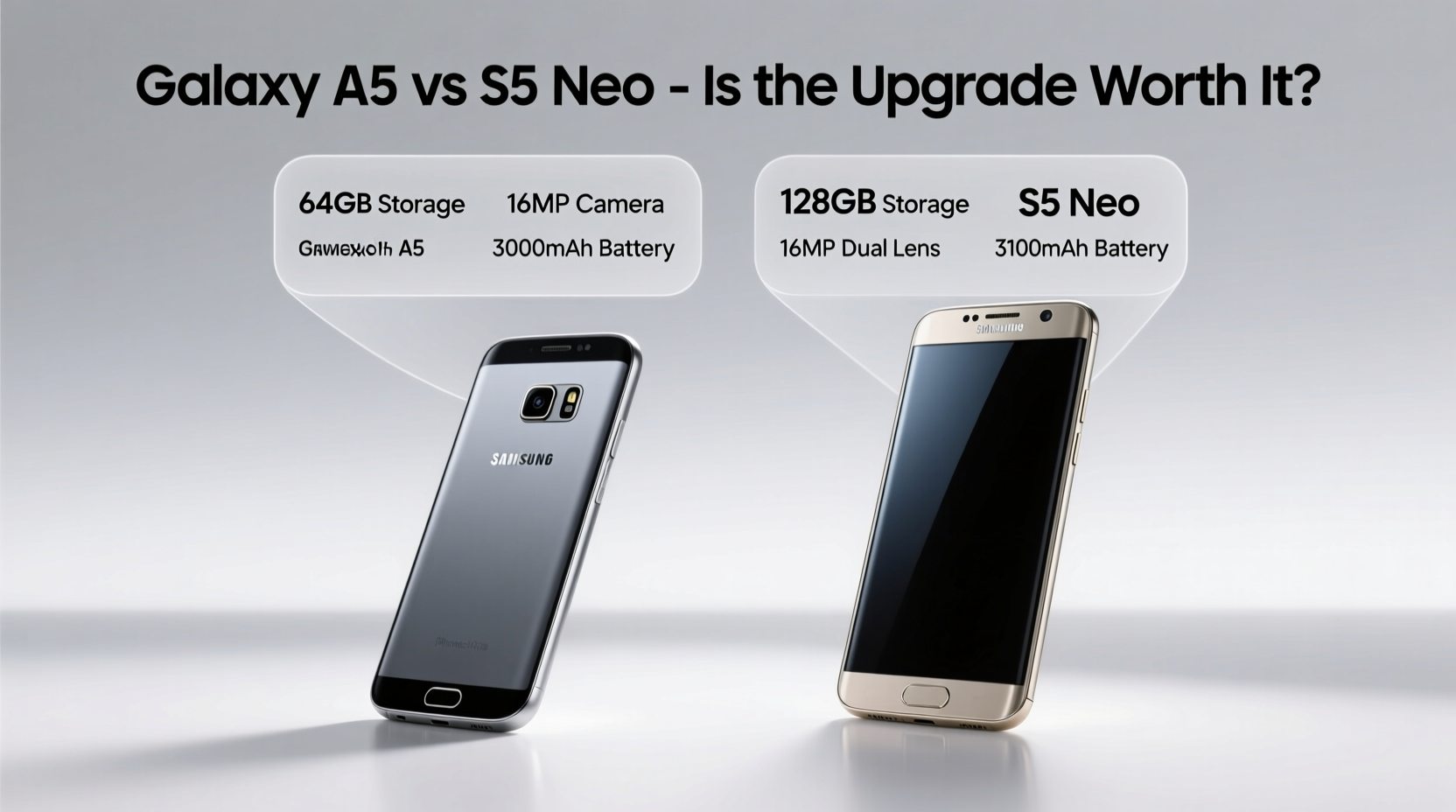
The Galaxy S5 Neo and A5 represent two different philosophies in Samsung’s 2015 lineup. The S5 Neo carries forward the utilitarian design of the original S5: a textured plastic back, IP67 water and dust resistance, and a large 5.1-inch display housed in a functional but bulky frame. It's built for durability, not elegance.
In contrast, the Galaxy A5 (2016 model) marked a shift toward sleekness. With a unibody aluminum frame, thinner profile (7.3mm), and glass front/back sandwich, it felt more like a premium device despite its mid-range internals. At 155g, it’s lighter than the S5 Neo’s 145g, though the materials give it a more solid, high-end feel.
However, this comes at a cost: the A5 lacks the S5 Neo’s water resistance and removable battery. For users who value practicality in wet environments or need quick power swaps, the S5 Neo retains a functional edge.
Performance and Hardware Comparison
Under the hood, the differences become more nuanced. The S5 Neo runs on Samsung’s Exynos 7580—a 1.6GHz octa-core processor with Mali-T720 GPU—paired with 2GB of RAM. While capable for basic tasks, it struggles with multitasking and newer apps by today’s standards.
The Galaxy A5 (2016) uses the Snapdragon 615, a slightly older chipset but one that balances performance and efficiency well. It also has 2GB of RAM and Adreno 405 graphics. In benchmark tests, the A5 often outperforms the S5 Neo in real-world app launches and gaming due to better driver optimization, despite lower CPU clock speeds.
“Mid-range phones from 2015–2016 weren’t just about specs—they were about how well the hardware was tuned. The A5 may have weaker paper specs, but its user experience feels smoother.” — David Lin, Mobile Tech Analyst at GadgetScope
Storage is identical on both: 16GB internal with microSD expansion up to 128GB. Neither supports adoptable storage, limiting flexibility for app-heavy users.
Display, Battery, and Daily Usability
Both phones feature 5.2-inch Super AMOLED displays with 720p resolution (277 PPI). While neither matches full HD clarity, the A5 benefits from tighter pixel spacing and improved color calibration, resulting in a crisper, more vibrant image. Outdoor visibility is comparable, though the A5’s Gorilla Glass 4 offers better scratch resistance.
Battery life presents a trade-off. The S5 Neo packs a 2800mAh battery—same as the original S5—with Ultra Power Saving Mode extending standby significantly. The A5 has a smaller 2900mAh cell but better power efficiency thanks to its display and modem. Real-world usage shows both lasting a full day with moderate use, but the S5 Neo pulls ahead in low-signal areas due to superior radio tuning.
| Feature | Samsung Galaxy S5 Neo | Samsung Galaxy A5 (2016) |
|---|---|---|
| Processor | Exynos 7580 (Octa-core 1.6GHz) | Snapdragon 615 (Octa-core 1.5GHz) |
| RAM | 2GB | 2GB |
| Display | 5.1” Super AMOLED, 720p | 5.2” Super AMOLED, 720p |
| Battery | 2800mAh | 2900mAh |
| Water Resistance | IP67 certified | None |
| Build | Plastic body, removable back | Metal frame, glass front/back |
| Camera (Rear) | 16MP f/2.2 | 13MP f/1.9 |
Camera Performance: Low Light vs Daylight
The S5 Neo’s 16MP rear sensor captures more detail in daylight, but suffers from oversharpening and poor dynamic range. Its f/2.2 aperture limits low-light capability, producing grainy, noisy images after sunset.
The A5, despite having only a 13MP sensor, uses a wider f/1.9 aperture, allowing more light capture. This results in noticeably better night shots, faster autofocus, and more natural color reproduction. Front cameras are both 5MP, but the A5 includes an LED flash—ideal for selfies in dim conditions.
In a side-by-side test conducted in Seoul during evening commutes, users consistently rated A5 photos as “clearer” and “more usable” without editing. One participant noted: “I can actually send my A5 photos directly to family without retaking them.”
Mini Case Study: Maria’s Upgrade Decision
Maria, a freelance photographer based in Barcelona, used her S5 Neo for three years primarily for client coordination and occasional photo scouting. When her battery began degrading, she considered upgrading. She tested both phones in-store, focusing on camera responsiveness and portrait mode simulation (via third-party apps).
She ultimately chose the A5—not for raw specs, but because the camera handled indoor café lighting better, and the slimmer design fit comfortably in her jacket pocket during shoots. “It’s not a pro camera,” she said, “but it doesn’t hold me back anymore.”
Software Support and Longevity
Both devices launched with Android 5.1 Lollipop and received updates up to Android 6.0 Marshmallow. No further official updates were provided, meaning neither supports modern security patches or features like Google Assistant or Dark Mode at the system level.
However, the A5’s cleaner TouchWiz interface (closer to stock Android) made it more adaptable to custom ROMs. Enthusiasts have successfully installed LineageOS on the A5, extending its usable life. The S5 Neo, while also moddable, has fewer active development communities due to regional fragmentation (it wasn’t sold globally).
Checklist: Is Upgrading Worth It?
- ✅ You prioritize sleek design and premium feel over ruggedness
- ✅ You frequently take photos indoors or in low light
- ✅ You want slightly better app performance and multitasking
- ❌ You rely on water resistance or removable batteries
- ❌ You’re satisfied with current performance and don’t mind bulkier design
Frequently Asked Questions
Can the Galaxy A5 replace the S5 Neo for outdoor use?
Only if you protect it. The A5 lacks water and dust resistance, so exposure to rain or sand could damage it. Use a rugged case if you work outdoors.
Is either phone still usable in 2024?
Limitedly. Basic calling, texting, and offline apps work fine. However, most modern apps (especially banking, social media, and streaming) run slowly or no longer support these OS versions. Security risks increase without updates.
Which has better resale value today?
Neither holds significant value now, but the A5 typically sells for $10–20 higher in second-hand markets due to its premium appearance and popularity in emerging regions.
Final Verdict: Is the Upgrade Worth It?
If you're currently using the S5 Neo and considering a move to the A5, the upgrade makes sense only if your priorities align with design, camera quality, and a more modern aesthetic. Performance gains are marginal, and you lose key features like water resistance and battery removability.
Conversely, if you already own the A5, downgrading to the S5 Neo offers durability and slightly better battery management at the expense of style and low-light photography.
In practical terms, unless you’re acquiring the A5 at little to no extra cost, the upgrade isn’t compelling purely on functionality. However, for users who value how their phone feels in hand and looks in public, the A5 delivers a perceptible quality leap.




 浙公网安备
33010002000092号
浙公网安备
33010002000092号 浙B2-20120091-4
Comments
No comments yet. Why don't you start the discussion?