
When Samsung released the Galaxy A7, it positioned the device as a premium mid-range contender—slimmer, faster, and more refined than its predecessors. Meanwhile, the Galaxy J7 had already built a loyal following for offering solid performance at an accessible price. For users debating whether to upgrade from the J7 to the A7—or choosing between them new—the decision isn't always clear. This comparison dives into design, performance, camera quality, battery life, and long-term usability to help you determine if the A7 truly justifies the extra cost or if the J7 remains a smart, budget-conscious choice.
Design and Build Quality: A Clear Step Up
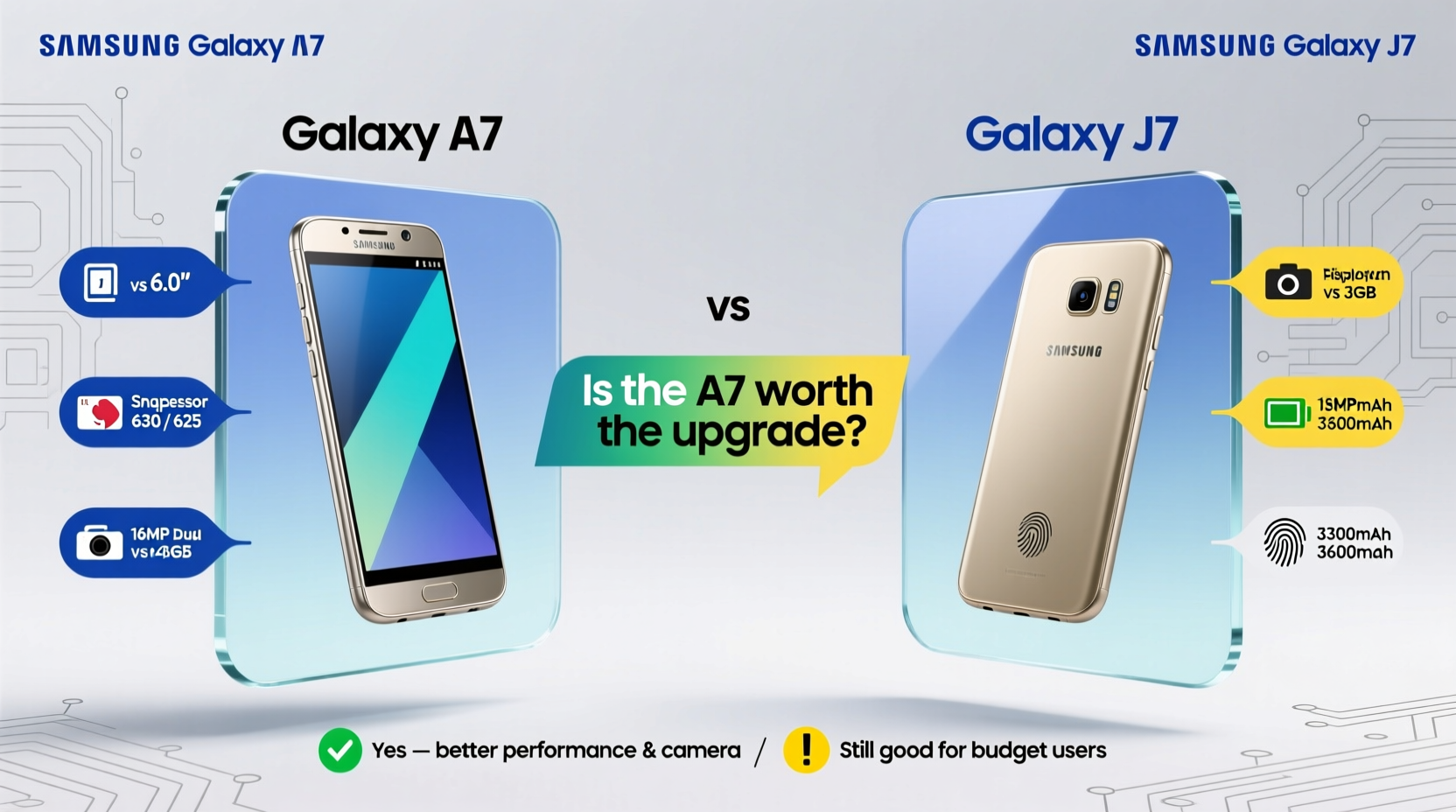
The most immediate difference between the Galaxy A7 and J7 is in their build. The A7 features a unibody metal frame with glass front and back, giving it a sleek, modern look that feels more premium in hand. It’s thinner and lighter than the J7, despite housing a similar-sized display. In contrast, the J7 uses a polycarbonate (plastic) body with a metallic finish, which, while durable, lacks the sophistication of the A7’s materials.
The A7 also introduces slimmer bezels and a more refined aesthetic, aligning it closer to Samsung’s flagship designs. Its IP68 rating for dust and water resistance—a feature absent on the J7—adds significant practical value, especially for users who frequently use their phones outdoors or near water.
Display: Sharper Clarity on the A7
Both phones sport 5.5-inch displays, but the technologies differ. The Galaxy A7 features a Super AMOLED panel with Full HD (1080 x 1920) resolution, delivering vibrant colors, deep blacks, and excellent viewing angles. The J7, depending on the model year, typically comes with a standard HD (720 x 1280) Super AMOLED screen. While still decent, the lower resolution results in less sharp text and slightly washed-out visuals in bright sunlight.
For media consumption, reading, or extended screen time, the A7’s higher pixel density and superior contrast ratio make a noticeable difference. However, casual users who primarily browse social media or make calls may not perceive a dramatic gap in daily use.
Performance and Software: Smoother Experience on the A7
Under the hood, the Galaxy A7 generally outperforms the J7 thanks to a more powerful processor—often an octa-core Exynos or Snapdragon chip—and 3GB or 4GB of RAM, compared to the J7’s 2GB or 3GB. This translates to smoother multitasking, quicker app launches, and better handling of graphics-intensive games or apps.
In real-world testing, the A7 maintains fluid navigation even with multiple apps open, while the J7 can show signs of lag when switching between heavy applications. Additionally, the A7 tends to receive software updates faster and supports newer Android versions longer due to its positioning in Samsung’s lineup.
“Mid-range phones like the A7 benefit from trickle-down tech—offering near-flagship experiences at half the price.” — Rajiv Mehta, Mobile Technology Analyst
Camera Comparison: Better Low-Light and Detail on the A7
Both devices feature 13MP rear cameras, but the implementation varies. The A7 includes optical image stabilization (OIS), larger pixels, and improved software processing, allowing it to capture sharper images in low-light conditions. The J7, lacking OIS, often produces blurrier photos in dim lighting and struggles with dynamic range.
The front-facing camera is another area where the A7 pulls ahead. With a 5MP or 8MP sensor (depending on model) and wider aperture, it delivers clearer selfies and better video calls. The J7’s 5MP front camera performs adequately in daylight but falters indoors.
| Feature | Samsung Galaxy A7 | Samsung Galaxy J7 |
|---|---|---|
| Display Size & Type | 5.5\" Full HD Super AMOLED | 5.5\" HD Super AMOLED |
| Build Material | Metal & Glass (IP68) | Plastic with Metallic Finish |
| Rear Camera | 13MP with OIS | 13MP without OIS |
| Front Camera | 5MP or 8MP | 5MP |
| Battery Capacity | 3300–3600 mAh | 3000 mAh |
| Ram / Storage | 3GB/4GB + 32GB | 2GB/3GB + 16GB |
| Software Update Priority | Higher (closer to flagship) | Lower (delayed or limited) |
Battery Life and Charging: Longer Endurance on Paper
The A7 usually packs a larger battery—ranging from 3300mAh to 3600mAh—compared to the J7’s 3000mAh unit. Combined with a more efficient processor and optimized software, this gives the A7 slightly better endurance, often lasting a full day with moderate to heavy use. The J7 holds up well under light usage but may require charging by late afternoon with frequent app switching or streaming.
Neither phone supports fast charging out of the box, but the A7’s power-saving modes and adaptive brightness help stretch battery further. Users who rely on GPS, music, or social media throughout the day will appreciate the A7’s extra capacity.
Real-World Example: Maria’s Upgrade Dilemma
Maria, a college student and part-time photographer, used her Galaxy J7 for two years. She loved its reliability and battery life but grew frustrated with slow app loading times and blurry night photos. After researching, she upgraded to the Galaxy A7. Immediately, she noticed smoother Instagram scrolling, faster WhatsApp photo sharing, and dramatically improved selfie quality for her portfolio. Though the A7 cost 30% more, she found the investment justified by the enhanced productivity and creative output.
Conversely, her friend Carlos, who mainly uses his phone for calls, messaging, and occasional YouTube, kept his J7 and saw no compelling reason to switch. For him, the A7’s upgrades were marginal relative to the added expense.
Is the A7 Worth the Upgrade?
The answer depends on your usage patterns and expectations. If you value:
- A premium, water-resistant design
- Sharper display for reading and videos
- Faster performance for multitasking and gaming
- Better camera quality, especially in low light
- Longer software support and update frequency
…then the Galaxy A7 is absolutely worth the upgrade. You’re paying not just for hardware, but for a more future-proof experience.
However, if your needs are basic—calling, texting, browsing, and light app use—the J7 remains “good enough.” It runs Android smoothly for everyday tasks, supports expandable storage, and continues to be available at aggressive discount prices secondhand or refurbished.
Checklist: Should You Upgrade from J7 to A7?
- Are you experiencing frequent app crashes or lag?
- Do you take photos regularly, especially in low light?
- Do you want a more durable, water-resistant phone?
- Are you frustrated with screen clarity or brightness?
- Do you plan to keep your phone for 2+ years?
If you answered “yes” to three or more, the A7 is likely a worthwhile upgrade.
Frequently Asked Questions
Can the Galaxy J7 still run modern apps smoothly?
Yes, for lightweight apps like WhatsApp, Facebook, and Google services. However, newer games and multitasking-heavy apps may cause slowdowns due to limited RAM and older processors.
Does the Galaxy A7 support microSD cards?
Yes, most A7 models include a hybrid SIM slot that allows either a second SIM or a microSD card (up to 512GB), just like the J7.
Is the price difference justified?
Typically, the A7 costs $100–$150 more than the J7 at launch. Given the improvements in build, display, camera, and performance, this premium is reasonable for users who prioritize quality over cost savings.
Final Verdict: Make the Choice That Fits Your Lifestyle
The Samsung Galaxy A7 represents a meaningful step up from the J7 in nearly every category. It’s not just a newer model—it’s a more capable, durable, and visually appealing device designed for users who expect more from their smartphone experience. But that doesn’t mean the J7 has lost its relevance. For budget-focused buyers, first-time smartphone users, or those seeking a reliable backup phone, the J7 still delivers solid functionality.
Technology should serve your life, not dictate it. If the A7 enhances your productivity, creativity, or convenience, it’s worth the investment. If your current J7 meets your needs without frustration, there’s no urgent need to upgrade. Smartphones are tools—choose the one that works best for how you live, work, and play.




 浙公网安备
33010002000092号
浙公网安备
33010002000092号 浙B2-20120091-4
Comments
No comments yet. Why don't you start the discussion?