
Choosing between the Samsung Galaxy Watch and the Apple Watch isn’t just about brand loyalty—it’s a decision that hinges on real-world performance, daily usability, and long-term value. Two of the most advanced smartwatches on the market, these devices offer robust health tracking, seamless connectivity, and elegant designs. But when it comes to critical factors like battery life and feature depth, the differences become significant. For users deciding which ecosystem to invest in, understanding how each device performs under daily use is essential.
While both watches excel in design and functionality, their underlying philosophies diverge. Apple prioritizes tight integration with its ecosystem, delivering a polished, consistent experience. Samsung, on the other hand, emphasizes flexibility, longer battery life, and broader compatibility across Android devices. This comparison breaks down key aspects—battery longevity, health monitoring, software experience, and hardware capabilities—to reveal which smartwatch truly delivers more for your wrist.
Battery Life: The Defining Difference
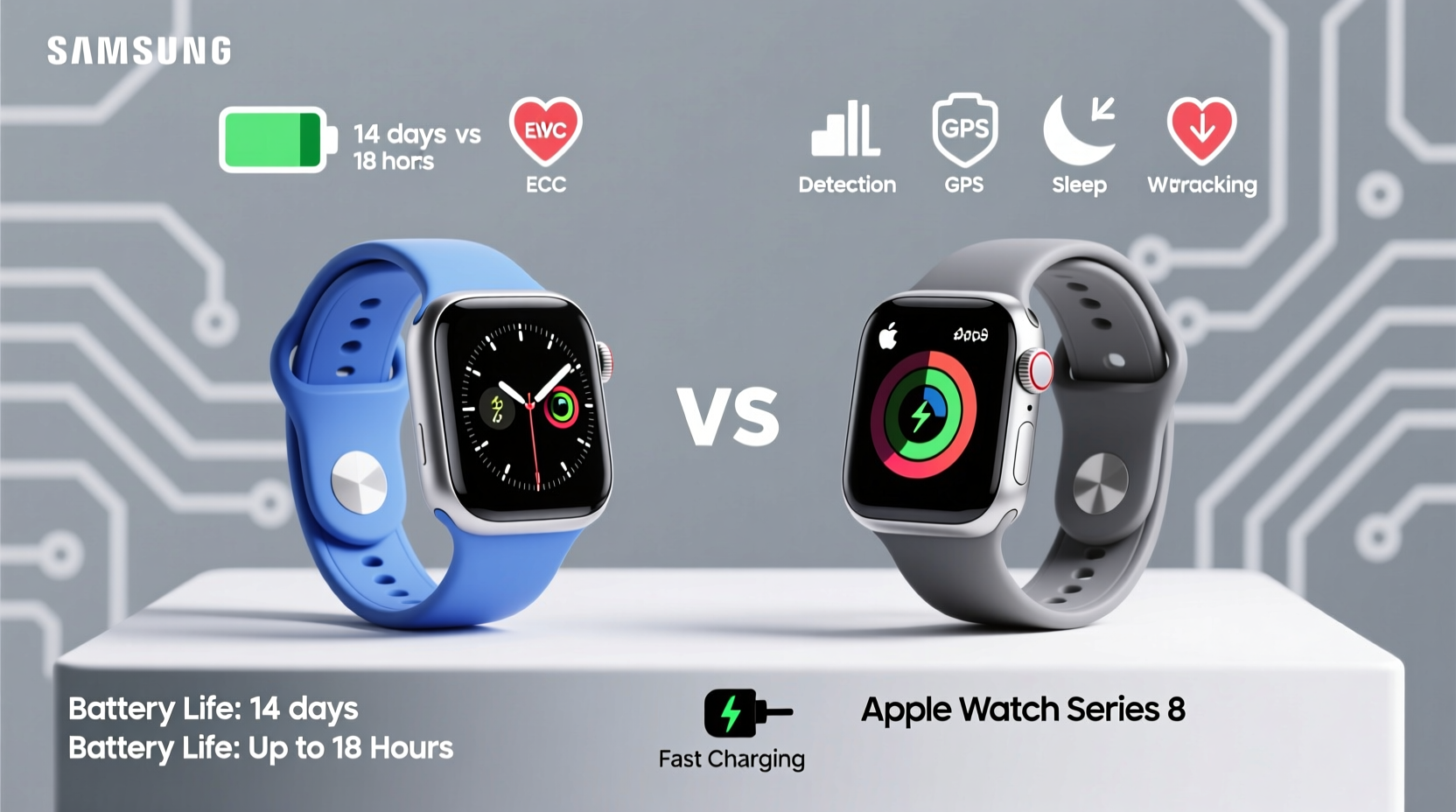
One of the most immediate and practical distinctions between the Samsung Galaxy Watch and Apple Watch is battery life. In real-world usage, this factor can dramatically affect user satisfaction, especially for those who travel frequently or dislike nightly charging routines.
The latest Apple Watch models, such as the Series 9 and Ultra 2, typically last about **18 to 36 hours** on a single charge. Even with optimized settings—lower brightness, reduced haptics, and disabling always-on display—most users need to recharge daily. The Apple Watch Ultra extends this slightly, offering up to 36 hours in normal mode and 72 hours in Low Power Mode, making it the longest-lasting option in Apple’s lineup. However, this still pales in comparison to Samsung’s offerings.
Samsung Galaxy Watch models, particularly the Galaxy Watch 6 and Watch 6 Classic, consistently deliver **40 to 80 hours**, depending on usage patterns. With moderate use—including continuous heart rate monitoring, sleep tracking, and occasional GPS workouts—many users report getting **four to five days** of battery life. In power-saving mode, some variants can stretch to over a week. This extended endurance stems from Samsung’s more efficient Exynos W930 chip and larger battery capacity relative to screen size.
This difference in battery performance isn’t trivial. Users accustomed to multi-day wear without charging often find returning to daily recharging inconvenient. For travelers, outdoor enthusiasts, or anyone seeking minimal maintenance, Samsung’s battery advantage is a compelling reason to choose its platform.
Feature Comparison: Health, Fitness, and Ecosystem Integration
Both watches offer comprehensive health and fitness tracking, but they approach data collection and user engagement differently.
The Apple Watch leads in clinical-grade health insights. It includes an FDA-cleared ECG app capable of detecting atrial fibrillation, a built-in blood oxygen sensor, and advanced fall detection with emergency SOS calling. Recent models also support temperature sensing for cycle tracking and improved sleep staging analysis. Apple’s integration with the Health app on iPhone provides a unified dashboard for medical records, workout history, and medication tracking—making it ideal for users invested in holistic health management.
Samsung Galaxy Watch matches many of these features with its own ECG and blood pressure monitoring (available in select regions after calibration), SpO2 tracking, and stress detection via HRV analysis. However, Samsung’s ECG is not FDA-cleared in the U.S., limiting its diagnostic credibility compared to Apple’s. On the upside, Samsung offers more extensive sleep coaching through partnerships with SleepScore Labs and includes tools like snore detection and personalized sleep reports.
Fitness tracking is robust on both platforms. The Apple Watch excels in guided workouts, automatic exercise detection, and integration with Apple Fitness+. Samsung counters with a wider range of preloaded workout modes (over 100), advanced running dynamics, and route tracking with back-to-start navigation. GPS accuracy is comparable, though independent tests show slight advantages for Apple in dense urban environments.
“Battery life shouldn’t be sacrificed for features—but most users don’t realize how much daily charging impacts long-term adoption.” — Dr. Lena Patel, Wearable Technology Researcher at MIT Media Lab
Software Experience and Compatibility
The operating system defines much of the user experience. Apple Watch runs watchOS, known for its smooth animations, intuitive interface, and deep app ecosystem. Third-party developers prioritize watchOS due to its predictable hardware specs and large user base. Apps tend to be more polished, responsive, and regularly updated.
Samsung Galaxy Watch uses Wear OS powered by Samsung, a customized version of Google’s platform. While it offers access to the Google Play Store and services like Google Maps, Wallet, and Assistant, the experience can feel less cohesive than watchOS. Some apps are slower to load, and UI transitions aren’t as fluid. However, Samsung overlays useful features like rotating bezel navigation (on Classic models), enhanced Bixby voice commands, and seamless pairing with Galaxy smartphones.
Compatibility is another crucial differentiator. The Apple Watch works exclusively with iPhones. If you’re using an Android phone, pairing is impossible. Conversely, Samsung Galaxy Watches work best with Galaxy devices but maintain full functionality with any Android phone running Android 10 or higher. They do not support iOS, so iPhone users are locked out.
This means your smartphone choice largely dictates your smartwatch options. There’s no workaround—Apple’s ecosystem is closed, while Samsung’s is open within the Android world.
Detailed Feature and Battery Comparison Table
| Feature | Apple Watch Series 9 | Samsung Galaxy Watch 6 |
|---|---|---|
| Battery Life (Typical Use) | 18–36 hours | 40–80 hours (4–5 days) |
| Charging Time | ~90 minutes (0–100%) | ~120 minutes (0–100%) |
| ECG Monitoring | FDA-cleared, available globally | Available (region-dependent), not FDA-cleared |
| Blood Oxygen (SpO2) | Yes | Yes |
| Blood Pressure Monitoring | No | Yes (with calibration via smartphone app) |
| Sleep Tracking & Coaching | Sleep stages, respiratory rate | Sleep score, snore detection, coaching |
| GPS Accuracy | High (dual-frequency) | High (dual-band support) |
| Water Resistance | WR50 (swim-proof) | WR50 (swim-proof) |
| Operating System | watchOS 10 | Wear OS 4 + One UI 5 Watch |
| Smartphone Compatibility | iOS only | Android 10+, best with Galaxy phones |
| Price Range (40mm) | $399+ | $349+ |
Real-World Example: A Week in the Life of Two Users
Consider two professionals: Maya, an iPhone user and nurse working 12-hour shifts, and James, an Android-using software developer who hikes weekly.
Maya relies on her Apple Watch for ECG checks during stressful shifts, fall detection in case she slips, and quick access to hospital alerts. She charges it every night while changing scrubs. Though the daily ritual is manageable, she occasionally forgets, leaving her watch dead mid-shift. Still, the seamless integration with her iPhone and clinic’s health systems outweighs the inconvenience.
James uses his Galaxy Watch 6 during weekend backpacking trips where charging isn’t possible. He appreciates the five-day battery life, allowing him to track hikes, monitor altitude, and check messages without carrying a charger. During weekdays, he uses Samsung Health to analyze stress trends and adjust work breaks accordingly. When his sister switched to iPhone, he was glad he hadn’t gone the Apple route—his watch still works perfectly with his Pixel phone.
Their experiences highlight how lifestyle and ecosystem shape preferences. For integrated health care and premium polish, Apple wins. For autonomy, flexibility, and endurance, Samsung takes the lead.
Actionable Checklist: Choosing the Right Watch for You
- Determine your smartphone OS: iPhone = Apple Watch only; Android = consider Samsung.
- Evaluate charging habits: Can you charge nightly? If not, prioritize Samsung’s battery life.
- Assess health priorities: Need ECG with regulatory approval? Choose Apple. Want blood pressure tracking? Go Samsung.
- Check fitness needs: Serious runners may prefer Samsung’s running metrics; gym-goers might favor Apple Fitness+.
- Review budget: Samsung often offers lower entry prices and better value for standalone features.
- Test connectivity: Ensure Bluetooth stability and notification sync with your primary phone.
Frequently Asked Questions
Can I use a Samsung Galaxy Watch with an iPhone?
No. While limited third-party apps may allow partial connectivity, Samsung does not support iOS devices. Core features like calls, messaging, and health syncing will not function properly.
Does the Apple Watch work with Android phones?
No. The Apple Watch requires an iPhone running iOS 17 or later. Without an iPhone, the watch cannot be set up or used.
Which watch lasts longer overall?
In terms of hardware durability, both brands build high-quality devices with sapphire glass and stainless steel options. However, Samsung’s longer battery life reduces charging cycles over time, potentially extending battery lifespan. Apple’s tighter software updates ensure longer support—typically 5–6 years vs. Samsung’s 4-year promise.
Final Verdict: Which Should You Buy?
If your priority is **battery life and cross-device flexibility**, the Samsung Galaxy Watch is the superior choice. Its ability to go days without charging, combined with strong health tracking and broad Android compatibility, makes it ideal for active users who value independence from daily routines.
If you're deeply embedded in the **Apple ecosystem** and prioritize medical-grade health monitoring, seamless app integration, and premium build quality, the Apple Watch remains unmatched. Despite its shorter battery life, its reliability, accuracy, and ecosystem cohesion justify the trade-off for millions of users.
Ultimately, neither watch is universally “better.” The decision depends on your phone, lifestyle, and what you expect from a wearable. Battery life favors Samsung; ecosystem depth and health validation favor Apple.




 浙公网安备
33010002000092号
浙公网安备
33010002000092号 浙B2-20120091-4
Comments
No comments yet. Why don't you start the discussion?