
When Samsung introduced the Galaxy J2 Core as a successor to the original Galaxy J2, many assumed it was a straightforward upgrade—after all, \"newer\" usually means \"better.\" But in the world of budget smartphones, that’s not always true. The J2 Core, launched in 2018, replaced the 2016 J2 with Android Go and stripped-down hardware. While marketed as modern and efficient, the reality for everyday users tells a more complicated story. This article breaks down the key differences between the Samsung Galaxy J2 and Galaxy J2 Core to answer the pressing question: Is the newer Core version actually an upgrade?
Hardware and Performance: A Step Forward or Backward?
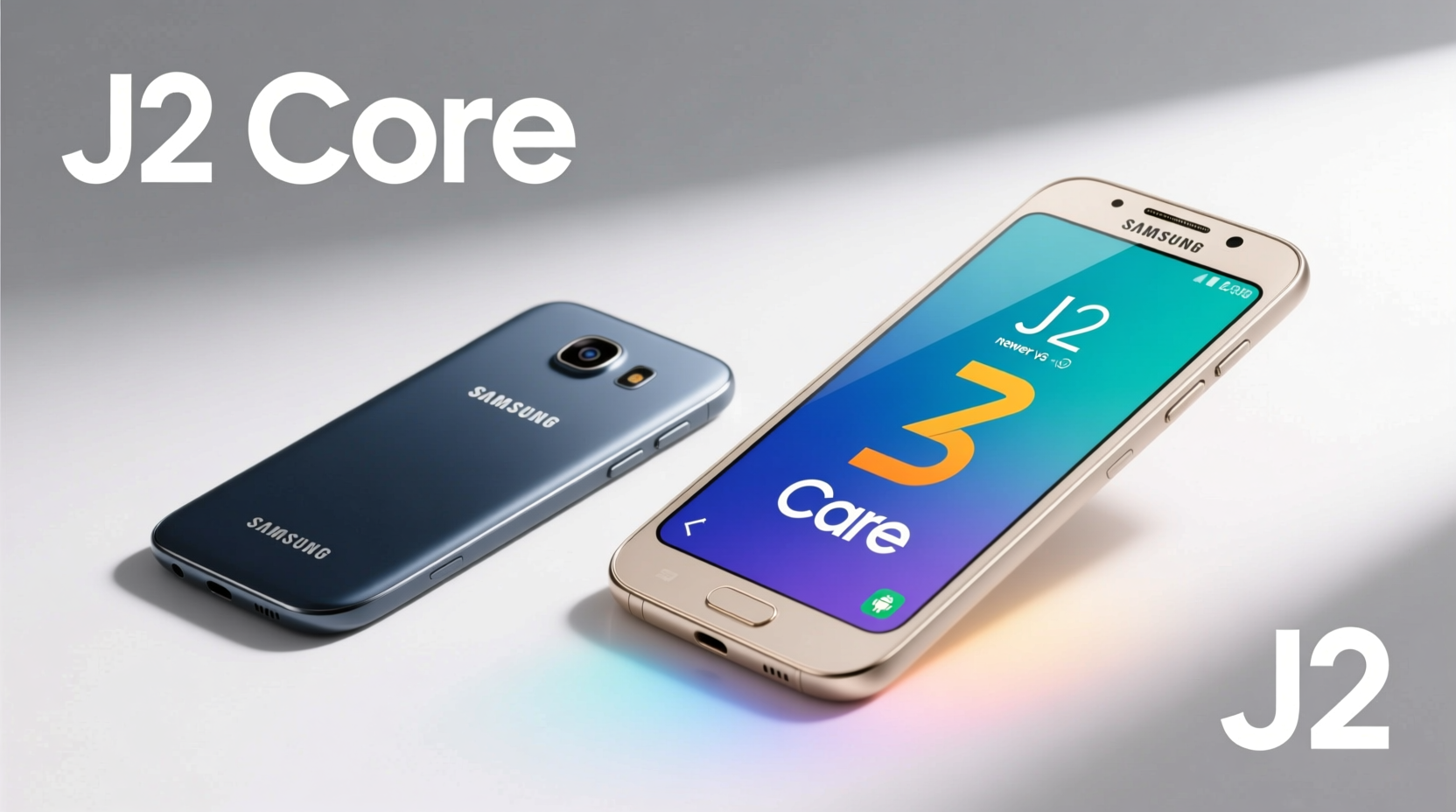
The original Galaxy J2 ran on a 1.3 GHz quad-core processor, paired with 1GB of RAM and 8GB of internal storage. It used the Exynos 3475 chipset and supported microSD expansion up to 128GB. For its time, this setup provided acceptable performance for basic tasks like calling, texting, and light web browsing.
In contrast, the Galaxy J2 Core features a slightly faster 1.4 GHz quad-core processor but uses the Spreadtrum SC7731E—a chipset commonly found in ultra-low-cost devices. Despite the higher clock speed, real-world performance often feels sluggish due to lower GPU capabilities and less optimized architecture. More critically, the J2 Core retains only 1GB of RAM but ships with Android 8.1 Oreo (Go Edition), which is designed to run efficiently on limited hardware.
While Android Go reduces background processes and pre-installs lightweight versions of Google apps, it doesn’t compensate for the underpowered chipset. Users report longer app launch times, frequent stutters during multitasking, and poor gaming performance—even in casual titles like Candy Crush.
Display and Design: Nearly Identical, But Not Improved
Both phones feature a 4.7-inch TFT display with a resolution of 540 x 960 pixels. The pixel density sits at around 234 PPI, which is acceptable for a device in this price range but far from sharp by today’s standards. Neither model uses Super AMOLED technology, despite Samsung’s reputation for high-quality displays in its flagship lineup.
The physical design is nearly identical—both have a plastic body, rounded edges, and a removable back cover. The placement of buttons, ports, and camera modules remains consistent across models. However, the J2 Core removed the LED flash for the front-facing camera, a small but noticeable downgrade for users who frequently take selfies in low light.
Weight-wise, the J2 Core is slightly lighter at 154g compared to the original J2’s 158g, but this difference is negligible in daily use. Build quality remains utilitarian—functional but not durable over long periods.
Detailed Comparison: Key Specifications Side-by-Side
| Feature | Samsung Galaxy J2 (2016) | Samsung Galaxy J2 Core (2018) |
|---|---|---|
| Operating System | Android 5.1.1 (Lollipop), upgradable to 6.0.1 | Android 8.1 Oreo (Go Edition) |
| Processor | Exynos 3475 (Quad-core 1.3 GHz) | Spreadtrum SC7731E (Quad-core 1.4 GHz) |
| RAM | 1 GB | 1 GB |
| Internal Storage | 8 GB (expandable up to 128 GB) | 8 GB (expandable up to 512 GB) |
| Display | 4.7\" TFT, 540 x 960 | 4.7\" TFT, 540 x 960 |
| Rear Camera | 8 MP, f/2.2, AF | 8 MP, f/2.2, AF |
| Front Camera | 5 MP, f/2.2, LED flash | 5 MP, f/2.2, no LED flash |
| Battery | 2000 mAh (removable) | 2600 mAh (removable) |
| Connectivity | MicroUSB, 3G, Wi-Fi b/g/n | MicroUSB, 3G, Wi-Fi b/g/n |
| FM Radio | Yes | Yes |
At first glance, the J2 Core appears to improve on storage expandability and battery capacity. The larger 2600 mAh battery is a meaningful upgrade, offering up to 30% more screen-on time. However, the lack of 4G LTE support on both models limits their usefulness in regions where 3G networks are being phased out.
“Replacing a functional older device with a 'newer' model isn’t progress if the user experience degrades.” — Raj Mehta, Mobile Usability Analyst
User Experience: Real-World Scenarios
Consider Maria, a schoolteacher in rural India, who relies on her phone for communication, accessing digital lesson plans, and staying connected with parents via WhatsApp. She upgraded from a Galaxy J2 to a J2 Core expecting better performance. Instead, she found that while the battery lasted longer, apps took noticeably longer to open. YouTube Go worked, but videos frequently buffered. Even WhatsApp, after updates, became laggy when opening media-heavy chats.
Maria’s experience reflects a broader trend: devices running Android Go can handle essential functions, but they struggle with evolving app demands. Google’s own “Go” apps save space, but third-party apps still install full versions unless manually managed. Over time, the 8GB storage fills quickly, leading to constant app uninstalls and frustration.
Meanwhile, the original J2, though outdated, ran a lighter version of Android with fewer background services. With careful management, it remained usable for years. The J2 Core, despite newer software, feels constrained by hardware limitations and lacks future-proofing.
Software and Long-Term Support
One area where the J2 Core theoretically wins is software. Shipping with Android 8.1 instead of Android 5.1 gives it a four-year jump in OS maturity. Android Go includes built-in data saver, app usage monitoring, and optimized Google Play Store recommendations. Security patches were delivered more consistently during its support window.
However, neither device receives updates today. Samsung ended official support for both models years ago. Without security patches or OS upgrades, both are vulnerable to emerging threats. The J2 Core’s newer base doesn’t translate into longer support—it simply reached end-of-life faster due to its niche positioning.
For users prioritizing longevity, the original J2’s simpler software environment may have offered more stability over time, especially when rooted or flashed with lightweight custom ROMs—an option less viable on the J2 Core due to limited developer community interest.
Is the J2 Core Actually an Upgrade? The Verdict
The answer depends on what you value. If battery life and slightly more modern software are your top priorities, then yes—the J2 Core offers tangible improvements. Its 2600 mAh battery provides meaningful gains, and Android Go helps manage resources more efficiently than stock Lollipop.
But if performance, camera functionality, and long-term usability matter, the original J2 holds its ground. The Exynos chipset, while older, delivers more consistent responsiveness. The inclusion of a front LED flash improves usability. And despite its age, many users report the 2016 model feeling snappier in day-to-day tasks.
In essence, the J2 Core represents a shift in Samsung’s strategy: sacrificing performance and hardware quality to meet aggressive price points while leveraging Android Go to maintain a veneer of modernity. It’s not a true successor—it’s a cost-reduced alternative aimed at first-time smartphone buyers in emerging markets.
Frequently Asked Questions
Can the J2 Core run Facebook or Instagram smoothly?
No. Even lightweight versions of these apps perform poorly due to limited RAM and processing power. Expect frequent crashes and slow loading times.
Which phone has better battery life?
The J2 Core wins here. Its 2600 mAh battery lasts significantly longer than the original J2’s 2000 mAh unit, especially with Android Go’s power-saving features.
Should I buy either phone in 2024?
Not recommended unless absolutely necessary. Both are outdated, lack 4G, and no longer receive security updates. Consider newer Android Go devices like the Nokia C02 or Samsung’s own Galaxy A03 Core for better value.
Final Thoughts: Progress Isn't Always Forward
The story of the Samsung J2 vs. J2 Core illustrates a critical truth in tech: newer doesn’t always mean better. Marketing language often frames newer releases as upgrades, but real-world performance, user needs, and long-term usability must be the final judges.
If you’re holding onto a Galaxy J2, there’s no urgent need to replace it with the J2 Core. In many ways, you might be stepping backward. True upgrades come from meaningful improvements in speed, reliability, and functionality—not just newer software skins on weaker hardware.




 浙公网安备
33010002000092号
浙公网安备
33010002000092号 浙B2-20120091-4
Comments
No comments yet. Why don't you start the discussion?