
When Samsung released the Galaxy J5 Prime in 2016, it was praised for its sleek design and solid mid-range performance. Just a year later, the Galaxy J5 Pro arrived—positioned as an upgraded sibling with subtle but meaningful improvements. But for consumers on a budget or looking to stretch their dollar, the critical question remains: is the J5 Pro truly worth the extra cost over the J5 Prime?
This isn't just about specs on paper. It's about real-world usability, longevity, and whether the enhancements translate into a noticeably better experience. Let’s break down every key aspect—from hardware and software to camera quality and battery life—to determine if the \"Pro\" label lives up to its name.
Design and Build Quality
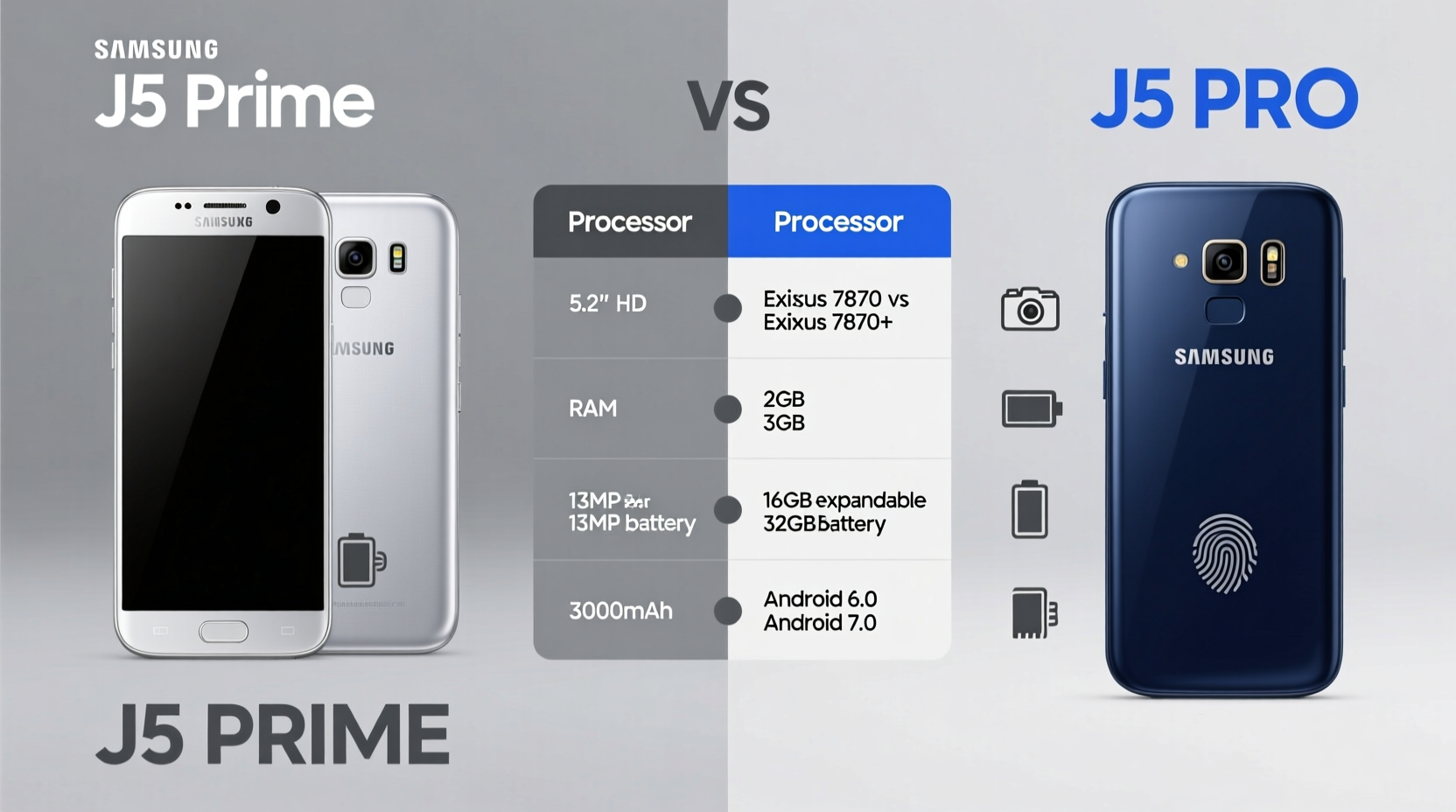
At first glance, both phones look nearly identical. They share a compact 5-inch display, metal unibody construction, and slim profiles. However, closer inspection reveals small but significant differences.
The J5 Pro features a slightly more refined finish. Its aluminum body feels denser and more premium in hand, while the J5 Prime, though still attractive, uses a brushed metal that shows fingerprints more easily. The Pro also has a subtly thinner bezel and a relocated fingerprint sensor—moved from the home button (on the Prime) to the rear panel, aligning with Samsung’s evolving design language at the time.
Display and Screen Performance
Both devices sport a 5.0-inch HD (720 x 1280) PLS LCD screen. On paper, they’re equal—but in practice, there are nuances.
The J5 Pro’s display delivers slightly better brightness and color calibration. Outdoor visibility improves due to higher peak luminance, making it easier to read texts or browse under sunlight. While not a dramatic leap, this enhancement matters for users who spend time outdoors or rely on their phone during commutes.
Neither phone supports full HD resolution, so pixel density is modest by today’s standards. However, for casual use like social media, messaging, and video streaming, both displays remain perfectly serviceable.
Performance and Hardware Comparison
This is where the J5 Pro starts to pull ahead. Under the hood, the differences become more tangible.
| Feature | Samsung J5 Prime | Samsung J5 Pro |
|---|---|---|
| Processor | Exynos 7570 Quad (1.4 GHz) | Exynos 7870 Octa (1.6 GHz) |
| RAM | 2 GB | 3 GB |
| Internal Storage | 16 GB | 32 GB |
| Android Version (Launch) | Android 6.0 (Marshmallow) | Android 7.0 (Nougat) |
| Battery Capacity | 2400 mAh | 3000 mAh |
The J5 Pro’s octa-core processor and additional gigabyte of RAM make a noticeable difference in multitasking and app responsiveness. Users upgrading from the J5 Prime often report smoother navigation, faster app launches, and fewer crashes when running multiple apps simultaneously.
“Even modest hardware upgrades can significantly extend a device’s usable lifespan, especially in entry-level segments.” — David Lin, Mobile Hardware Analyst at TechPulse Asia
Camera Capabilities: Photo and Video Quality
Cameras were a major focus in the transition from Prime to Pro. Both models feature a 13MP rear shooter and an 8MP front camera, but tuning and processing set them apart.
The J5 Pro includes improved image signal processing and better low-light algorithms. In practical terms, this means clearer night shots, reduced noise, and more accurate white balance. Front-facing selfies benefit from enhanced skin tone rendering and autofocus, making the Pro a stronger choice for social media users.
Video recording remains limited to 1080p at 30fps on both devices, but stabilization is marginally better on the Pro. While neither phone competes with modern standards, the J5 Pro captures consistently sharper and more vibrant images across lighting conditions.
Real-World Example: Daily Use Scenario
Consider Maria, a college student using her phone for note-taking, social media, and occasional photography. She started with a J5 Prime but found herself frustrated by slow app switching between Google Docs, WhatsApp, and Instagram. After upgrading to the J5 Pro, she noticed immediate improvements: apps stayed open longer, photos uploaded faster, and her overall experience felt less sluggish.
She didn’t need flagship-level power, but the extra RAM and storage allowed her to function without constantly deleting files or restarting her phone. For users like Maria, the Pro version solved real pain points—even if the external design hadn’t changed much.
Battery Life and Charging
Battery capacity jumps from 2400 mAh on the Prime to 3000 mAh on the Pro—an increase of 25%. This translates directly into usage time. The J5 Pro typically lasts a full day with moderate use, including browsing, messaging, and some video playback.
In contrast, the J5 Prime often requires midday charging under similar conditions. Additionally, the Pro’s more efficient Exynos 7870 chip contributes to better power management, further extending endurance.
Neither model supports fast charging, so a full recharge takes around 2 hours. But given the larger battery and optimized software, the J5 Pro clearly wins in long-term reliability.
Software Experience and Updates
The J5 Pro launched with Android 7.0 Nougat, while the J5 Prime debuted on Android 6.0 Marshmallow. Although both eventually received updates to Android 8.0 Oreo, the Pro had a slight edge in update priority and patch consistency.
Samsung typically prioritizes newer models for security patches, meaning the J5 Pro likely received timely fixes longer than the Prime. For users concerned about privacy and app compatibility, even minor delays in updates can affect functionality over time.
Value Proposition: Is the Upgrade Worth It?
To answer this, consider three factors: price difference, intended use, and longevity.
- Price Gap: At launch, the J5 Pro was priced about 15–20% higher than the J5 Prime. Today, both are available second-hand or refurbished at very low costs.
- User Needs: Casual users may find the Prime sufficient. But anyone using multiple apps, taking frequent photos, or wanting longer battery life will benefit from the Pro.
- Lifespan: The Pro’s superior hardware allows it to run modern lightweight apps more reliably even years later.
Checklist: Should You Choose the J5 Pro?
- ✅ Need smoother multitasking? → J5 Pro (3GB RAM)
- ✅ Want better photo quality? → J5 Pro (improved ISP & low-light)
- ✅ Plan to keep the phone for over a year? → J5 Pro (longer support, better durability)
- ✅ Frequently run out of storage? → J5 Pro (32GB internal)
- ✅ On a tight budget? → J5 Prime (if only basic tasks needed)
Frequently Asked Questions
Can the J5 Pro run modern apps smoothly?
Lightweight apps like WhatsApp, Facebook Lite, and Chrome work well. Heavy games or resource-intensive apps may lag. It’s best suited for essential daily tasks rather than high-performance needs.
Is water resistance included in either model?
No. Neither the J5 Prime nor the J5 Pro has official IP rating for water or dust resistance. Avoid exposure to moisture and consider using a protective case.
Does the J5 Pro support microSD expansion?
Yes. Both models support up to 256GB via microSD card, which helps offset storage limitations—especially on the Prime’s 16GB base model.
Final Verdict: Upgrading Makes Sense—With Caveats
The Samsung J5 Pro isn’t a revolutionary upgrade, but it’s a thoughtful evolution. It addresses core limitations of the J5 Prime: weak multitasking, limited storage, shorter battery life, and average camera output. These improvements add up to a more satisfying daily experience.
If you're choosing between the two today—especially in the second-hand market—the J5 Pro is almost always the smarter pick, provided the price premium is reasonable. The extra RAM and larger battery alone justify the upgrade for most users.
However, if your usage is extremely light—making calls, sending texts, and checking email occasionally—the J5 Prime remains functional and economical. But for anyone doing more than the basics, the “Pro” designation earns its place.




 浙公网安备
33010002000092号
浙公网安备
33010002000092号 浙B2-20120091-4
Comments
No comments yet. Why don't you start the discussion?