
When choosing a premium external display for creative work, video editing, or high-end computing, two names often dominate the conversation: Samsung’s M8 Smart Monitor and Apple’s Studio Display. Both are sleek, modern, and packed with features tailored to professionals and power users. But they differ significantly in price—Apple’s Studio Display retails at $1,599, while the Samsung M8 sits around $799. That’s an $800 gap. The real question isn’t just about specs; it’s whether that extra cost delivers proportional value.
The answer depends on your workflow, ecosystem preferences, and how much you prioritize design over functionality. Let’s break down both displays across key categories to see if the Apple premium truly pays off—or if Samsung offers smarter value for most users.
Design and Build Quality: Minimalism vs. Flexibility
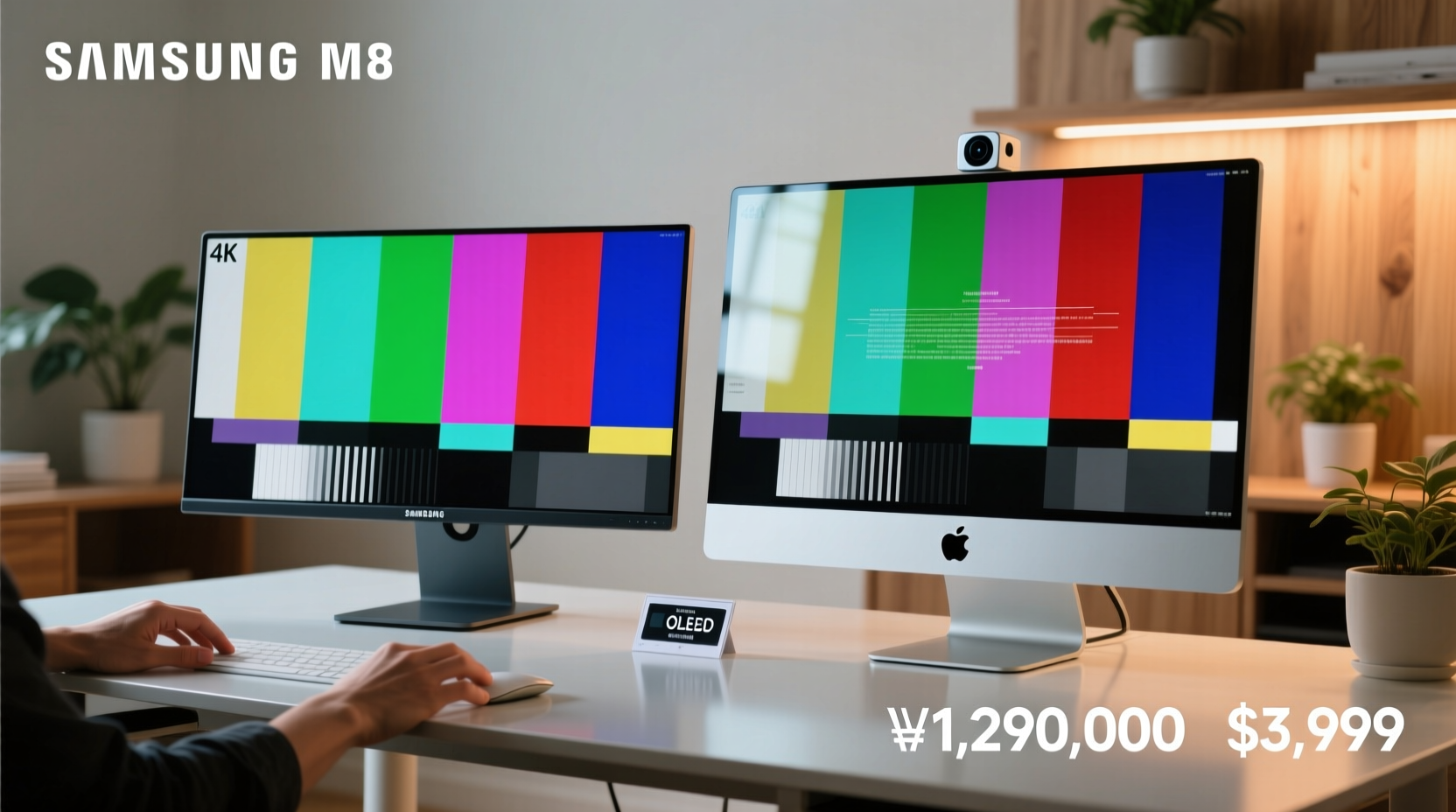
Apple’s Studio Display embraces the brand’s signature minimalist aesthetic. It features a slim aluminum enclosure, narrow bezels, and seamless integration with MacBooks and iMacs. The stand offers tilt adjustment only, but an optional (and expensive) nano-texture glass and VESA mount adapter increase flexibility—for a fee. Its build feels solid, premium, and unmistakably “Apple.”
The Samsung M8 takes a different approach. It’s thinner than many monitors in its class and uses a minimalist white stand that matches its clean look. However, unlike the Studio Display, the M8 comes with built-in height and tilt adjustments out of the box. This makes ergonomics easier to fine-tune without additional purchases. It also includes a built-in smart platform powered by Tizen OS, allowing it to function as a standalone streaming device when disconnected from a computer.
Display Performance: Brightness, Color, and Resolution
Both monitors deliver 5K resolution (5120 x 2880), ensuring crisp text and stunning detail for photo editors, designers, and developers. However, differences emerge in brightness and color accuracy.
The Apple Studio Display peaks at 600 nits of brightness and supports P3 wide color gamut with factory calibration for precise color reproduction. It’s designed to match the Retina displays on MacBooks, making it ideal for creatives who demand consistency across devices.
The Samsung M8 reaches up to 400 nits, which is sufficient for indoor use but falls short in brightly lit environments. While it covers 98% of the DCI-P3 spectrum, it lacks factory calibration, meaning color-critical work may require third-party profiling tools. For general productivity, media consumption, or even light photo editing, the M8 performs admirably—but professionals relying on pixel-perfect accuracy will notice the gap.
“Color fidelity isn’t just about specs—it’s about trust. When your monitor is calibrated to match your source, you eliminate guesswork.” — Lena Park, Senior Colorist at Lumina Post
Connectivity and Ecosystem Integration
This is where the divide becomes steepest. The Apple Studio Display connects via a single Thunderbolt 3 cable, delivering power, data, and video in one streamlined connection—especially powerful when used with MacBook Pro or Mac Studio. It also includes three USB-C ports (up to 10 Gbps) and a 14MP Ultra Wide camera with Center Stage, enhancing video calls.
The Samsung M8 uses USB-C for video and power delivery (up to 65W), but only supports HDMI and Wireless DeX for alternate inputs. It lacks Thunderbolt support, limiting daisy-chaining and high-speed peripheral access. On the plus side, its built-in Wi-Fi and Bluetooth allow direct streaming from Netflix, Apple TV+, and other platforms—something the Studio Display cannot do without being connected to a host device.
If you’re embedded in the Apple ecosystem, the Studio Display integrates effortlessly. But for Windows, Android, or hybrid users, the M8’s versatility shines.
Detailed Comparison Table
| Feature | Samsung M8 | Apple Studio Display |
|---|---|---|
| Price | $799 | $1,599 |
| Resolution | 4K UHD (3840 x 2560) | 5K (5120 x 2880) |
| Brightness | 400 nits | 600 nits |
| Color Accuracy | Good (requires calibration) | Excellent (factory calibrated) |
| Stand Adjustments | Tilt + Height | Tilt only (height upgrade: +$400) |
| Ports | USB-C (65W), HDMI, Ethernet (via adapter) | Thunderbolt 3, 3x USB-C |
| Smart Features | Yes (Tizen OS, streaming apps) | No |
| Ecosystem Lock-in | Low | High (optimized for Mac) |
Real-World Use Case: Freelance Designer's Dilemma
Jessica, a freelance graphic designer working primarily on a MacBook Pro, considered both displays. She needed accurate colors for client branding projects and wanted a clutter-free desk. Initially drawn to the M8’s lower price and smart features, she tested both in-store.
She noticed the Studio Display rendered subtle gradients more smoothly and matched her laptop screen almost perfectly. The M8 required manual calibration and looked slightly cooler out of the box. Though the M8’s built-in streaming was convenient for background music, Jessica rarely used it during work hours. In the end, she chose the Studio Display despite the cost, citing long-term efficiency and reduced eye strain as decisive factors.
Her experience highlights a crucial insight: for professionals, time saved through seamless integration and reliable output often outweighs upfront savings.
Step-by-Step: Choosing the Right Display for You
- Assess your primary device: If you use a Mac daily, Apple’s ecosystem advantages compound. For PC or mixed setups, Samsung offers broader compatibility.
- Evaluate your visual workload: Are you editing HDR video or preparing print layouts? Opt for the Studio Display. For web design or coding, the M8 suffices.
- Check your desk space and needs: Do you want a second screen that doubles as a smart TV? The M8 wins. Need a no-compromise workspace extension? Consider Apple.
- Calculate total cost: Remember, adding height adjustment to the Studio Display costs $400 extra. Factor that into your budget.
- Test before buying: Visit an Apple Store or electronics retailer to compare side-by-side. Differences in brightness and color temperature are best judged in person.
FAQ
Can the Samsung M8 replace a TV?
Yes, thanks to its built-in Wi-Fi, speakers, and access to major streaming platforms, the M8 can function as a compact smart display for casual viewing—something the Studio Display cannot do.
Is the Studio Display worth upgrading for height adjustment?
If ergonomics are critical, yes—but at $400, it nearly doubles the M8’s total price. Third-party VESA mounts offer cheaper alternatives if you’re comfortable modifying setup.
Does the M8 support AirPlay like Apple devices?
Yes, the Samsung M8 supports AirPlay 2, allowing iPhone and iPad users to mirror or stream content directly—a rare cross-platform feature that bridges Apple and non-Apple ecosystems.
Final Verdict: Value vs. Premium Experience
The $800 price gap between the Samsung M8 and Apple Studio Display reflects more than hardware—it represents philosophy. Apple sells integration, precision, and peace of mind. Samsung offers flexibility, affordability, and smart independence.
For Mac-centric professionals who rely on consistent color, Thunderbolt speed, and seamless pairing, the Studio Display justifies its cost. But for students, remote workers, hybrid users, or those balancing multiple devices, the Samsung M8 delivers 80% of the experience at half the price.
Ultimately, the premium isn’t inherently “worth it”—it depends on what you value most: uncompromised performance within a closed ecosystem, or adaptable functionality across platforms.




 浙公网安备
33010002000092号
浙公网安备
33010002000092号 浙B2-20120091-4
Comments
No comments yet. Why don't you start the discussion?