
For years, the smartphone divide has been clear: Apple for simplicity and ecosystem cohesion, Samsung for customization and innovation. But with the release of the Samsung Galaxy S25 and the iPhone 16 Plus, that line is blurring faster than ever. If you’ve spent a decade in the Apple ecosystem but are starting to wonder whether Android now offers better value, performance, or long-term flexibility, this isn’t just curiosity—it might be a tipping point.
The decision to switch isn’t about specs alone. It’s about how your phone fits into your life: how it charges, how it handles multitasking, how it integrates with your other devices, and how much control you want over its behavior. The S25 and iPhone 16 Plus represent not just technological evolution, but philosophical differences in design and user experience. So, is it finally time to make the leap?
Performance and Hardware: Raw Power vs Efficiency
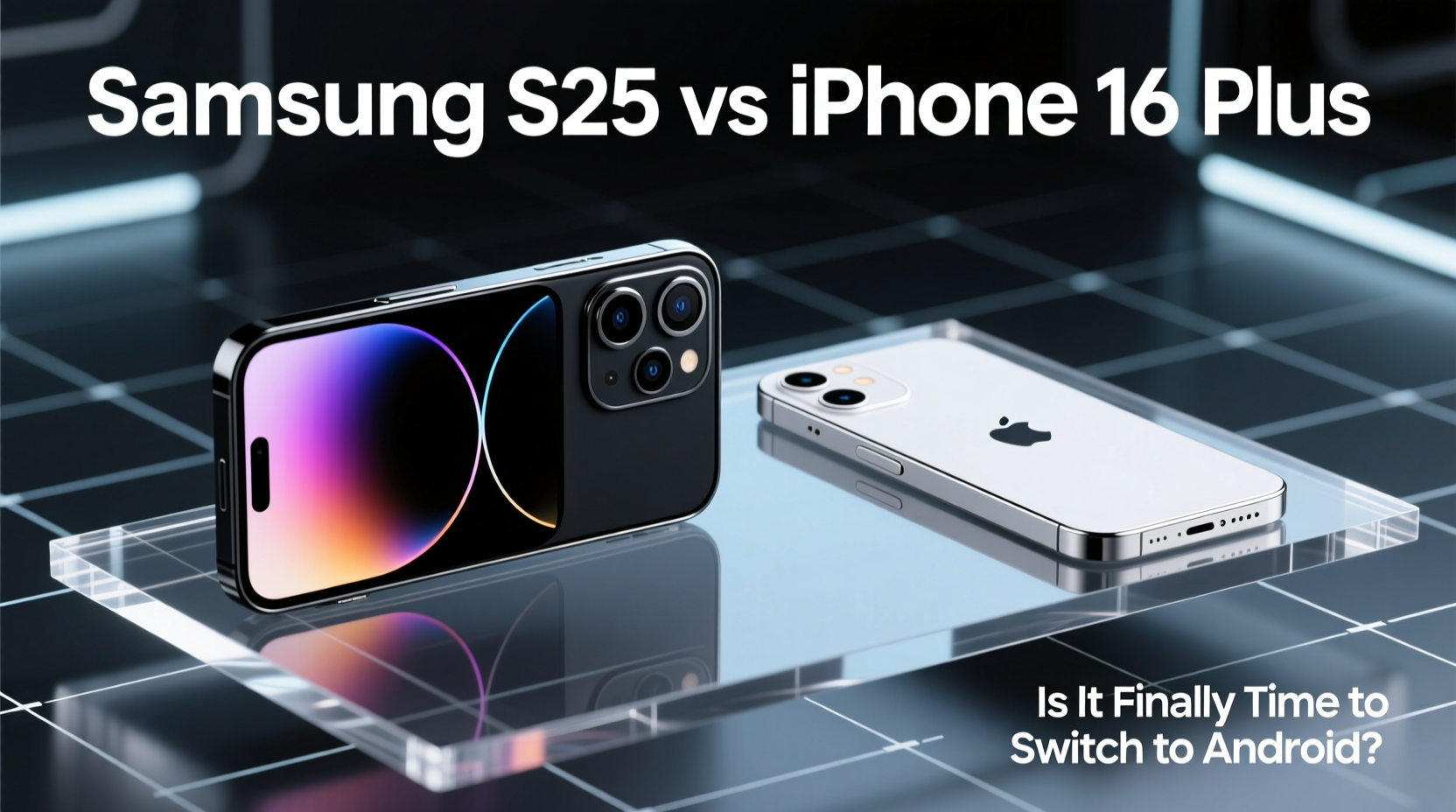
The Samsung S25 is expected to launch with the latest Snapdragon 8 Gen 4 chipset (or a next-gen Exynos variant in select regions), built on a 3nm process. This brings AI-driven optimizations, improved thermal management, and significantly faster neural processing—especially beneficial for photography, voice assistants, and real-time translation. With up to 16GB of RAM and UFS 4.0 storage, the S25 is built for heavy multitaskers and power users who run multiple apps, games, or productivity tools simultaneously.
In contrast, the iPhone 16 Plus will likely feature Apple’s A18 chip, also on a 3nm node. While Apple doesn’t lead in raw RAM or benchmark numbers, its hardware-software integration ensures buttery-smooth performance with minimal lag, even after years of use. iOS optimizes background processes aggressively, meaning the iPhone often feels faster in daily tasks despite lower spec sheets.
Where the S25 pulls ahead is in connectivity and expandability. It supports Wi-Fi 7, ultra-wideband enhancements, and potentially satellite messaging in select models. It also retains the option for expandable storage via microSD—a rare feature in flagship phones. The iPhone 16 Plus sticks with fixed storage tiers and relies on iCloud for expansion, which can become costly over time.
Camera Showdown: Flexibility vs Consistency
Photography remains a key battleground. The S25 is rumored to feature a 200MP main sensor with advanced pixel binning, a 50MP ultrawide, and a 10x periscope zoom lens. Its computational photography engine now leverages on-device AI to adjust lighting, depth, and color tone in real time—ideal for dynamic scenes like concerts or outdoor adventures.
Apple, meanwhile, continues refining its approach: fewer megapixels, but larger sensors and superior image signal processing. The iPhone 16 Plus will likely include a new tetraprism telephoto lens with 5x optical zoom and improved low-light video stabilization. For most users, iPhone photos “just look right”—natural skin tones, balanced exposure, and excellent dynamic range without over-processing.
But where Samsung wins is versatility. The S25 offers Pro mode with manual controls for shutter speed, ISO, white balance, and RAW capture. It also supports 8K video at 60fps, whereas the iPhone 16 Plus caps at 4K. If you edit photos or videos seriously, the S25 gives you more creative freedom.
“Android flagships now match or exceed iPhones in technical camera capabilities—but Apple still leads in consistency across lighting conditions.” — David Lin, Mobile Imaging Analyst at DXOMARK
Ecosystem Integration: Staying Locked In or Breaking Free?
This is where switching gets emotional. If you own an iPad, MacBook, AirPods, or Apple Watch, the iPhone 16 Plus is the linchpin of a seamless ecosystem. Features like Universal Clipboard, AirDrop, Handoff, and Continuity Camera create frictionless workflows. Switching to Android means losing these—or finding imperfect replacements.
However, Samsung has made massive strides with its ecosystem. The S25 works seamlessly with Galaxy Buds, Galaxy Watches, and Galaxy Tabs. With Samsung DeX, you can turn your phone into a desktop computer. SmartThings allows unified control of smart home devices. And Microsoft integration—especially Outlook, OneDrive, and Teams—is smoother on Android than on iOS.
If your digital life revolves around Google services (Gmail, Drive, Calendar), Android becomes the natural fit. Google Assistant is more deeply integrated, and features like Live Translate, Now Playing, and adaptive battery learning offer tangible benefits. On the iPhone, Google apps function well but lack system-level access.
Checklist: Are You Ready to Switch?
- ✅ Evaluate your current Apple device count (iPhone, iPad, Mac, Watch)
- ✅ Test Android compatibility with your primary cloud services (Google, Dropbox, Microsoft)
- ✅ Check if your favorite apps have full Android support (e.g., banking, fitness, note-taking)
- ✅ Try side-loading or borrowing a Galaxy S-series phone for a weekend
- ✅ Back up all data before initiating transfer via Samsung Smart Switch
Battery Life and Charging: Real-World Endurance
Battery anxiety is real, and here the S25 holds a distinct advantage. Expected to pack a 5000mAh battery with 45W fast charging, it can go from 0 to 70% in under 30 minutes. It also supports 15W wireless charging and reverse wireless charging—useful for powering up earbuds or a friend’s phone in a pinch.
The iPhone 16 Plus, while improved, likely maxes out at 30W fast charging (with USB-C) and 20W wireless. Its battery may be slightly smaller (~4500mAh), though iOS efficiency helps extend usage. Still, getting a full charge takes nearly twice as long as on the S25.
And let’s talk about chargers: Samsung no longer includes one in the box, but any USB-PD or Qualcomm Quick Charge adapter works. Apple now ships with a 20W charger in some regions, but anything faster requires a separate purchase—adding hidden costs.
| Feature | Samsung S25 | iPhone 16 Plus |
|---|---|---|
| Battery Capacity | ~5000mAh | ~4500mAh |
| Fast Charging | 45W (adapter sold separately) | 30W (requires separate purchase) |
| Wireless Charging | 15W | 20W (MagSafe only) |
| Reverse Charging | Yes | No |
Real-Life Scenario: When the Switch Made Sense
Consider Maria, a freelance photographer and content creator who used iPhones for 12 years. She loved the camera quality and iMovie integration but grew frustrated with slow charging, limited file access, and expensive iCloud upgrades. After testing the S23 Ultra, she switched to Android permanently.
With the S25, her workflow transformed: she transfers RAW files directly via USB-C, uses third-party file managers to organize shoots, and edits 8K footage on her phone using DaVinci Resolve. She pairs her Galaxy Watch with Google Fit and syncs everything to Google Drive. The initial transition took two weeks, mostly relearning navigation and replacing a few niche apps. But now, she says, “I have more control, faster tools, and I’m saving $120 a year on cloud storage.”
Frequently Asked Questions
Can I transfer my messages, photos, and contacts from iPhone to S25?
Yes. Samsung Smart Switch can migrate contacts, messages, photos, calendar events, and even app data wirelessly or via cable. Some iMessage formatting may be lost, but all core data transfers successfully.
Will my AirPods work with the S25?
AirPods will pair via Bluetooth and function as standard headphones. However, you’ll lose features like automatic switching, spatial audio with head tracking, and seamless Siri activation. For full functionality, consider Galaxy Buds or Sony WF-1000XM5.
Is Android secure enough for banking and sensitive apps?
Yes. Modern Android includes Google Play Protect, regular security patches, biometric authentication, and sandboxed app environments. Samsung Knox adds military-grade encryption and hardware-backed security, making the S25 one of the most secure Android devices available.
Conclusion: Time to Reassess Your Loyalty?
The gap between iOS and Android at the flagship level has never been narrower—and in several areas, Android now leads. The Samsung S25 delivers faster charging, greater customization, superior multitasking, and deeper integration with open ecosystems. The iPhone 16 Plus remains a polished, reliable choice, especially within Apple’s walled garden.
But if you value control, flexibility, and long-term cost efficiency, the S25 makes a compelling case. Switching isn’t trivial, but it’s no longer a sacrifice. Tools like Smart Switch, cross-platform apps, and improved Android stability have removed many historical pain points.




 浙公网安备
33010002000092号
浙公网安备
33010002000092号 浙B2-20120091-4
Comments
No comments yet. Why don't you start the discussion?