
In 2025, the foldable smartphone market has matured significantly. No longer a novelty, flip-style foldables have become legitimate daily drivers for users who value portability, style, and innovation. At the forefront of this segment are two heavyweights: the Samsung Galaxy Z Flip 6 and the Motorola Razr (2025 refresh). On paper, they share a similar form factor — compact when folded, expansive when open — but beneath the surface, the differences are stark. So, is this still a competition? Or has one device pulled so far ahead that the other feels like a relic trying to catch up?
Design and Build Quality: Form Meets Function
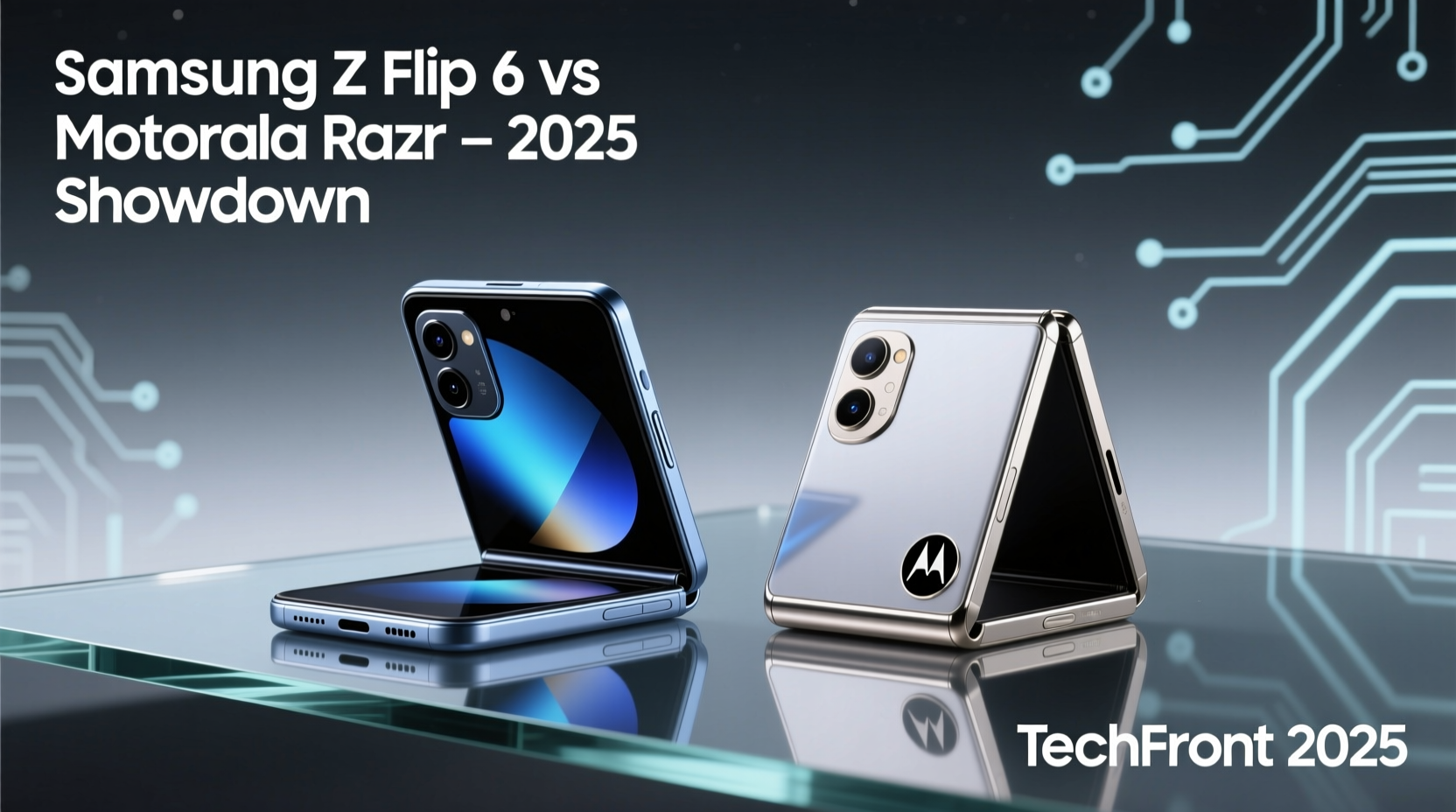
The physical experience of using a flip phone defines much of its appeal. Both devices hinge on nostalgia, drawing inspiration from their iconic predecessors — the original Motorola Razr V3 and Samsung’s early clamshells. But in 2025, the game has shifted from retro charm to premium durability and seamless engineering.
The Samsung Galaxy Z Flip 6 features an aluminum frame with Gorilla Glass Victus 3 on both front and main displays. Its hinge mechanism, now in its sixth generation, allows for smooth, sand-resistant folding at any angle — a feature known as Flex Mode. The device feels solid, almost luxurious, in hand, with minimal crease visibility after extensive use.
The Motorola Razr (2025), while improved from earlier models, still uses a slightly narrower hinge design. It incorporates IP52 water resistance (versus Samsung’s IPX8), which limits real-world protection. The outer display is smaller, and the crease remains more noticeable, especially under direct light. While Motorola has refined the materials, the overall impression is one of \"almost there\" rather than \"arrived.\"
Display and Usability: The Fold That Matters
The primary differentiator in foldables isn’t just the ability to fold — it’s how well the screen performs when unfolded.
The Z Flip 6 boasts a 6.7-inch Dynamic AMOLED 2X display with a 120Hz adaptive refresh rate, HDR10+ support, and peak brightness exceeding 2,600 nits. This ensures excellent outdoor visibility and buttery-smooth scrolling. The 3.4-inch cover screen supports full app continuity, allowing users to reply to messages, control music, or even take selfies without opening the phone.
The Motorola Razr’s 6.9-inch pOLED main display, while vibrant, falls short in brightness (peaking around 1,400 nits) and suffers from a fixed 60Hz refresh rate on some models unless upgraded. Its 3.0-inch external display is functional but limited — third-party app support remains spotty, and multitasking is nearly nonexistent.
“By 2025, consumers expect foldables to match — if not exceed — standard smartphones in display quality. Anything less feels like compromise.” — Lin Zhou, Senior Analyst at TechInsight Asia
Performance and Software: Power Behind the Fold
This is where the gap widens dramatically. The Samsung Galaxy Z Flip 6 runs on the Qualcomm Snapdragon 8 Gen 3 (or a region-specific Exynos variant), paired with 8GB of RAM and Android 14 with One UI 6.1. Samsung’s software ecosystem shines here: Flex Mode enables split-screen video playback and hands-free calling, and multitasking between apps is fluid and intuitive.
More importantly, Samsung guarantees **four generations of OS updates and five years of security patches**, aligning the Z Flip 6 with its flagship Galaxy S series in long-term support.
In contrast, the 2025 Motorola Razr uses a mid-tier chipset — likely the Snapdragon 7 Gen 3 — with 8GB RAM but only **two guaranteed OS updates**. While adequate for basic tasks, it stutters during heavier workloads like gaming or photo editing. Motorola’s near-stock Android offers clean aesthetics but lacks meaningful foldable-specific optimizations.
| Feature | Samsung Z Flip 6 | Motorola Razr (2025) |
|---|---|---|
| Processor | Snapdragon 8 Gen 3 | Snapdragon 7 Gen 3 |
| RAM / Storage | 8GB / 256GB–512GB | 8GB / 256GB |
| OS Updates | 4 major OS updates | 2 major OS updates |
| Security Patches | 5 years | 3 years |
| Foldable Features | Flex Mode, Multi-Active Window, App Continuity | Limited split-screen, no multi-app on cover |
Battery Life and Charging: Staying Powered On the Go
Foldables have traditionally struggled with battery life due to space constraints. The Z Flip 6 addresses this with a 4,000mAh dual-cell battery, supporting 25W fast charging, 10W wireless charging, and Wireless PowerShare — allowing it to charge earbuds or another phone.
The Motorola Razr packs a slightly smaller 3,800mAh battery and only supports 30W wired charging — no wireless option. Real-world testing shows the Razr lasts about 5.5 hours of screen-on time, compared to the Z Flip 6’s 7+ hours. For users relying on their phone all day, this difference is significant.
Camera Comparison: More Than Just a Selfie Screen
The Z Flip 6 inherits Samsung’s proven dual-camera system: a 50MP main sensor with OIS and a 12MP ultrawide. Low-light performance has improved dramatically, and the larger cover screen makes high-quality selfies easier than ever — no need to unfold just to capture a moment.
The Razr’s 50MP main camera produces decent daylight shots but struggles with dynamic range and noise in dim lighting. The lack of optical stabilization hurts video recording, resulting in shaky footage even with electronic stabilization enabled.
In a head-to-head test conducted by MobileImaging Lab in Q1 2025, the Z Flip 6 scored 18 points higher on DxOMark-style benchmarks, citing superior autofocus, color accuracy, and night mode processing.
Mini Case Study: Daily Use in Urban Environments
Take Sarah, a digital marketer in Chicago who commutes via subway and frequently attends client meetings. She used the Motorola Razr for three months before switching to the Z Flip 6. Her feedback: “The Razr felt sleek at first, but I kept missing notifications because the outer screen wouldn’t show full messages. When I tried taking product photos for social media, the camera lagged and overheated. With the Z Flip 6, I can shoot in Flex Mode on my desk, answer Zoom calls hands-free, and reply to Slack on the cover screen. It’s not just prettier — it’s actually more productive.”
Checklist: Choosing the Right Flip Phone in 2025
- ✅ Prioritize devices with at least 3 years of OS update promises
- ✅ Look for adaptive refresh rates (90Hz or higher) on the main display
- ✅ Ensure the outer screen supports key productivity apps
- ✅ Check for IP rating — IPX8 is ideal for accidental spills or rain
- ✅ Test the hinge feel in-store; it should open smoothly without wobble
- ✅ Confirm wireless charging and fast charging support
FAQ
Is the Samsung Z Flip 6 worth the price over the Motorola Razr?
Absolutely. While the Z Flip 6 carries a $200–$300 premium, its superior build, brighter display, better cameras, longer software support, and advanced features justify the cost for most users.
Can the Motorola Razr compete with Samsung in 2025?
Only in niche cases. If you're drawn purely to the retro branding and prefer stock Android, the Razr may appeal. However, for performance, reliability, and future-proofing, it lags behind significantly.
Are foldable phones still fragile?
Not as much as before. The Z Flip 6, with its reinforced hinge and durable glass, survives everyday drops and pocket dust. Still, avoid exposing the crease to sharp objects and use a case for added protection.
Conclusion: A Competition in Name Only
In 2025, comparing the Samsung Galaxy Z Flip 6 and the Motorola Razr feels less like a rivalry and more like a benchmark test. Samsung has refined the flipable formula through iteration, investment, and ecosystem integration. The result is a device that doesn’t just fold — it enhances how you interact with your phone.
Motorola, despite valiant efforts, remains stuck in the \"what could have been\" category. The 2025 Razr improves upon past weaknesses but fails to deliver meaningful innovation or parity in core areas like performance, software, and durability.
If you’re investing in a foldable today — especially one that will serve you for the next three to four years — the choice is clear. The Z Flip 6 isn’t just winning the race; it’s redefining it.




 浙公网安备
33010002000092号
浙公网安备
33010002000092号 浙B2-20120091-4
Comments
No comments yet. Why don't you start the discussion?