
The semicolon is one of the most misunderstood punctuation marks in English. Often mistaken for a comma or misused as a colon, it holds a unique place in sentence structure—bridging ideas with precision and clarity. While not used as frequently as commas or periods, the semicolon serves a critical role in advanced writing, especially in formal essays, journalism, and literary prose. This article dissects the correct use of semicolons by analyzing real excerpts, breaking down grammatical principles, and offering actionable guidance for writers at all levels.
Understanding the Semicolon’s Role
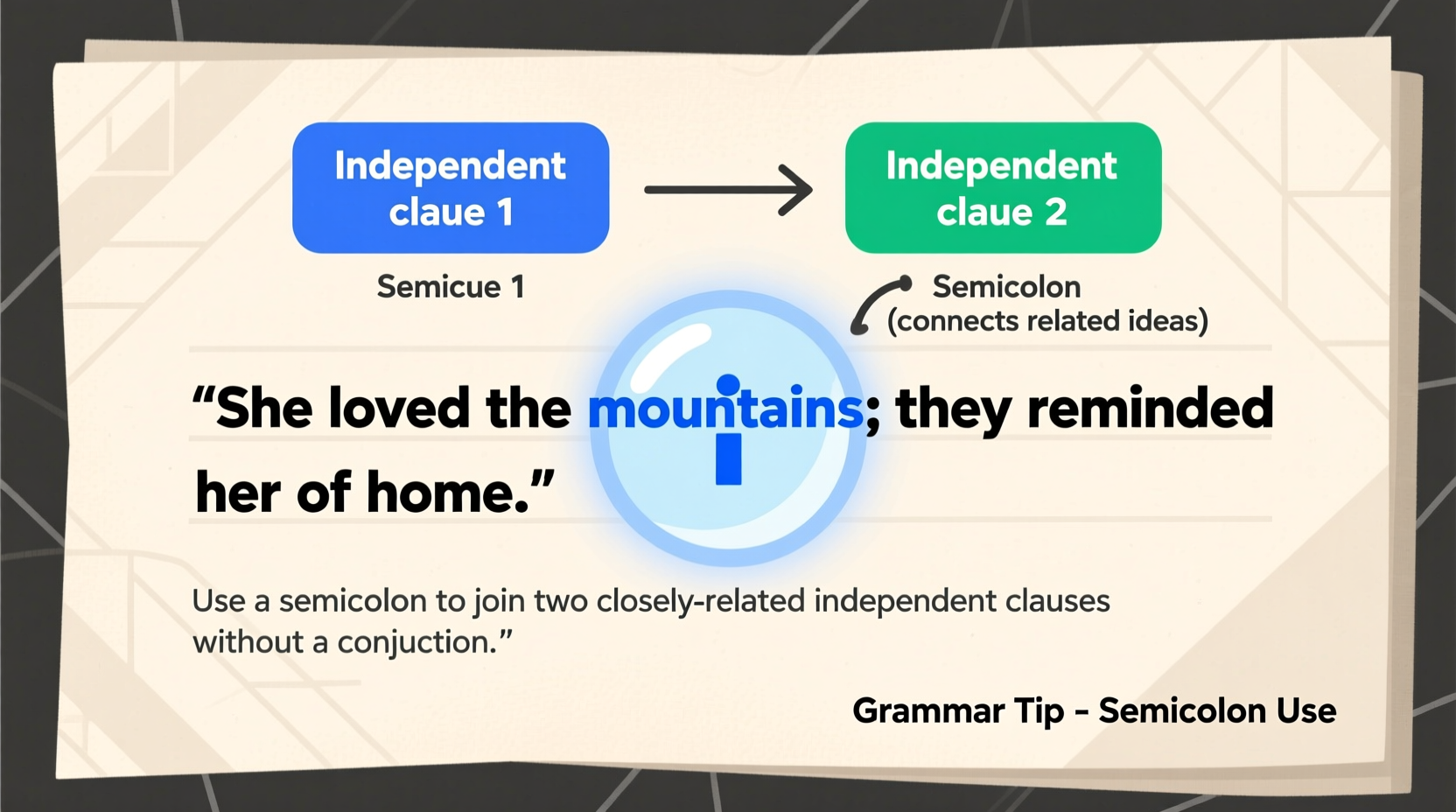
The semicolon (;) functions primarily to connect two independent clauses that are closely related in thought but could stand as sentences on their own. Unlike a period, which creates a full stop, the semicolon suggests a tighter relationship between ideas. It's stronger than a comma but softer than a period.
Consider this example:
\"She finished her presentation early; the audience responded with enthusiastic applause.\"
Here, both clauses are complete sentences. A period would work, but the semicolon emphasizes the cause-and-effect relationship more subtly than a conjunction like “and” or “so.”
Core Rules of Semicolon Usage
To use semicolons correctly, follow these three foundational rules:
- Linking Independent Clauses: Use a semicolon between two grammatically complete sentences that are thematically linked.
- Replacing Conjunctions: When the relationship between clauses is clear (e.g., contrast, sequence, consequence), a semicolon can replace “and,” “but,” or “so” for stylistic effect.
- Separting Complex List Items: In lists where items contain internal commas, use semicolons to avoid confusion.
Let’s examine each rule with examples.
1. Linking Independent Clauses
This is the most common use. Each clause must be able to stand alone as a sentence.
| Incorrect | Correct |
|---|---|
| I love reading; because it expands my mind. | I love reading; it expands my mind. |
| He arrived late, he missed the announcement. | He arrived late; he missed the announcement. |
In the first incorrect example, “because it expands my mind” is a dependent clause—it cannot stand alone. Thus, a semicolon is inappropriate. The second correction shows proper use: two independent clauses joined correctly.
2. Replacing Coordinating Conjunctions
Writers often use semicolons to create a more sophisticated tone by omitting conjunctions like “and” or “but” when the logical connection is implied.
“Freedom is the right to tell people what they do not want to hear.” — George Orwell; his words remain relevant today.
This construction links Orwell’s quote with a reflective comment. While a period would separate them too abruptly, and a comma would create a run-on, the semicolon strikes the right balance.
3. Semicolons in Complex Lists
When list items contain internal punctuation—especially commas—semicolons clarify boundaries.
Example:
- New York, NY; Los Angeles, CA; Chicago, IL; and Houston, TX
- The conference featured speakers from Paris, France; Berlin, Germany; Tokyo, Japan; and Sydney, Australia.
Without semicolons, readers might misread the list as having more items than intended.
Analyzing Real Excerpts: Grammar in Action
Let’s analyze a passage from Joan Didion’s essay “Goodbye to All That” to see how semicolons function in professional writing:
“You will think it is never going to come off again, and that you have aged ten years in the five weeks you have been there, and that you somehow never quite recovered from the way the darkness covers New York; it will never be the same again.”
While this excerpt doesn’t use a semicolon, consider how one might restructure it for emphasis:
“You will think it is never going to come off again; you have aged ten years in the five weeks you have been there; you somehow never quite recovered from the way the darkness covers New York.”
Here, the semicolons break up the long compound sentence into distinct yet connected reflections. Each clause stands independently, but together they build a cumulative emotional weight. The rhythm changes—becomes more deliberate and introspective—thanks to the semicolons.
Another example comes from Ernest Hemingway:
“The world breaks everyone; many become strong at the broken places.”
This famous line uses a semicolon to juxtapose a universal truth with a conditional response. The pause allows the reader to absorb the first idea before confronting the paradox in the second. It’s concise, powerful, and grammatically sound.
Common Mistakes and How to Avoid Them
Even experienced writers slip up with semicolons. Here are frequent errors and corrections:
| Mistake | Correction | Reason |
|---|---|---|
| I need to buy apples, oranges, and bananas; and milk. | I need to buy apples, oranges, and bananas; and milk. | Unnecessary semicolon before “and”—no complex list items. |
| Because I was tired; I went to bed early. | Because I was tired, I went to bed early. | Semicolon after dependent clause—must use comma. |
| She smiled; and waved. | She smiled and waved. | No need for semicolon with simple compound verb. |
Expert Insight on Punctuation and Style
Punctuation is not just about rules—it’s about rhythm and meaning. As author Lynne Truss famously wrote:
“Punctuation is a courtesy designed to help readers understand a text easily.” — Lynne Truss, Eats, Shoots & Leaves
This principle applies perfectly to the semicolon. Its purpose isn’t to impress but to clarify. When used well, it guides the reader through complex ideas with grace. When overused or misapplied, it disrupts flow and confuses meaning.
Style guides vary slightly. The Chicago Manual of Style encourages semicolons in complex lists and between closely related independent clauses. The AP Stylebook, aimed at journalists, advises caution—recommending simpler punctuation unless clarity demands otherwise.
Step-by-Step Guide to Using Semicolons Correctly
Follow this five-step process to ensure proper semicolon usage:
- Identify the clauses: Check if both parts of the sentence are independent (can stand alone).
- Assess the relationship: Are the ideas closely related in theme, time, or logic?
- Decide on conjunction use: If using “and,” “but,” etc., a comma may suffice. If omitting the conjunction, consider a semicolon.
- Check list complexity: In lists with internal commas, switch to semicolons for clarity.
- Read aloud: Does the pause feel natural? If it sounds awkward, revise.
Frequently Asked Questions
Can I use a semicolon with a conjunction like \"and\"?
Generally, no. You should not use a semicolon immediately before coordinating conjunctions such as \"and,\" \"but,\" or \"or\" unless the clauses are very long and contain internal commas. Example: “I had a meeting in Boston, Massachusetts; and although I arrived late, I still made my presentation.” Even then, rephrasing is often clearer.
Is the semicolon becoming obsolete?
No. While its use has declined in casual writing, it remains essential in academic, literary, and professional contexts. Many editors and publishers still expect mastery of the semicolon as a sign of strong writing ability.
How many semicolons should I use in one paragraph?
There’s no fixed rule, but moderation is key. Overuse can make writing feel stilted. One or two per paragraph is usually sufficient unless writing complex technical or philosophical material.
Final Thoughts: Mastering the Semicolon
The semicolon is not a decorative mark—it’s a tool for precision. By connecting related ideas with subtle strength, it enhances clarity and depth in writing. Whether you're drafting an essay, editing a report, or refining a novel, understanding how to use the semicolon correctly sets your work apart.
Revisit classic literature. Analyze how authors like Virginia Woolf, James Baldwin, or David Foster Wallace wield semicolons to control pace and meaning. Then apply those lessons deliberately in your own writing.




 浙公网安备
33010002000092号
浙公网安备
33010002000092号 浙B2-20120091-4
Comments
No comments yet. Why don't you start the discussion?