
For many households, bread is a daily staple—used for sandwiches, toast, or simply enjoyed with butter. Yet one of the most common kitchen dilemmas isn’t about recipes or ingredients, but storage: should you keep your loaf on the counter or in the refrigerator? The answer isn’t as straightforward as it seems, and the wrong choice can lead to stale, moldy, or unappetizing bread within days. Understanding the science behind starch retrogradation, moisture loss, and microbial growth helps clarify what food scientists and culinary professionals recommend.
The Science Behind Bread Staling
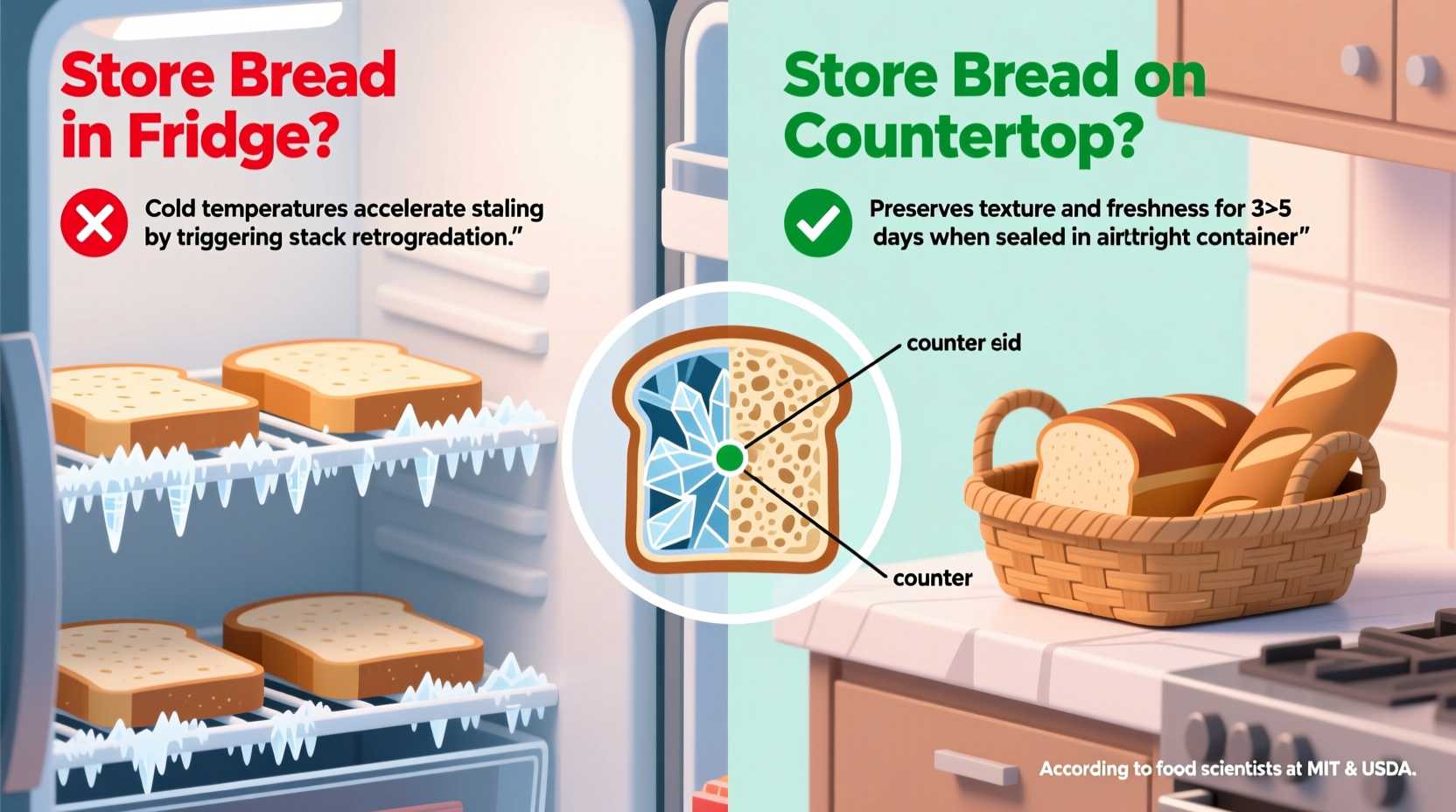
Bread doesn't spoil only because of mold—it begins to degrade almost immediately after cooling. The primary culprit is a process called **starch retrogradation**, where the gelatinized starch molecules in baked bread begin to recrystallize as they cool. This realignment causes the crumb structure to harden, leading to that familiar dry, chewy texture we associate with \"stale\" bread—even if no mold is present.
Temperature plays a critical role in this process. Counterintuitively, refrigeration accelerates staling. Studies show that bread stored between 0°C and 10°C (32°F–50°F)—the typical fridge range—undergoes retrogradation up to six times faster than bread kept at room temperature. This means that while refrigeration slows mold growth, it makes bread taste stale far sooner.
“Refrigeration may extend shelf life in terms of mold prevention, but it drastically shortens sensory quality. For optimal texture, room temperature is nearly always better.” — Dr. Susan Selke, Director of the School of Packaging at Michigan State University
Fridge vs. Countertop: A Direct Comparison
The decision between fridge and countertop storage hinges on two competing factors: **mold growth** and **texture degradation**. Here's how each environment affects bread over time:
| Storage Method | Staling Speed | Mold Growth Risk | Best For | Worst For |
|---|---|---|---|---|
| Countertop (Room Temp) | Slow staling (3–5 days optimal) | Higher risk after day 3–4 | Immediate consumption, artisanal loaves | Humid climates, long-term storage |
| Refrigerator | Rapid staling (within 1–2 days) | Significantly reduced | Delayed use in humid environments | Preserving softness or flavor |
| Freezer | Negligible staling | None (when properly sealed) | Long-term storage (up to 3 months) | Daily access without thawing |
As shown, refrigeration wins on mold suppression but loses on texture. Room temperature preserves mouthfeel but risks spoilage in warm or humid conditions. The freezer, often overlooked, emerges as the best compromise for long-term preservation.
When the Fridge Makes Sense (And When It Doesn’t)
There are specific situations where refrigerating bread may be the lesser of two evils. In regions with high humidity—such as coastal areas or tropical climates—mold can develop on a countertop loaf in as little as 48 hours. In these cases, some bakers and food safety experts suggest short-term refrigeration as a practical workaround, especially if the bread will be toasted or warmed before eating.
However, even under these conditions, refrigeration should be limited. Once bread goes stale due to cold storage, reheating cannot fully restore its original softness. The crust may soften too much, and the crumb can become gummy or tough.
Conversely, refrigeration is strongly discouraged for sourdough, whole grain, and artisan loaves. These breads rely heavily on complex starch structures and natural fermentation, which are particularly sensitive to retrogradation. Their open crumb and lack of preservatives make them more prone to drying out quickly when chilled.
A Better Alternative: The Freezer Solution
If your goal is to preserve both freshness and safety beyond a few days, freezing is the gold standard. Unlike refrigeration, freezing halts both mold growth and staling by immobilizing water molecules and preventing starch recrystallization.
To freeze bread effectively:
- Slice the loaf immediately after purchase (if not pre-sliced).
- Wrap tightly in plastic wrap or aluminum foil.
- Place in a resealable freezer bag, squeezing out excess air.
- Label with the date (use within 2–3 months for best quality).
When ready to eat, remove individual slices and toast directly from frozen. A toaster oven or regular toaster works perfectly, restoring crispness and warmth without requiring full thawing. For larger portions, thaw at room temperature for 30–60 minutes or warm in a 350°F (175°C) oven for 10–15 minutes.
“We freeze all our bread at home. It’s the only way to ensure every slice tastes fresh, whether it’s day one or day thirty.” — James Chen, Professional Baker and Owner of Hearth & Crust Bakery
Real-World Example: The Houston Household Dilemma
Consider a family in Houston, Texas—one of the most humid cities in the U.S. They buy a fresh sourdough loaf on Monday morning. By Tuesday evening, they notice faint specks of mold forming near the heel of the loaf, despite storing it in a bread box on the counter. Frustrated, they switch to refrigerating their next loaf.
This time, no mold appears—but by Wednesday, the bread is so dry and rubbery that even toasting fails to make it palatable. After reading about freezing options, they try slicing and freezing half the loaf upon arrival. Over the next month, they enjoy fresh-tasting toast every morning, pulling only what they need. Their waste drops to zero, and satisfaction soars.
This scenario illustrates a key principle: environmental conditions influence storage decisions, but modern solutions like freezing can outperform traditional methods regardless of climate.
Common Myths About Bread Storage Debunked
- Myth: Keeping bread in a plastic bag prevents staling. While plastic bags reduce moisture loss, they don’t stop starch retrogradation. In fact, they can trap condensation, promoting mold in warm environments.
- Myth: A bread box keeps bread fresher longer than an open counter. Bread boxes help regulate airflow and protect from light and pests, but they don’t significantly extend shelf life beyond 3–5 days. In humid areas, they may even increase mold risk if not cleaned regularly.
- Myth: Refrigerating bread kills bacteria and mold spores. Cold temperatures only slow microbial growth—they don’t eliminate existing spores or kill them. Once returned to room temperature, mold resumes growing rapidly.
Step-by-Step Guide to Optimal Bread Storage
Follow this timeline-based approach to maximize freshness based on your consumption pattern:
- Day 0 – Purchase: Immediately assess how quickly you’ll consume the loaf. If finishing within 3 days, leave whole and store at room temperature. If slower, slice and prepare for freezing.
- Days 1–3 – Countertop: Keep in a paper bag or cloth-lined basket. Avoid plastic unless using within 24 hours. Store cut-side down on a cutting board to minimize exposed surface area.
- After Day 3 – Evaluate: Check for signs of mold or staleness. If still good, consider toasting to revive texture. Do not refrigerate unless absolutely necessary.
- For Long-Term Use – Freeze: Wrap sliced bread in parchment, then foil, then place in a freezer bag. Remove slices as needed.
- Thawing: For best results, toast frozen slices directly. For sandwiches, thaw wrapped bread at room temperature for 30 minutes.
Expert Tips for Different Bread Types
Not all bread reacts the same way to storage. Here’s how to handle popular varieties:
- White Sandwich Bread: Often contains preservatives, allowing 5–7 days on the counter. Still benefits from freezing if unused after day 4.
- Sourdough: Lacks preservatives and has natural acidity that resists mold slightly longer. Best consumed within 4 days at room temp. Never refrigerate.
- Brioche or Enriched Doughs: High fat and egg content make them more perishable. Store no more than 2–3 days on counter; freeze extras promptly.
- Pita or Flatbreads: Prone to drying out. Store in airtight container with a damp cloth for 2–3 days, or freeze for longer use.
FAQ: Your Bread Storage Questions Answered
Can I bring refrigerated bread back to freshness?
Partially. Warming refrigerated bread in an oven or toaster can improve texture temporarily, but it won’t reverse starch retrogradation. The crumb will remain drier than freshly baked bread. Prevention—via freezing—is far more effective.
Does a bread machine delay staling?
No. While convenient, bread made in a home machine follows the same chemical principles. Without preservatives, it stales at similar rates to store-bought artisan bread. Freeze portions you won’t eat within 3 days.
Is vacuum sealing worth it for bread storage?
Only if combined with freezing. Vacuum sealing at room temperature offers minimal benefit and may compress delicate crumb structures. For fridge or freezer storage, it helps prevent freezer burn and extends quality, but isn’t essential.
Final Recommendations: What You Should Do Today
The consensus among food scientists, bakers, and packaging experts is clear: do not store bread in the refrigerator unless you live in an extremely humid environment and plan to consume it within 24 hours of removal. Even then, freezing remains a superior option.
For most people, the ideal strategy combines room-temperature storage for immediate use and freezing for anything beyond three days. This approach balances flavor, texture, and food safety without compromise.
Invest in a simple bread bin or linen bag for your countertop stash. Label and date frozen loaves. Slice before freezing to avoid crushing the loaf later. And above all, trust your senses—discard bread at the first sign of mold, regardless of storage method.
“The best bread storage method depends not on tradition, but on your actual usage. Plan ahead, freeze early, and never suffer through a stale slice again.” — Dr. Alison Hill, Food Preservation Researcher, UC Davis
Take Action Now
Your next loaf doesn’t have to end up stale or moldy. Start applying these expert-backed strategies today: assess your consumption habits, organize your storage tools, and embrace the freezer as your ally. Share your experience or ask questions in the comments—help others discover smarter ways to enjoy fresh bread, every time.




 浙公网安备
33010002000092号
浙公网安备
33010002000092号 浙B2-20120091-4
Comments
No comments yet. Why don't you start the discussion?