
Setting the date on a quartz watch may seem straightforward, but doing it incorrectly can lead to mechanical stress, inaccurate timekeeping, or even long-term damage to the movement. Many people unknowingly harm their watches by adjusting the date during restricted hours or forcing the crown. With the right knowledge and technique, you can maintain your timepiece’s precision and longevity—just like a seasoned watch enthusiast.
This guide breaks down the correct process into simple, actionable steps, explains common pitfalls, and shares insider tips used by professionals. Whether you’ve just bought your first quartz watch or have been wearing one for years, mastering this fundamental skill ensures your watch remains reliable and accurate.
Understanding How Quartz Watches Display the Date
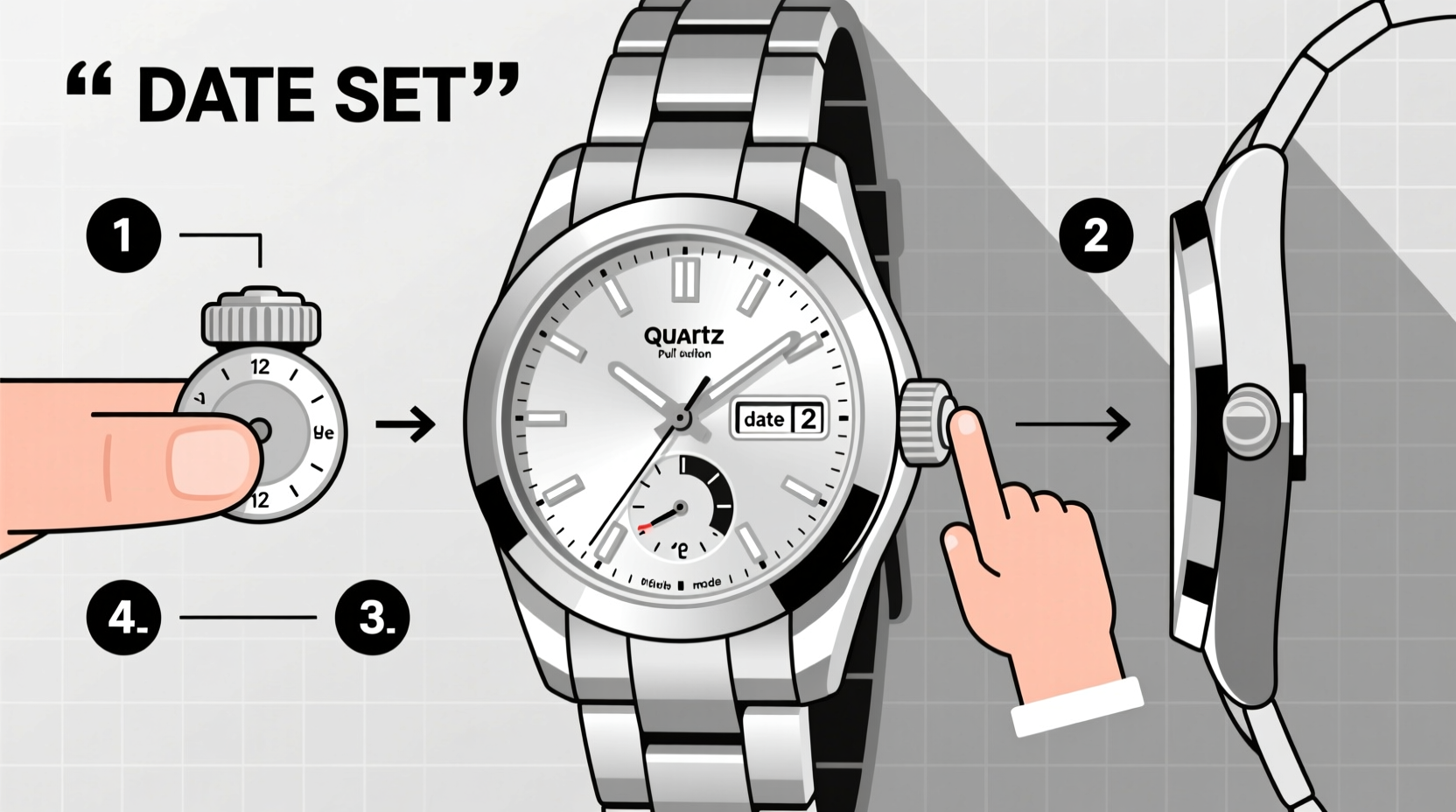
Quartz watches use a battery-powered electronic oscillator regulated by a quartz crystal to keep time. The date function is typically controlled by a small gear train that advances the date wheel once every 24 hours. Unlike mechanical watches, quartz movements are generally more forgiving—but they still have limitations when it comes to date adjustment.
The date change usually occurs gradually over several minutes or instantly at midnight, depending on the model. Some watches feature a \"quick-set\" date function, allowing you to adjust the date independently of the hour hand. Others require you to cycle through 24-hour increments to reach the correct date.
“Even though quartz watches are durable, adjusting the date between 9 PM and 3 AM risks damaging the internal gears. It’s a small window, but respecting it makes a big difference.” — Daniel Reyes, Watch Technician & Vintage Timepiece Restorer
Step-by-Step Guide: Setting the Date Safely and Accurately
Follow this sequence to set your quartz watch without risking damage. This method works for most standard quartz watches with a stem-adjusted date function.
- Check the current time: Pull the crown out to its first position (if your watch supports mid-position date adjustment) or second position (time-setting mode). Observe whether the date changes when you move the hands.
- Avoid the danger zone: Never adjust the date between 9:00 PM and 3:00 AM. During this period, the internal mechanism is in the process of advancing the date. Forcing a change can misalign gears or damage the date jumper spring.
- Set the correct time: Advance the hands clockwise until the date flips to the previous day. This ensures you're just before the changeover point.
- Use the quick-set function (if available): On many modern quartz watches, pulling the crown to the first click allows you to rotate it to advance the date only. Turn gently until the correct date appears.
- Finalize the setting: Push the crown back in fully and adjust the time precisely, ensuring AM/PM alignment is correct.
Do’s and Don’ts When Adjusting Your Watch Date
| Do’s | Don’ts |
|---|---|
| Set the date between 6:00 AM and 8:00 PM | Adjust the date between 9:00 PM and 3:00 AM |
| Pull the crown gently to avoid stripping | Force the crown if it resists movement |
| Use the quick-set function when available | Try to change the month/year via the crown unless designed for it |
| Ensure the crown is fully pushed in after use | Expose the watch to water with the crown pulled out |
| Wash hands before handling to prevent oil buildup | Adjust the date daily while wearing the watch tightly on wrist |
Real Example: Avoiding Costly Mistakes
Mark, an office manager in Chicago, received a sleek quartz dress watch as a gift. Excited to wear it, he adjusted the date every evening before bed—often around 10:30 PM. After three months, the date stopped changing altogether. He brought it to a local jeweler, who diagnosed a bent date indicator lever caused by repeated adjustments during the prohibited window.
The repair cost $45, and the technician advised him to always set the date in the morning. Mark now sets his watch after breakfast, turning a routine into a mindful habit. His watch has worked flawlessly since.
Essential Tips for Long-Term Watch Care
Accurate date setting is part of broader watch maintenance. Incorporate these habits to protect your investment:
- Sync daylight saving time carefully: When clocks change, advance the time slowly through each hour rather than skipping ahead rapidly.
- Check water resistance regularly: If your watch is water-resistant, ensure the crown is fully seated before exposure to moisture.
- Store properly when not worn: Keep your watch in a dry place away from magnets and extreme temperatures.
- Replace batteries promptly: A dying battery can leak and damage the movement. Replace it within one month of the seconds hand jumping in two-second intervals.
Quick Checklist: Setting Your Quartz Watch Date Like a Pro
Keep this checklist handy the next time you need to adjust your watch:
- ✅ Confirm the current date and time
- ✅ Wait until the time is between 6:00 AM and 8:00 PM
- ✅ Gently pull the crown to the first or second position
- ✅ Use the quick-set function (first position) if available
- ✅ If no quick-set, advance hands past midnight to change the date
- ✅ Set the precise time, including AM/PM
- ✅ Push the crown fully back in (screw down if applicable)
- ✅ Verify the date changes correctly the following night
Frequently Asked Questions
Can I set the date every day without harming my watch?
Yes, but only outside the 9:00 PM to 3:00 AM window. Daily adjustments are safe as long as you respect the movement’s mechanics. Frequent misuse during the changeover phase, however, can lead to premature wear.
Why doesn’t my watch have a quick-set date function?
Some entry-level or minimalist quartz watches omit the quick-set feature to reduce manufacturing costs or maintain slim profiles. In such cases, you must cycle the time forward (or backward, if supported) to adjust the date.
What should I do if the date won’t change?
First, ensure the battery isn’t dead. If the hands move but the date doesn’t, try advancing the time past midnight manually. If the issue persists, the date wheel or driving pinion may be jammed or damaged—seek professional service.
Master the Small Details, Elevate Your Routine
Setting the date on a quartz watch might seem trivial, but precision in small habits defines how well your tools serve you over time. By understanding the mechanics behind the dial and treating your watch with informed care, you extend its life, accuracy, and reliability.
Whether you rely on your watch for punctuality, style, or sentiment, taking a few extra moments to set it correctly reflects respect for craftsmanship and attention to detail. These quiet acts of maintenance compound into years of flawless performance.




 浙公网安备
33010002000092号
浙公网安备
33010002000092号 浙B2-20120091-4
Comments
No comments yet. Why don't you start the discussion?