
When shopping for an engagement ring or a special piece of jewelry, many consumers today are drawn to alternatives to mined diamonds. Two popular options—simulated diamonds and lab grown diamonds—are often confused, especially when it comes to how they look and sparkle. While both may appear dazzling under store lighting, their composition, brilliance, and long-term value differ significantly. Understanding these differences helps you make an informed decision that aligns with your budget, ethics, and aesthetic preferences.
Understanding the Key Differences
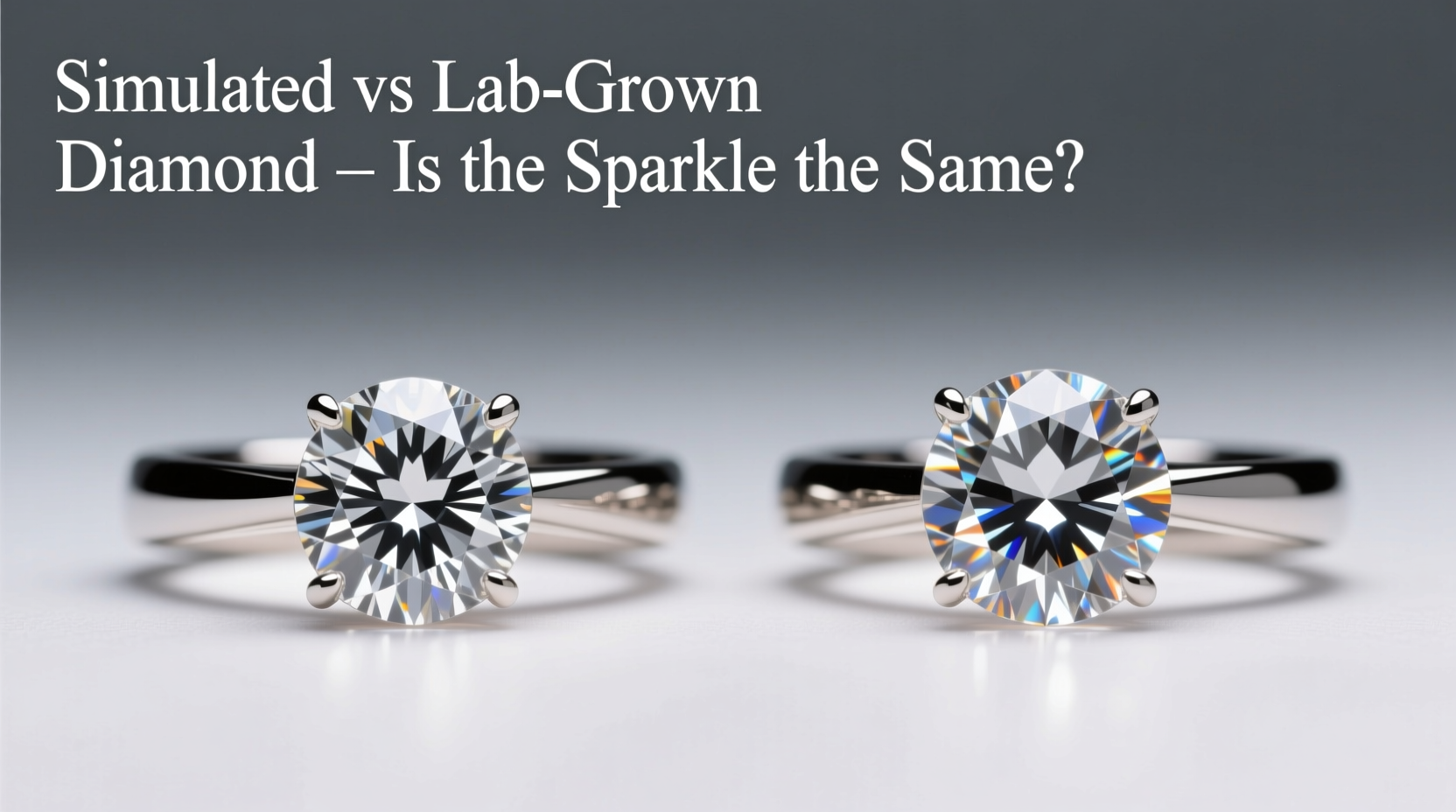
The first step in evaluating sparkle is understanding what each term means. A simulated diamond is a stone designed to mimic the appearance of a diamond but is made from materials such as cubic zirconia (CZ), moissanite, or glass. These are not chemically or structurally related to real diamonds. In contrast, a lab grown diamond is created in a controlled environment using advanced technology that replicates the natural conditions under which diamonds form deep within the Earth. The result is a diamond with the same chemical composition (pure carbon), crystal structure, and optical properties as a mined diamond.
This fundamental difference affects everything from durability to brilliance. Simulated stones may sparkle brightly at first glance, but their light performance—how they reflect, refract, and disperse light—varies widely based on material. Moissanite, for instance, has higher dispersion than diamond, meaning it produces more colorful flashes (often called \"fire\"), which some people love and others find too flashy. Cubic zirconia tends to lose its luster over time and can scratch easily, dulling its shine.
“Lab diamonds are optically, physically, and chemically identical to earth-mined diamonds. To the naked eye—and even under magnification by most jewelers—they are indistinguishable.” — Dr. Sarah Chen, Gemologist and Director of Certification, International Gemological Institute (IGI)
Sparkle Science: Refraction, Fire, and Brilliance
Sparkle isn’t just about brightness—it’s a combination of three key optical effects:
- Brilliance: The amount of white light reflected back to the viewer.
- Fire: The dispersion of light into spectral colors (rainbow flashes).
- Scintillation: The pattern of light and dark areas and the sparkle produced when the stone or light source moves.
Lab grown diamonds score nearly identically to mined diamonds across all three metrics because they share the same atomic structure. Their refractive index (how much light bends as it enters the stone) is 2.42, and their dispersion value is 0.044—both benchmarks for true diamond fire and brilliance.
Simulated stones vary:
| Material | Refractive Index | Dispersion (Fire) | Durability (Mohs Scale) |
|---|---|---|---|
| Diamond (Mined or Lab Grown) | 2.42 | 0.044 | 10 |
| Moissanite | 2.65–2.69 | 0.104 | 9.25 |
| Cubic Zirconia (CZ) | 2.15–2.18 | 0.058–0.066 | 8–8.5 |
| Glass | ~1.5 | Low | 5–6 |
As shown, moissanite actually exceeds diamond in fire and refraction, which can lead to a noticeably different kind of sparkle—one rich in rainbow flashes. Some wearers enjoy this vibrant effect; others find it less refined than the subtle, balanced brilliance of a diamond. CZ starts bright but degrades over time due to surface scratches and clouding, reducing its long-term sparkle.
Real-World Example: Choosing for an Engagement Ring
Consider Emma and James, a couple planning their engagement. They wanted a beautiful ring but were mindful of both budget and environmental impact. At first, they were drawn to a large cubic zirconia center stone because it looked stunning in the display case. However, after wearing a sample for a week, Emma noticed it had dulled and collected fine scratches from daily use—even from typing and washing hands.
They then tried a one-carat lab grown diamond in a similar setting. Though slightly smaller in size for the same price, the stone retained its sharp sparkle, showed no signs of wear, and looked identical to a mined diamond in every way. Their jeweler explained that while CZ needed frequent replacement, the lab diamond would last generations. This experience shifted their perspective: longevity and authenticity mattered as much as initial appearance.
How to Evaluate Sparkle When Shopping
Whether online or in-store, assessing sparkle requires attention to detail. Follow this checklist before making a purchase:
- View in multiple lighting conditions: Check the ring under natural daylight, indoor lighting, and dim ambient light. Diamonds perform best across all settings.
- Move the stone: Observe scintillation by tilting the ring. Look for a balanced mix of white flashes and subtle colored fire.
- Compare side-by-side: If possible, place a simulated stone next to a lab grown diamond. Note differences in sharpness and depth of reflection.
- Ask for certification: Reputable lab grown diamonds come with grading reports from labs like IGI or GCAL, verifying cut, clarity, color, and origin.
- Check the setting: Even the finest stone can appear dull in a poorly designed setting. Ensure prongs don’t block light entry.
Cost, Ethics, and Long-Term Value
Price is often a deciding factor. Simulated diamonds like CZ cost a fraction of lab grown stones—sometimes under $50 for a one-carat equivalent. Moissanite ranges from $200–$600 per carat. Lab grown diamonds typically cost 30–50% less than mined diamonds, placing a one-carat stone between $800 and $2,500 depending on quality.
But cost shouldn’t be viewed in isolation. Consider long-term value:
- Lab grown diamonds hold resale value better than simulants.
- They are certified, insurable, and can be passed down as heirlooms.
- Many couples appreciate that lab diamonds have a smaller environmental footprint than mining operations.
In contrast, simulated stones are generally not considered valuable assets. While ethical concerns about mining labor practices drove interest in alternatives, it's important to note that lab grown diamonds offer a sustainable, traceable option without sacrificing authenticity.
Frequently Asked Questions
Can a jeweler tell if a diamond is lab grown?
Not with the naked eye. Specialized equipment is required to detect growth patterns unique to lab diamonds. Most consumer-grade tools cannot distinguish them from mined diamonds.
Do lab grown diamonds get cloudy over time?
No. Like mined diamonds, lab grown diamonds do not cloud with age. Any loss of sparkle is due to surface dirt or oils, which can be cleaned with mild soap and water.
Is moissanite a type of lab grown diamond?
No. Moissanite is silicon carbide, a different mineral altogether. It is always lab-created but is not a diamond, simulated or otherwise—though it is often marketed as a diamond alternative.
Final Thoughts: Sparkle With Integrity
The sparkle of a diamond ring is more than a visual effect—it’s a symbol of clarity, commitment, and craftsmanship. While simulated stones can offer short-term dazzle at a low price, only lab grown diamonds deliver the full spectrum of brilliance, fire, and durability that defines a true diamond experience. They provide peace of mind through verifiable origins, lasting beauty, and emotional resonance.
If you want a ring that looks identical to a mined diamond, performs beautifully in any light, and stands the test of time, a lab grown diamond is the superior choice. The sparkle is not only the same—it carries the weight of authenticity.




 浙公网安备
33010002000092号
浙公网安备
33010002000092号 浙B2-20120091-4
Comments
No comments yet. Why don't you start the discussion?