
Slow download speeds in Google Chrome can be frustrating, especially when you're trying to install software, grab important files, or stream media. While Chrome is known for its speed and efficiency, various factors—ranging from network congestion to misconfigured settings—can significantly reduce download performance. The good news is that most slowdowns are fixable without technical expertise. This guide walks through actionable, real-world-tested solutions to restore fast downloads in Chrome.
Diagnose the Real Cause of Slow Downloads
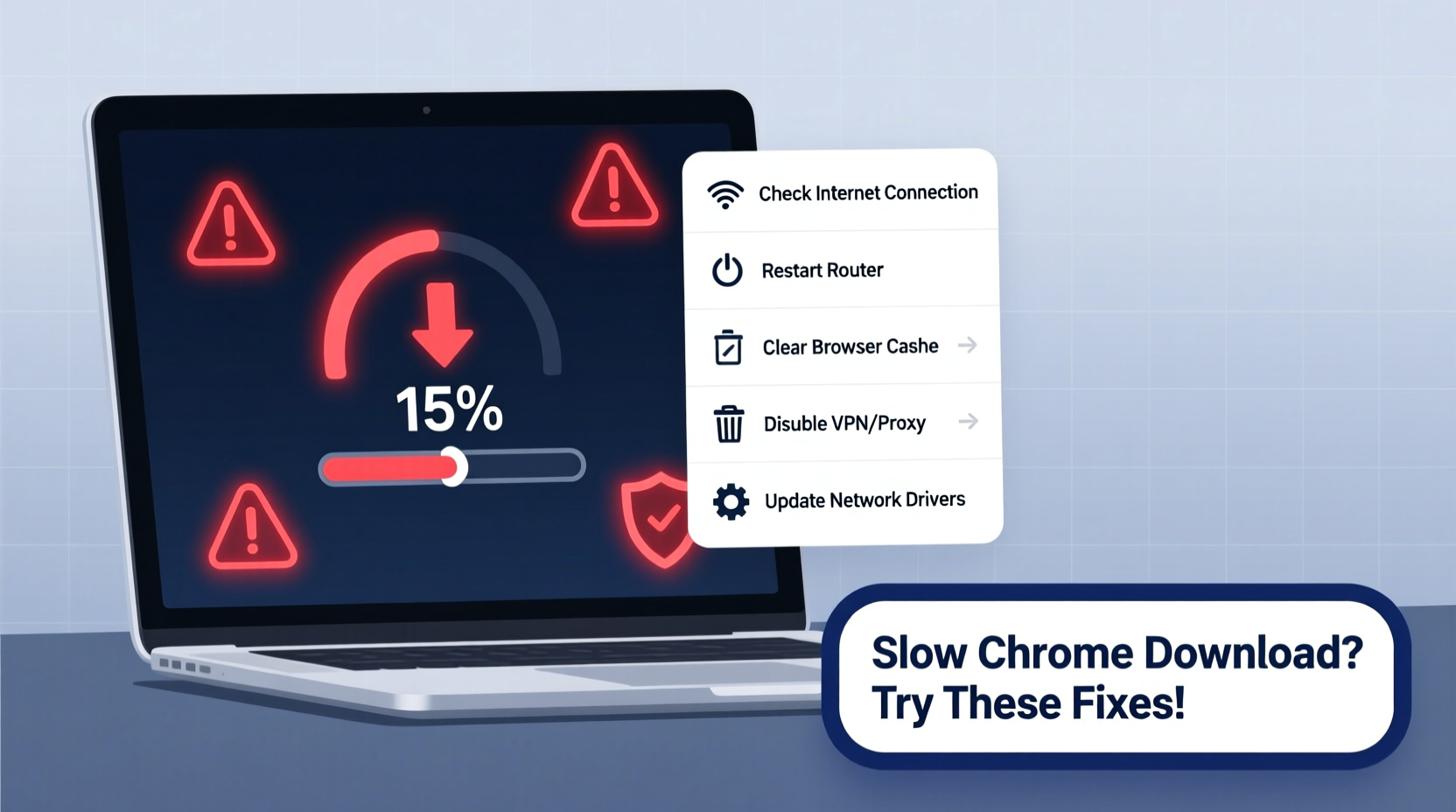
Before jumping into fixes, it's essential to determine whether the issue lies with Chrome itself, your internet connection, or external factors like server limitations. Start by testing your actual internet speed using a reliable service such as Speedtest.net. Compare the results with what your ISP promises. If speeds are consistently below expectations, the problem may be your network—not Chrome.
If general browsing is fast but only downloads are slow, Chrome-specific issues are likely at play. These include outdated browser versions, corrupted cache, conflicting extensions, or bandwidth throttling within Chrome’s own settings.
“Many users blame their ISP when Chrome download speeds drop, but over 60% of cases stem from local browser or device configurations.” — Rajiv Mehta, Network Performance Analyst at WebOptima Labs
Step-by-Step Guide to Restore Fast Chrome Downloads
Follow this structured approach to systematically eliminate causes of slow downloads:
- Check Internet Speed: Use a third-party speed test tool to confirm your baseline download rate.
- Test Download in Another Browser: Try downloading the same file in Firefox or Edge. If speeds are normal, the issue is isolated to Chrome.
- Clear Browsing Data: Corrupted cache or cookies can interfere with download processes.
- Disable Extensions: Some ad blockers or download managers interfere with Chrome’s native download engine.
- Update Chrome: Outdated versions may lack performance optimizations or contain bugs.
- Reset Chrome Settings: If all else fails, revert to default settings to eliminate configuration conflicts.
Common Fixes That Deliver Immediate Results
1. Clear Cache and Site Data
Over time, accumulated cache can cause erratic behavior in Chrome. To clear it:
- Navigate to Settings > Privacy and Security > Clear Browsing Data.
- Select “Cached images and files” and “Cookies and other site data”.
- Set time range to “All time” and click “Clear data”.
2. Disable or Remove Problematic Extensions
Extensions like ad blockers, privacy tools, or download accelerators can unintentionally throttle or reroute traffic. Test by launching Chrome in Incognito mode (which disables most extensions by default). If downloads speed up, re-enable extensions one by one to identify the culprit.
3. Turn Off Predictive Network Actions
Chrome’s “Preload pages for faster browsing” feature can consume bandwidth in the background. To disable:
- Go to Settings > Privacy and Security > Cookies and Other Site Data.
- Turn off “Preload pages for faster browsing and searching”.
4. Adjust DNS Settings
Your default DNS provider might be slow or unreliable. Switching to a faster DNS like Google DNS (8.8.8.8) or Cloudflare (1.1.1.1) often improves connectivity. This change is made at the system level:
- Open Network & Internet Settings (Windows: Control Panel > Network and Sharing Center).
- Change adapter settings > Right-click your connection > Properties.
- Select “Internet Protocol Version 4 (TCP/IPv4)” > Properties.
- Choose “Use the following DNS server addresses” and enter preferred and alternate DNS.
Troubleshooting Checklist
- Run an internet speed test to rule out ISP issues
- Try downloading the same file in another browser
- Clear Chrome’s cache and cookies
- Launch Chrome in Incognito mode to test extension impact
- Disable bandwidth-heavy extensions (e.g., ad blockers)
- Update Chrome to the latest version
- Turn off predictive preloading in settings
- Change DNS to Google (8.8.8.8) or Cloudflare (1.1.1.1)
- Reset Chrome settings if problems persist
- Restart your router and modem
When Chrome Isn’t the Problem: External Factors
Sometimes, slow downloads aren't due to Chrome at all. Consider these often-overlooked factors:
| Factor | Impact on Downloads | Solution |
|---|---|---|
| Server Location & Load | Distant or overloaded servers deliver slower downloads | Try downloading during off-peak hours or use a mirror site |
| Wi-Fi Interference | Physical obstacles or signal congestion reduce throughput | Switch to Ethernet or move closer to the router |
| Background Applications | Cloud sync, updates, or streaming apps consume bandwidth | Pause non-essential apps during large downloads |
| Router Firmware | Outdated firmware can limit performance | Check manufacturer website for updates |
Mini Case Study: Office Worker Regains Full Download Speed
Sarah, a project manager in Toronto, noticed her Chrome downloads crawling at 1 Mbps despite having a 100 Mbps plan. She tested in Firefox—downloads ran at full speed. After disabling her ad blocker extension, downloads in Chrome immediately jumped to 90+ Mbps. The extension was silently injecting filters that disrupted connection handshakes. By switching to a lighter alternative, Sarah maintained both privacy and performance.
Advanced Fixes for Persistent Issues
Reset Chrome to Default Settings
If standard fixes don’t work, reset Chrome entirely:
- Go to Settings > Advanced > Reset and Cleanup.
- Select “Restore settings to their original defaults”.
- Confirm the action. This won’t delete bookmarks or saved passwords but will disable extensions and clear temporary data.
Enable Hardware Acceleration (or Disable It)
Hardware acceleration uses your GPU to improve performance, but on some systems, it causes instability. Toggle it:
- Settings > System > \"Use hardware acceleration when available\".
- Toggle off, restart Chrome, and test downloads. If no improvement, toggle back on.
Flush DNS and Renew IP
On Windows, open Command Prompt as administrator and run:
ipconfig /flushdns
ipconfig /release
ipconfig /renew
This clears local DNS cache and refreshes your IP address, often resolving connectivity hiccups.
Frequently Asked Questions
Why are my downloads slow in Chrome but fast in other browsers?
This usually indicates a Chrome-specific issue such as corrupted profile data, problematic extensions, or misconfigured flags. Try resetting Chrome settings or testing in Incognito mode to isolate the cause.
Does clearing cache really improve download speed?
Yes—while cache primarily affects page loading, corrupted or bloated cache can interfere with background processes, including downloads. Regular cleanup helps maintain browser health and stability.
Can antivirus software slow down Chrome downloads?
Absolutely. Some security suites scan every downloaded file in real-time, adding significant latency. Temporarily disable real-time scanning to test. If speed improves, adjust your antivirus settings to exclude trusted sites or delay scans until after download completion.
Conclusion: Take Control of Your Chrome Experience
Slow Chrome download speeds are rarely permanent. With methodical troubleshooting—from checking your network to fine-tuning browser settings—most users see dramatic improvements within minutes. The key is to isolate variables, apply targeted fixes, and avoid unnecessary software bloat. Chrome remains one of the fastest browsers available, but it requires occasional maintenance to perform at its best.




 浙公网安备
33010002000092号
浙公网安备
33010002000092号 浙B2-20120091-4
Comments
No comments yet. Why don't you start the discussion?