
Lighting accounts for nearly 15% of household electricity use in the average American home. As homeowners look to reduce energy bills and environmental impact, the shift from traditional incandescent bulbs to LEDs has been a major step forward. But now, a new question arises: should you stick with standard LED bulbs or upgrade to smart bulbs? While both are vastly more efficient than older lighting technologies, their differences in energy consumption, control capabilities, and long-term cost-effectiveness can significantly influence your decision.
This article breaks down the real-world performance of smart bulbs versus regular LED bulbs, comparing energy efficiency, automation benefits, usability, and total ownership costs. Whether you're retrofitting a single room or planning a whole-home lighting overhaul, understanding these distinctions helps you make smarter, more sustainable choices.
Energy Efficiency: Do Smart Bulbs Use More Power?
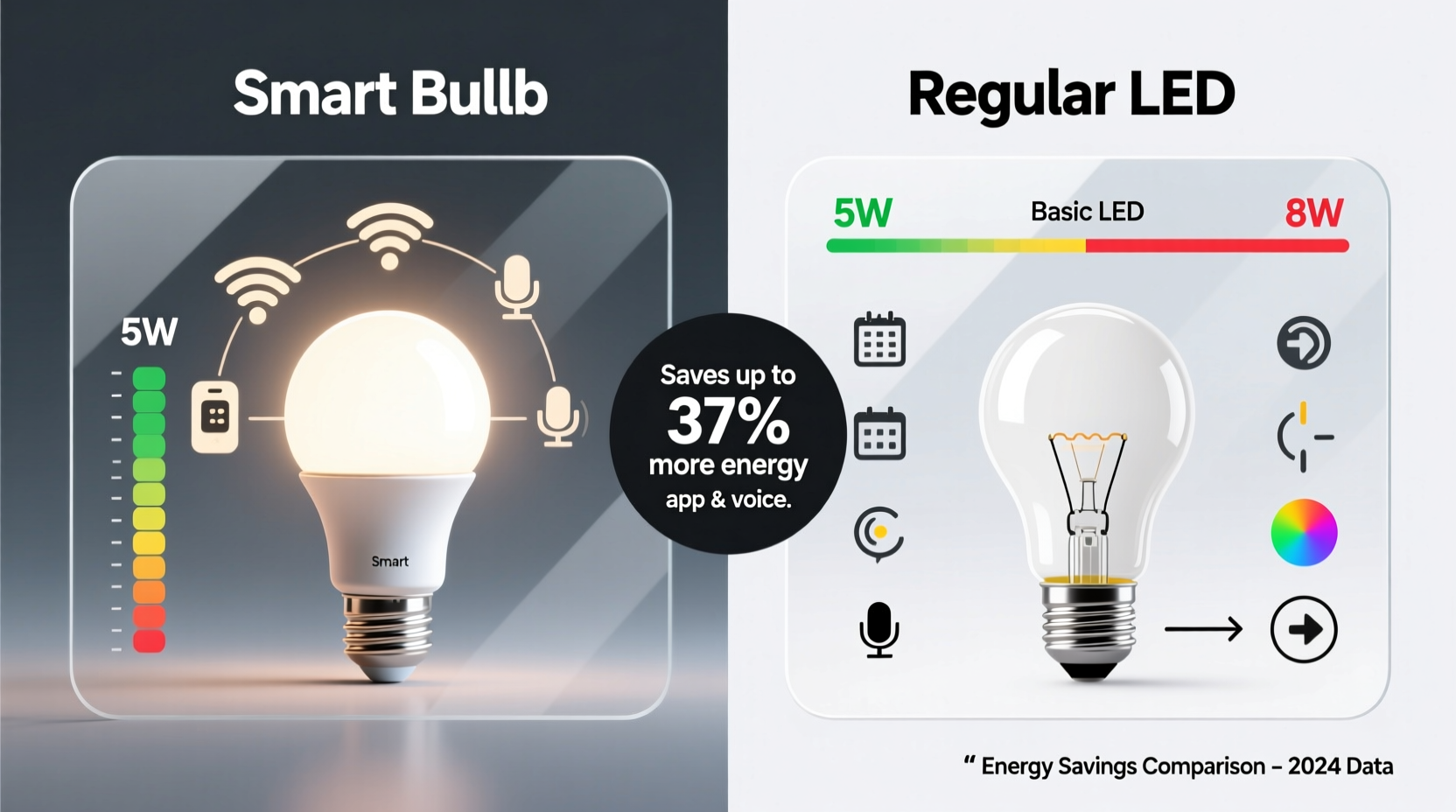
At their core, both smart bulbs and regular LED bulbs rely on light-emitting diode (LED) technology, meaning they are inherently energy-efficient compared to halogen or incandescent bulbs. A typical 800-lumen LED bulb consumes about 9–10 watts of power—roughly one-sixth the energy of an equivalent incandescent.
The key difference lies not in brightness per watt but in how smart bulbs use power even when \"off.\" Unlike regular LED bulbs, which cut off all current when switched off at the fixture, smart bulbs must remain partially powered to stay connected to Wi-Fi, Bluetooth, or Zigbee networks. This standby mode allows remote control and voice activation but comes at a small energy cost.
Studies by the U.S. Department of Energy indicate that most smart bulbs draw between 0.2 and 0.5 watts in standby mode. While this may seem negligible, it adds up over time—especially if you have multiple smart bulbs installed throughout your home.
Real-World Energy Comparison
A household with 20 light fixtures using regular LED bulbs will consume energy only during active use. In contrast, 20 smart bulbs could collectively draw an extra 4 to 10 watts continuously—equivalent to leaving a small nightlight on 24/7. Over a year, this translates to roughly 35–90 kWh of additional consumption, costing $5–$12 annually depending on local electricity rates.
However, smart bulbs often lead to net energy savings due to advanced usage patterns enabled by automation. For example, lights that automatically turn off when no one is in the room or dim based on natural daylight can reduce overall usage far more than the minimal standby drain.
“While smart bulbs consume slightly more energy in standby, their ability to optimize usage through scheduling and occupancy sensing typically results in lower total energy consumption.” — Dr. Lena Torres, Energy Efficiency Researcher at the Institute for Building Science
Control and Automation: Where Smart Bulbs Shine
Regular LED bulbs offer basic functionality: they turn on and off via a physical switch. Their simplicity is reliable, but limited. Smart bulbs, on the other hand, unlock a wide range of control options that transform how we interact with lighting.
- Remote Access: Control lights from anywhere using a smartphone app, whether you're upstairs, at work, or on vacation.
- Voice Commands: Integrate with assistants like Alexa, Google Assistant, or Siri for hands-free operation.
- Scheduling: Set lights to turn on at sunset and off at bedtime, improving consistency and reducing forgetfulness.
- Dimming & Color Tuning: Adjust brightness and color temperature (e.g., warm white for evenings, cool white for mornings) to support circadian rhythms.
- Scenes & Routines: Create ambiance presets like “Movie Night” or “Wake Up,” syncing multiple bulbs across rooms.
- Geofencing: Lights activate automatically when your phone enters the home’s vicinity.
These features aren’t just convenient—they encourage energy-conscious behavior. For instance, geofencing prevents lights from being left on unnecessarily, while motion-triggered shut-offs ensure rooms aren’t illuminated when unoccupied.
Limitations of Smart Bulb Control
Despite their advantages, smart bulbs come with trade-offs. Network dependency means outages or router issues can disable remote access. Some models require a hub (like Philips Hue Bridge), adding complexity and cost. Additionally, frequent firmware updates and app reliance may frustrate users seeking plug-and-play simplicity.
In contrast, regular LED bulbs work independently of internet connectivity, making them ideal for critical areas like stairwells or basements where reliability trumps automation.
Cost Analysis: Upfront Price vs Long-Term Value
When evaluating smart versus regular LED bulbs, cost extends beyond the sticker price. Consider both initial investment and long-term savings.
| Feature | Regular LED Bulb | Smart Bulb (Wi-Fi) |
|---|---|---|
| Average Unit Cost | $2–$5 | $10–$25 |
| Lifespan | 15,000–25,000 hours | 15,000–20,000 hours |
| Wattage (800 lumens) | 9–10W | 9–11W |
| Standby Power Draw | 0W | 0.2–0.5W |
| Dimmable? | Some models | Yes (standard feature) |
| Color Options | Fixed (usually warm/cool white) | Tunable white or RGB color |
| Hub Required? | No | Some brands (e.g., Hue) |
While smart bulbs cost 3–5 times more upfront, their automation features can yield indirect savings. A study by the Consumer Technology Association found households using smart lighting reported a 20–30% reduction in lighting-related energy use due to improved habits and automation.
For example, a family that previously left hallway and kitchen lights on for 10 hours daily might reduce usage to 4 hours through scheduled shut-offs and motion detection—saving over 100 kWh per year across just five fixtures.
Mini Case Study: The Miller Family's Lighting Upgrade
The Millers, a family of four in Portland, Oregon, replaced 12 regular LED bulbs with smart bulbs in their living room, kitchen, entryway, and outdoor porch. They chose Wi-Fi-enabled color-tunable bulbs compatible with Google Home.
Within two months, they noticed several changes:
- Lights turned off automatically after 15 minutes of inactivity in the kitchen and living room.
- Morning routines were enhanced with gradual wake-up lighting that mimicked sunrise.
- Outdoor lights activated at dusk and deactivated at midnight, eliminating overnight waste.
- Remote control allowed them to check and toggle lights while away, increasing security and peace of mind.
After six months, their utility bill showed a $7 monthly decrease in lighting costs despite higher baseline usage earlier in the year. They attributed the savings primarily to behavioral changes reinforced by automation—not the bulbs themselves, but how the technology changed their habits.
While the initial investment was around $200, they expect to recoup the added cost within three years through energy savings and reduced replacement frequency.
Step-by-Step Guide: Choosing the Right Option for Your Needs
Deciding between smart bulbs and regular LEDs shouldn’t be all-or-nothing. Most homes benefit from a hybrid approach. Follow this practical guide to make informed decisions room by room.
- Assess Usage Patterns: Identify which rooms are used frequently, which are prone to lights being left on, and where ambiance matters.
- Prioritize High-Impact Areas: Install smart bulbs in common areas (living room, kitchen), entry points, and outdoor spaces where automation adds convenience and efficiency.
- Stick with Regular LEDs in Low-Traffic Zones: Use standard dimmable LEDs in closets, garages, or guest rooms where smart features offer little benefit.
- Check Compatibility: Ensure your smart bulbs work with existing dimmer switches and voice assistants. Mismatches can cause flickering or failure.
- Start Small: Begin with 2–3 smart bulbs to test responsiveness, app usability, and network stability before scaling up.
- Evaluate Total System Cost: Factor in hubs, additional bridges, or subscription services (if applicable) when budgeting.
- Monitor Energy Use: Use a smart plug or energy monitor to track actual consumption of smart bulbs over time.
Frequently Asked Questions
Do smart bulbs really save energy?
Yes—but indirectly. While smart bulbs consume a small amount of power when off, their automation features (like scheduling, motion detection, and remote shutoff) typically lead to reduced overall usage. The energy saved from preventing unnecessary operation usually outweighs the standby drain.
Can I use smart bulbs with regular light switches?
You can, but with limitations. If you turn off a smart bulb at the wall switch, it loses power and disconnects from the network, disabling remote control. For best results, leave the switch on and control the bulb exclusively through the app or voice commands.
Are smart bulbs worth the extra cost?
They can be, depending on your lifestyle. If you value convenience, security, ambiance, or precise lighting control, smart bulbs deliver tangible benefits. For basic illumination needs, regular LEDs remain the most cost-effective choice.
- ✅ Reliable home Wi-Fi coverage in target rooms
- ✅ Compatible voice assistant or smartphone OS
- ✅ Willingness to keep wall switches ON for smart functionality
- ✅ Budget for $10–$25 per bulb (or more for premium models)
- ✅ Interest in automation, scenes, or color tuning
Final Verdict: Which Is Better for You?
When it comes to raw energy efficiency, regular LED bulbs have a slight edge—they consume zero standby power and perform identically in terms of lumens per watt. However, smart bulbs often deliver greater real-world energy savings by influencing user behavior and enabling intelligent automation.
The choice ultimately depends on your priorities:
- If your goal is **maximum efficiency at the lowest cost**, regular LED bulbs are sufficient and highly effective.
- If you want **advanced control, customization, and long-term behavioral optimization**, smart bulbs justify their higher price through convenience, ambiance, and indirect energy reductions.
A balanced strategy works best for most households: use smart bulbs where control and automation matter most, and rely on high-quality regular LEDs elsewhere. This hybrid model maximizes both efficiency and functionality without overspending.
“The future of home lighting isn’t just about efficiency—it’s about intelligence. The most energy-saving bulb is the one that turns off when you forget to.” — Mark Chen, Senior Product Manager at Luminova Labs
Take Action Today
Don’t let indecision keep your home stuck in outdated lighting habits. Audit your current setup: identify which lights are most often left on accidentally, which rooms would benefit from dimming or scheduling, and where simple illumination is enough. Start with one smart bulb in a high-use area and observe the difference it makes. Over time, build a lighting system that’s not only brighter but smarter and more sustainable.




 浙公网安备
33010002000092号
浙公网安备
33010002000092号 浙B2-20120091-4
Comments
No comments yet. Why don't you start the discussion?