
As homes grow smarter, consumers face a growing number of choices when it comes to automating lighting and appliances. Two of the most popular entry points into home automation are smart bulbs and smart plugs. Both promise convenience, remote control, and energy savings—but which actually delivers greater long-term energy efficiency?
The answer isn’t always straightforward. While both devices reduce energy waste through scheduling, automation, and monitoring, their impact depends on usage patterns, device types, and how they're integrated into daily life. To determine which option offers better energy savings over time, it’s essential to understand their mechanics, typical power draw, cost structures, and real-world performance.
How Smart Bulbs Work and Their Energy Profile
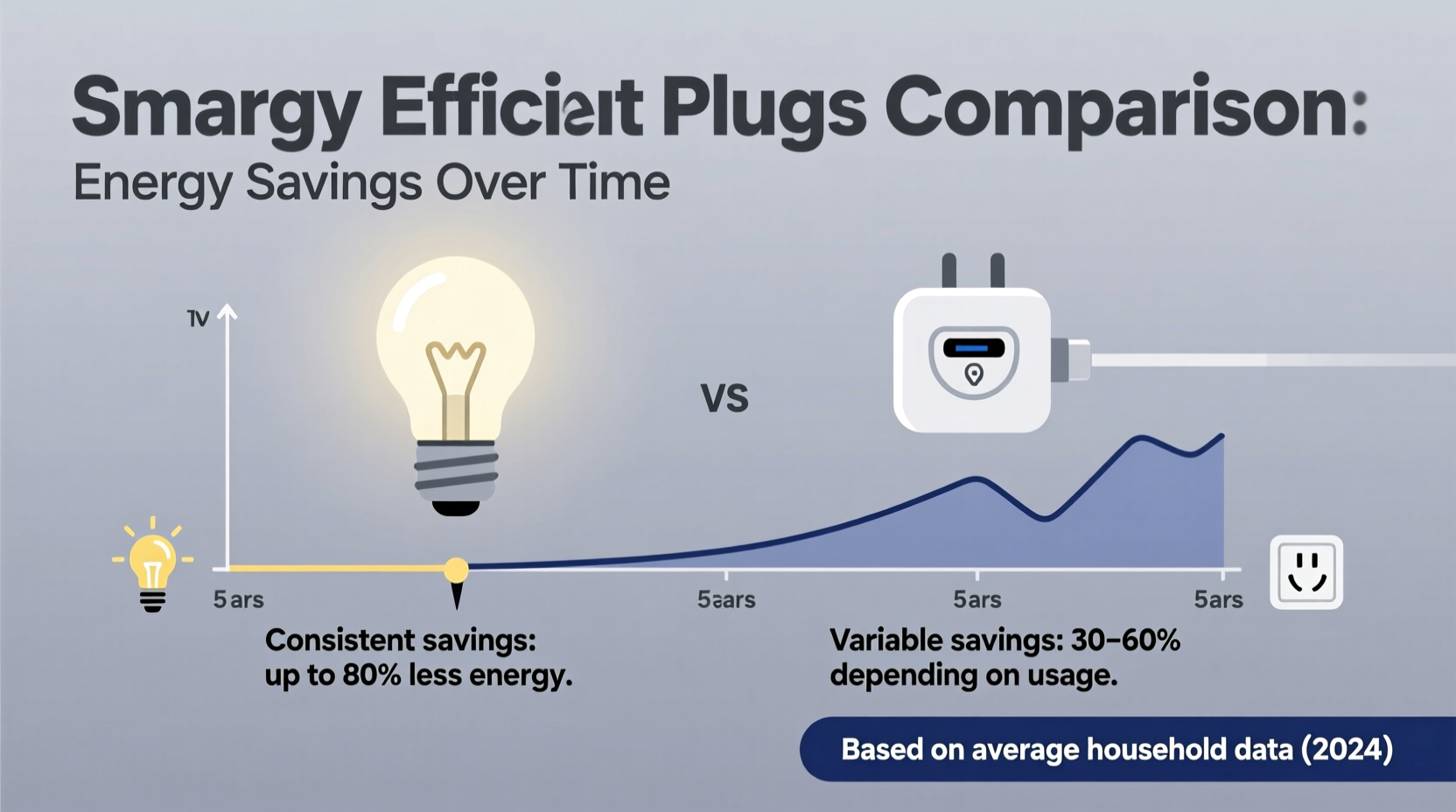
Smart bulbs replace traditional incandescent or LED bulbs with Wi-Fi- or Bluetooth-enabled lighting units. They allow users to adjust brightness, color temperature, and on/off states via smartphone apps, voice assistants, or automation routines. Most modern smart bulbs use LED technology, making them inherently more efficient than older lighting options.
However, being \"smart\" adds a small overhead. Even when turned off, many smart bulbs remain in standby mode to stay connected to your network. This phantom load typically consumes 0.2 to 0.5 watts per hour. While minimal, this adds up across multiple fixtures over months.
A typical smart bulb uses between 6 and 10 watts when lit—comparable to standard LEDs—but its true energy-saving potential lies in automation. Features like motion-triggered lighting, geofencing (turning lights off when you leave), and scheduled dimming prevent unnecessary usage.
Smart Plugs: Simplicity Meets Versatility
Smart plugs act as intermediaries between an outlet and any plugged-in device. They enable remote control, scheduling, and energy monitoring for lamps, fans, coffee makers, space heaters, and other appliances. Unlike smart bulbs, they don’t replace hardware—they retrofit existing devices.
One key advantage is flexibility. A single smart plug can manage a high-wattage floor lamp with an old-school incandescent bulb just as easily as a modern LED desk light. This makes them ideal for homes not ready to replace every bulb.
Energy-wise, smart plugs themselves consume about 0.5 to 1 watt in standby. But their real value is cutting power completely to devices that would otherwise draw “vampire power” even when switched off at the unit. For example, a TV on standby might use 5–10 watts continuously; a smart plug can eliminate that drain by fully disconnecting it after hours.
Some advanced models offer real-time energy tracking, allowing users to see exactly how much electricity a connected device consumes. This transparency often leads to behavioral changes—like unplugging rarely used gadgets or replacing inefficient ones.
Comparative Energy Efficiency: Smart Bulbs vs Smart Plugs
To evaluate long-term energy savings, consider three factors: baseline efficiency, automation capabilities, and cumulative impact.
- Baseline Efficiency: Smart bulbs are limited to lighting circuits and only improve efficiency if replacing less-efficient bulbs. If your home already uses standard LEDs, upgrading to smart versions yields minimal efficiency gains.
- Automation Reach: Smart plugs control a broader range of devices, many of which are larger energy consumers than lights (e.g., space heaters, entertainment systems).
- Cumulative Impact: Phantom loads from idle electronics often exceed lighting consumption over time. Eliminating these with smart plugs can lead to higher overall savings.
“While smart lighting gets attention, the biggest wins in residential energy savings come from managing standby power across multiple appliances.” — Dr. Linda Chen, Energy Efficiency Researcher at MIT Sustainable Systems Lab
Energy Consumption Comparison Table
| Device | Avg. Active Power | Standby Power | Typical Use Case | Potential Savings Path |
|---|---|---|---|---|
| Smart Bulb | 8W (lit) | 0.3W | Ceiling lights, lamps | Reduce runtime via schedules/motion |
| Smart Plug | N/A (passes power) | 0.7W | Lamps, TVs, heaters, chargers | Cut phantom load, automate shutdowns |
| Connected Device (e.g., TV) | 60–100W (on) | 5–10W (standby) | Entertainment system | Eliminate 80+ kWh/year standby use |
As shown, while smart bulbs save modestly on lighting, smart plugs unlock deeper cuts by targeting high-idle devices. Over a year, eliminating 10 watts of constant standby power saves roughly 87 kWh—equivalent to leaving a smart bulb on 24/7 for over a decade.
Real-World Example: The Johnson Family Home
The Johnsons live in a suburban three-bedroom house. They recently installed four smart bulbs in frequently used rooms and two smart plugs—one controlling a living room entertainment center (TV, soundbar, game console), the other managing a bedroom space heater used seasonally.
Before automation, their TV setup drew 8 watts in standby mode 20 hours a day. That’s 58.4 kWh annually—about $7 in wasted electricity. The space heater, accidentally left on overnight twice during spring, consumed 1,500 watts for 8 hours each time—adding nearly $30 in avoidable costs.
After setup, the smart plug shuts off the entertainment center at 11 PM nightly and disables the heater after 1 hour unless manually overridden. Combined with the smart bulbs turning off automatically when no motion is detected, their monthly electric bill dropped by 12% within three months.
Interestingly, the largest savings came not from the bulbs, but from the smart plug on the entertainment system. Despite the heater’s high wattage, its infrequent use limited annual impact. The constant, unnoticed drain of the TV setup was the real culprit.
When Smart Bulbs Save More
Smart bulbs outperform smart plugs in specific scenarios:
- Replacing inefficient bulbs: Swapping 60W incandescents with 9W smart LEDs in high-use areas (e.g., kitchen, office) can save hundreds of kWh per year.
- Frequent partial lighting: Dimmable smart bulbs used at 50% brightness consume roughly half the energy, especially effective in mood-lit spaces.
- Outdoor/security lighting: Automating porch or pathway lights with motion detection prevents all-night operation, common with manual switches.
In homes still using halogen or CFL bulbs, smart LEDs provide immediate efficiency gains beyond what smart plugs can offer through automation alone.
Action Plan: Maximizing Long-Term Energy Savings
For optimal results, combine both technologies strategically. Follow this step-by-step guide:
- Audit Your Devices: Identify which lights and appliances run longest or have high standby draw. Use a plug-in power meter to measure actual consumption.
- Prioritize High-Use Lighting: Replace bulbs in rooms used >2 hours/day with smart LEDs if not already efficient.
- Target Phantom Loads: Install smart plugs on entertainment centers, computer setups, coffee makers, and chargers.
- Set Automation Rules: Schedule lights to turn off at bedtime. Program plugs to cut power to non-essential devices overnight.
- Monitor and Adjust: Review app data monthly. If a device shows high idle usage, consider unplugging it permanently or replacing it with a more efficient model.
Checklist: Energy-Saving Smart Device Setup
- ☐ Audit current lighting and appliance energy use
- ☐ Replace inefficient bulbs with LED or smart LED equivalents
- ☐ Install smart plugs on devices with known standby consumption
- ☐ Enable auto-off schedules (e.g., 11 PM for living areas)
- ☐ Use motion sensors for hallways, bathrooms, garages
- ☐ Monitor energy reports weekly for first month
- ☐ Adjust settings based on actual usage data
Cost-Benefit Analysis Over Time
Initial investment matters. Smart bulbs typically cost $10–$20 each; smart plugs average $15–$25. Assuming five bulbs ($75) or three plugs ($60), payback periods vary:
- Smart Bulbs: Saving 50 kWh/year across replacements at $0.15/kWh = $7.50/year → ~10-year payback (excluding automation benefits).
- Smart Plugs: Saving 100 kWh/year from phantom loads = $15/year → ~4-year payback.
But automation multiplies savings. Turning off a forgotten space heater once a month could save $10/month in winter. Preventing overuse of holiday lights or aquarium pumps adds further value. These behavioral nudges often deliver faster returns than pure efficiency upgrades.
FAQ: Common Questions About Smart Bulbs and Plugs
Do smart bulbs use electricity when turned off?
Yes. Most consume 0.2–0.5 watts in standby to maintain Wi-Fi connectivity. This adds about $1–$2 to your annual bill per bulb. Models with local control (Thread/Zigbee) often use less than cloud-dependent ones.
Can I use a smart plug with a lamp instead of a smart bulb?
Absolutely. A smart plug controls the entire lamp, including on/off and scheduling. You lose color tuning and dimming unless the lamp has its own dial, but gain full power cutoff—eliminating all standby draw.
Which is safer: smart bulbs or smart plugs?
Both are UL-certified and safe when used correctly. However, smart plugs offer circuit-level shutoff, reducing fire risk from overheating appliances. Smart bulbs pose minimal risk but should not exceed fixture wattage ratings.
Final Recommendation: It’s Not Either/Or—It’s Strategy
The question isn’t whether smart bulbs or smart plugs save more energy, but how to deploy each where they’re most effective. Smart bulbs excel in lighting-centric efficiency and ambiance control. Smart plugs dominate in eliminating hidden energy drains and managing diverse appliances.
For maximum long-term savings, adopt a hybrid approach:
- Use smart bulbs primarily in high-traffic areas where lighting automation adds convenience and reduces runtime.
- Deploy smart plugs on devices with significant standby consumption or unpredictable usage patterns.
- Leverage energy monitoring features to identify new saving opportunities.
Technology evolves, but human behavior remains the biggest variable. The most efficient system is one that aligns automation with awareness—turning insights into action.




 浙公网安备
33010002000092号
浙公网安备
33010002000092号 浙B2-20120091-4
Comments
No comments yet. Why don't you start the discussion?