
Home automation begins with lighting. Whether you're retrofitting a rental or upgrading a modern home, choosing between smart bulbs and smart switches sets the tone for your entire smart home journey. Both options offer remote control, scheduling, voice integration, and energy monitoring—but they differ significantly in installation, cost, scalability, and long-term reliability. The decision isn’t just about technology; it’s about lifestyle, budget, and how much control you want over your environment.
For many beginners, the question isn't whether to automate lighting—it's where to start. Smart bulbs are marketed as plug-and-play solutions, while smart switches promise seamless integration into existing infrastructure. But appearances can be deceiving. Understanding the real-world trade-offs helps avoid costly mistakes and ensures your first step into automation is both practical and sustainable.
Installation & Compatibility: What You Need to Know
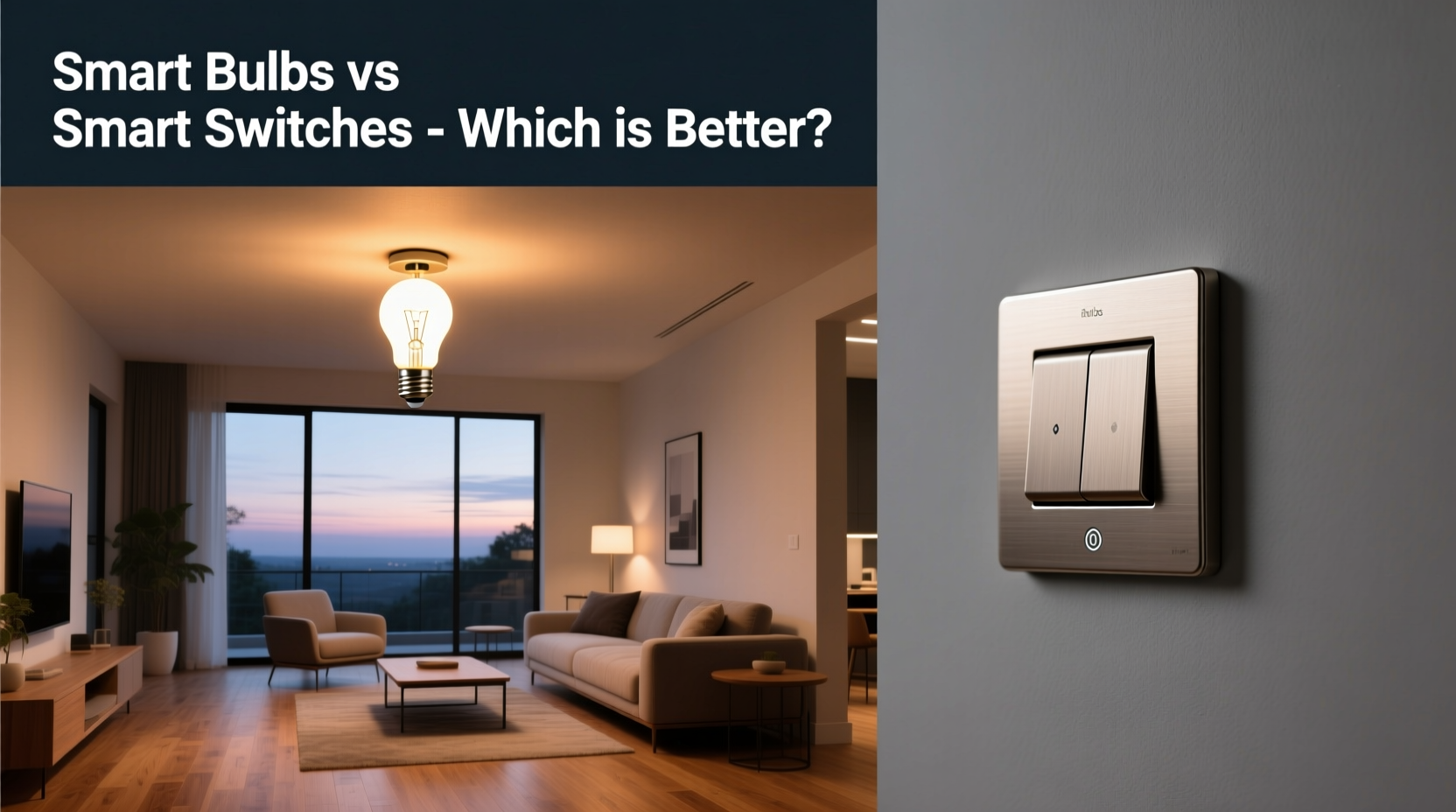
One of the most immediate differences between smart bulbs and smart switches lies in their installation process.
Smart bulbs require no rewiring. Simply screw them into existing fixtures and connect via Wi-Fi, Bluetooth, or a hub (like Philips Hue Bridge). This makes them ideal for renters or those hesitant to touch electrical wiring. However, compatibility issues arise with enclosed fixtures, dimmer circuits not designed for LEDs, or multi-way switches (where two switches control one light).
Smart switches, on the other hand, replace your current wall switch. They require access to a neutral wire in most cases—something older homes may lack. Installation involves turning off the circuit breaker, removing the old switch, and connecting wires correctly. While DIY-friendly for those with basic electrical knowledge, improper installation can pose safety risks or damage devices.
Moreover, smart switches control the entire fixture, meaning any bulb—dimmable or not—can be used. This offers greater flexibility when changing bulbs later. In contrast, smart bulbs lock you into specific form factors (A19, BR30, etc.) and often require LED-compatible dimmers even if the bulb itself handles dimming internally.
Control & Flexibility: Who’s Really in Charge?
Smart bulbs give per-bulb control. Want warm light in the bedroom and cool white in the kitchen at different brightness levels—all scheduled independently? Smart bulbs make this easy. Many support color tuning and millions of hues, enabling mood lighting, sunrise simulations, or party effects. Brands like Philips Hue, Nanoleaf, and Lifx dominate this space with robust ecosystems.
Smart switches, by comparison, treat each light fixture as a single unit. Once installed, they control everything downstream: multiple bulbs, ceiling fans, or even outlets wired to the same circuit. While some high-end switches offer dimming and scheduling, they don’t allow granular control over individual bulbs within a multi-light fixture unless paired with additional sensors or automations.
However, smart switches shine in usability. They retain physical toggle functionality. Even if your Wi-Fi goes down or an app crashes, you can still turn lights on manually. With smart bulbs, flipping the wall switch cuts power entirely, rendering the bulb \"offline\" and unresponsive until powered back on—unless you install a bypass switch or use dual-control setups.
“Smart switches provide more reliable daily operation because they preserve traditional interaction patterns. People still want to flip a switch.” — David Kim, Home Automation Consultant at NestLogic
Cost Comparison Over Time
At first glance, smart bulbs seem cheaper. A single bulb might cost $15–$25. But multiply that across six recessed lights in a living room, plus entryway, hallway, and bedrooms, and costs add up quickly. High-end color-tunable bulbs can exceed $50 each. For a full-home setup, you could spend $300–$600 easily.
Smart switches have higher upfront costs per device ($30–$70), but cover all lights on a circuit. One switch replaces manual control for four or more bulbs. Over time, this leads to significant savings, especially in rooms with multiple fixtures.
| Factor | Smart Bulbs | Smart Switches |
|---|---|---|
| Upfront Cost per Unit | $15–$50 | $30–$70 |
| Covers How Many Lights? | One per bulb | All on circuit |
| Lifespan | 15,000–25,000 hours | 10+ years (mechanical) |
| Replacement Frequency | Every few years | Rarely needed |
| Neutral Wire Required? | No | Usually yes |
| Manual Override Possible? | Only if switch stays on | Yes, always |
The long-term math favors switches. Bulbs degrade over time, lose brightness, and eventually fail. Replacing smart bulbs means re-pairing devices, updating apps, and potential obsolescence if the model is discontinued. Smart switches, once installed, typically last a decade or longer with minimal maintenance.
Real-World Example: Sarah’s Starter Setup
Sarah lives in a two-bedroom apartment she rents. She wanted to automate her bedroom and living room lighting without permanent changes. She started with smart bulbs—two color-tunable ones in floor lamps and three in her overhead ceiling fixture.
Initially, everything worked well. She set morning routines, adjusted colors for movie nights, and controlled lights from her phone. But after three months, she noticed inconsistencies. When guests turned off the bedroom light using the wall switch, the bulb lost power and disconnected from Wi-Fi. She had to manually reset it every time.
She also found herself frustrated during internet outages—her lights became inaccessible despite being physically functional. After researching alternatives, she invested in a Lutron Caseta smart switch (which doesn’t require a neutral wire) for her living room. It integrated with Alexa, allowed physical toggling, and controlled all four recessed lights seamlessly.
Now, she uses a hybrid approach: smart bulbs only in portable lamps where fine-tuned ambiance matters, and smart switches for fixed overhead lighting. Her system is more reliable, easier to manage, and avoids unnecessary complexity.
Step-by-Step Guide to Choosing Your Starting Point
Follow this decision framework to determine whether smart bulbs or smart switches are right for your situation:
- Assess your living situation. Are you renting or owning? Renters benefit from non-invasive smart bulbs. Owners can consider permanent upgrades like switches.
- Check your electrical setup. Open your switch plate (after turning off power) and inspect the box. Do you see a neutral wire (usually white)? If not, smart switches may require special models.
- Evaluate the number of bulbs per fixture. Rooms with multiple lights (e.g., kitchens with six cans) favor switches. Single-lamp areas (desk lamp, bedside) suit bulbs.
- Determine your control needs. Do you want color-changing capabilities or just on/off and dimming? Bulbs offer advanced features; switches deliver simplicity.
- Test connectivity. Ensure strong Wi-Fi or Zigbee/Z-Wave coverage near switches and fixtures. Poor signal causes lag and unreliability.
- Start small. Install one smart bulb and one smart switch in different rooms. Use them for two weeks. Note which feels more intuitive and dependable.
- Scale accordingly. Based on your trial, expand using the technology that best fits your habits and infrastructure.
Hybrid Approach: Best of Both Worlds?
Many experienced users combine smart bulbs and switches strategically. For example:
- Use smart switches for general ambient lighting (hallways, kitchens, bathrooms).
- Reserve smart bulbs for accent lighting (floor lamps, under-cabinet strips, vanity mirrors).
- Install smart switches with companion apps that support scene creation, then enhance scenes with color shifts from smart bulbs.
This layered method maximizes reliability where it matters most while preserving creative lighting options elsewhere. It also future-proofs your system—you’re not locked into one ecosystem or limitation.
Just ensure compatibility across platforms. If your switch uses Zigbee and your bulbs use Wi-Fi, managing both through a central hub like Samsung SmartThings or Apple Home improves cohesion.
Frequently Asked Questions
Can I use smart bulbs with a regular switch?
Yes, but only if the wall switch remains in the “on” position. Turning it off cuts power and disconnects the bulb from the network. To retain manual control, pair smart bulbs with smart switches or use a switch that sends signals instead of cutting power.
Do smart switches work without the internet?
Yes. Unlike many smart bulbs, smart switches continue functioning locally when Wi-Fi drops. You can still toggle them manually, and local automations (like motion detection or time-based rules) often run without cloud dependency, depending on the brand.
Which lasts longer—smart bulbs or smart switches?
Smart switches generally last longer. Most rated for tens of thousands of cycles, far exceeding typical usage. Smart bulbs degrade in brightness over time and usually need replacement after 3–5 years, even if functional.
Final Recommendation: Where Should You Start?
For most homeowners, **smart switches** are the better starting point. They integrate naturally into daily life, reduce dependency on mobile apps, lower long-term costs, and offer superior reliability. They represent a foundational upgrade—one that supports broader automation later, such as integrating with sensors, blinds, or security systems.
For renters, frequent movers, or those seeking colorful ambiance in specific zones, **smart bulbs** are the logical entry point. Their flexibility and zero-installation appeal outweigh limitations—at least initially.
The key is intentionality. Don’t automate for automation’s sake. Begin with one room, evaluate what works, and build outward based on real experience. Technology should serve convenience, not complicate it.
“The best smart home isn’t the most connected—it’s the one you actually use without thinking.” — Lena Torres, UX Designer at SmartDwell Labs
Ready to Make Your Move?
Your first lighting decision shapes your entire smart home trajectory. Whether you choose smart bulbs for their vibrant versatility or smart switches for their enduring simplicity, take action now. Pick one room, define your goal (energy savings, convenience, ambiance), and install your chosen solution this weekend.
Track how it feels over the next month. Notice what frustrates you and what delights you. That feedback is worth more than any review. Then scale intelligently—because true automation grows not from gadgets, but from thoughtful choices.




 浙公网安备
33010002000092号
浙公网安备
33010002000092号 浙B2-20120091-4
Comments
No comments yet. Why don't you start the discussion?