
Every November, millions of households face the same quiet dilemma: do they reach for the familiar spool of incandescent or LED string lights—affordable, predictable, and plug-and-play—or invest in smart lights promising color-shifting animations, voice control, and app-driven schedules? The marketing buzz around smart lighting often implies obsolescence: that basic strings are “old-school,” even “outdated.” But is that true? Not necessarily. The real question isn’t whether smart lights are impressive—it’s whether their capabilities translate into meaningful improvements for *your* decorating style, budget, timeline, and long-term satisfaction. This isn’t about gadgetry for its own sake. It’s about matching technology to intention.
What Actually Defines “Smart” in Holiday Lighting?
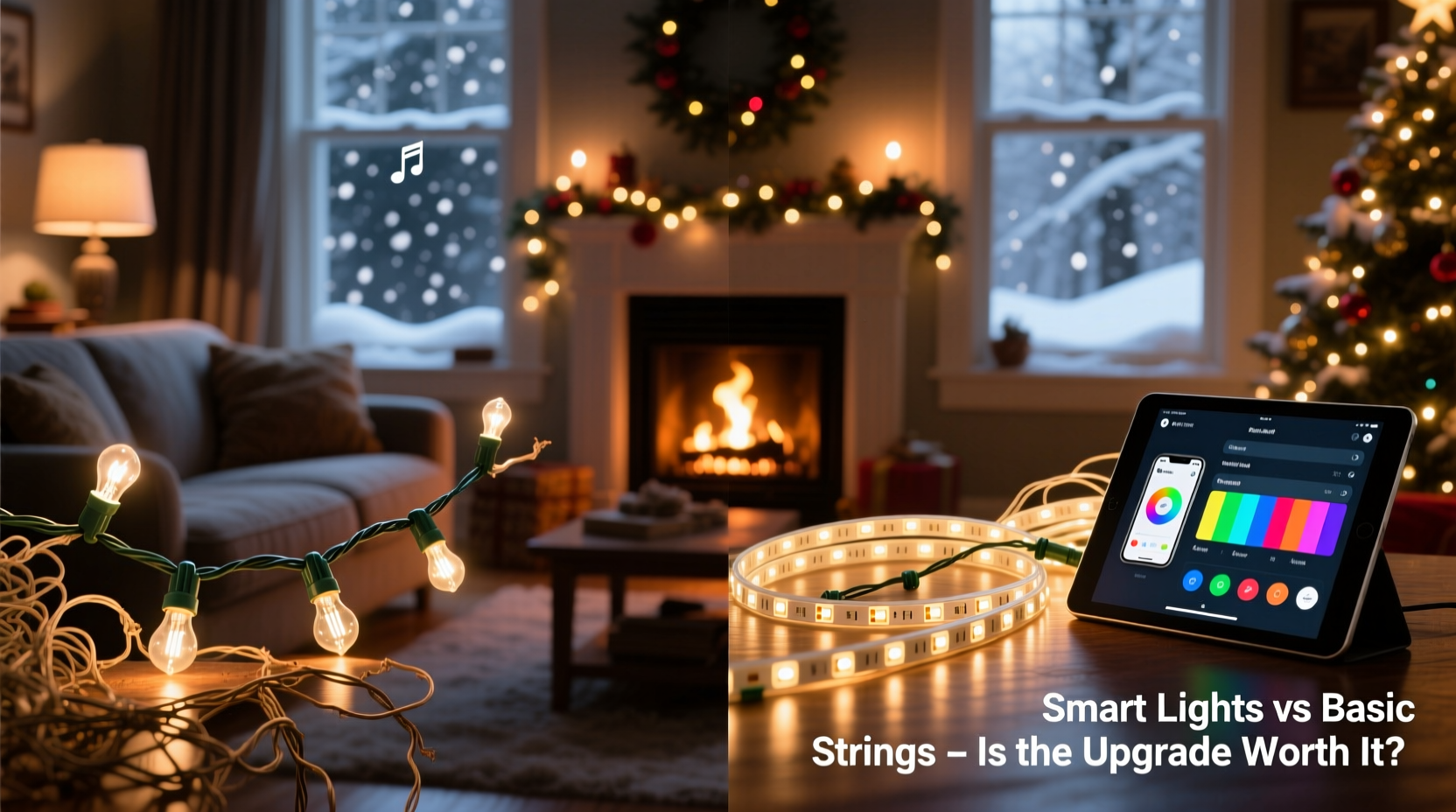
“Smart” isn’t a single feature—it’s a functional stack. At minimum, smart Christmas lights must offer at least two of the following: remote control via smartphone app, programmable scheduling (e.g., on at dusk, off at 11 p.m.), customizable color and animation sequences, and integration with voice assistants like Alexa or Google Assistant. Most rely on Wi-Fi or Bluetooth, though newer models increasingly use Matter-over-Thread for broader home ecosystem compatibility. Crucially, smart lights are almost always LED-based—but not all LED lights are smart. A basic LED string light may use 75% less energy than incandescent bulbs, but it still operates as a simple on/off circuit with no intelligence layer.
Basic string lights fall into three categories: traditional incandescent (warm glow, higher heat output, shorter lifespan), standard LED (cool-running, energy-efficient, fixed white or single-color), and multi-color LED strings with manual controllers (e.g., “twinkle,” “chase,” or “fade” modes activated by a physical button). These last ones are sometimes mistaken for “smart,” but lack connectivity, scheduling, or granular control—they’re pre-programmed hardware, not software-defined systems.
Cost Analysis: Upfront, Operational, and Long-Term
Price is the most immediate differentiator—and where assumptions often mislead. A 100-light basic LED string retails for $8–$15. A comparable 100-light smart string starts at $35 and commonly runs $50–$80, especially for premium brands like Philips Hue, Nanoleaf, or Govee. That’s a 300–400% markup. But cost extends beyond purchase price.
| Factor | Basic LED String Lights | Smart Christmas Lights |
|---|---|---|
| Upfront Cost (per 100 lights) | $8–$15 | $35–$80+ |
| Avg. Power Consumption (per 100 lights, 6 hrs/day) | 4–6 watts | 5–8 watts (slightly higher due to controller & radio) |
| Lifespan (rated hours) | 25,000–50,000 hrs | 20,000–35,000 hrs (controller electronics often fail before LEDs) |
| Repairability | High—bulbs replaceable; fuses accessible | Low—entire strand typically discarded if controller fails |
| Scalability (adding more strands) | Simple daisy-chaining (within UL wattage limits) | Complex—requires compatible hubs, IP address management, network bandwidth |
The energy difference is negligible: over a 30-day season, both types cost under $0.30 in electricity. Where smart lights lose ground is longevity and repairability. Basic LED strings have discrete components—replace a blown bulb, swap a fuse, or splice a broken wire. Smart strands integrate microcontrollers, antennas, and power converters into a sealed, non-serviceable housing. When one node fails, the whole segment goes dark—and replacement parts don’t exist. As lighting engineer Rajiv Mehta notes:
“Smart lights trade mechanical resilience for digital convenience. You’re not buying bulbs—you’re buying a distributed embedded system. And like any complex electronics, failure modes multiply.” — Rajiv Mehta, Senior Product Architect, LumenTech Labs
Real-World Usability: Control, Consistency, and Cognitive Load
Smart lights shine brightest in controlled environments: a porch with consistent Wi-Fi, a living room tree near a router, or a small indoor display. But outdoors—especially across yards, garages, or multi-story facades—Wi-Fi dropouts, signal interference from metal gutters or brick walls, and Bluetooth range limitations (typically under 30 feet) create frustrating gaps. One user in Portland reported that her smart lights on the garage roof failed to sync 40% of evenings during December due to winter humidity affecting her outdoor access point. She reverted to basic timers paired with high-CRI white LEDs—achieving reliable, warm, and consistent illumination without daily troubleshooting.
Then there’s the cognitive load. Programming a 500-light display with synchronized music, gradient transitions, and sunrise-sunset triggers demands time, technical comfort, and patience. For many, the “smart” promise becomes a chore: updating firmware, resetting hubs, renaming devices (“Front Porch Left”, “Front Porch Right”, “Front Porch Top”), and reconciling conflicting app permissions. Basic lights require zero setup: plug in, flip switch, enjoy. Their simplicity isn’t a limitation—it’s reliability engineered into the interface.
Practical Decision Framework: When Smart Makes Sense (and When It Doesn’t)
Instead of asking “Are smart lights better?” ask “Do they solve a problem I actually have?” Use this checklist to guide your choice:
- You host frequent gatherings and want ambient mood shifts (e.g., warm white for dinner parties, cool blue for movie nights).
- You travel during holidays and need remote on/off capability to deter break-ins or simulate occupancy.
- You decorate annually with precision—think synchronized roof lines, animated window frames, or musical light shows—and have 5+ hours to dedicate to programming and testing.
- You already use a smart home ecosystem (e.g., Apple Home, Samsung SmartThings) and value unified control—not another siloed app.
- You prioritize aesthetics over longevity and accept replacing strands every 2–3 seasons for new features or improved brightness.
If fewer than three items resonate, basic lights are likely the wiser investment. They deliver 95% of the visual impact with 10% of the complexity.
Mini Case Study: The Suburban Family’s Two-Year Comparison
The Chen family in Austin installed both systems side-by-side in 2022. For their front yard (200 ft of eaves + 3 large shrubs), they used 12 smart RGBW strands ($720 total). Indoors, they kept 8 basic warm-white LED strings ($96) for the tree, mantel, and staircase.
In Year 1, the smart setup dazzled guests—color-matching their daughter’s school colors, fading to gold on Christmas Eve, pulsing gently to holiday playlists. But by mid-December, two strands lost Wi-Fi sync after a firmware update. One required a factory reset; another needed physical repositioning of its signal booster. In Year 2, three strands developed intermittent flickering—traced to moisture ingress in the controller housings. They replaced them, spending $210. Meanwhile, their basic indoor strings performed identically—no updates, no resets, no failures. By December 2023, they’d simplified: smart lights only on the front porch (visible from street), basic strings everywhere else. “We got the ‘wow’ where it mattered,” says Mei Chen, “and peace of mind where it didn’t.”
Step-by-Step: Choosing & Setting Up Based on Your Needs
- Map your display zones. List each area (e.g., “roof line,” “front door wreath,” “back patio railing”) and note distance from power outlets and your home Wi-Fi router.
- Calculate total linear footage needed. Measure—not guess. Add 10% for slack and routing. Then divide by standard strand lengths (e.g., 25 ft, 33 ft, 50 ft) to determine how many strings you’ll need.
- Evaluate your network. Walk each zone with a Wi-Fi analyzer app (like NetSpot or WiFi Analyzer). If signal strength drops below -70 dBm, avoid smart lights there—or budget for an outdoor-rated mesh node.
- Decide on color strategy. Warm white (2700K) creates classic, cozy ambiance and works with any decor. Cool white (5000K+) feels modern but can appear clinical. RGB smart lights offer flexibility—but 80% of users default to warm white or static red/green. Ask: Will you change colors weekly, or stick with one palette?
- Test before committing. Buy one smart strand and one basic strand of equivalent length and brightness. Install both in the same location for 7 days. Note which requires less attention, delivers more consistent light, and aligns with your daily routine.
FAQ
Can I mix smart and basic lights on the same circuit?
Yes—electrically, they’re compatible. Both operate on standard 120V household current and can share a grounded outlet or timer. Just ensure total wattage stays within the circuit’s capacity (typically 1,800 watts for a 15-amp breaker). Avoid plugging smart hubs or controllers into the same power strip as high-draw appliances like refrigerators or space heaters, as voltage fluctuations can cause disconnects.
Do smart lights increase my home’s cybersecurity risk?
Potentially—but risk is low for reputable brands. Smart lights don’t store personal data or grant remote access to your network. However, poorly secured devices (especially budget brands using default passwords or unencrypted cloud links) could serve as entry points. Mitigate this by changing default credentials, enabling two-factor authentication if offered, and isolating holiday devices on a guest Wi-Fi network—not your primary network with laptops and phones.
Are basic LED strings really safer than incandescent ones?
Yes, significantly. Incandescent mini-lights run at surface temperatures up to 200°F—hot enough to scorch dry pine boughs or ignite loose wrapping paper. Modern LED strings operate below 104°F (40°C), reducing fire risk and making them safe for use on artificial trees with plastic foliage, delicate ornaments, or near curtains. UL-listed LED strings also include built-in fuses and current-limiting circuits that shut down the entire strand if a bulb shorts—preventing overheating cascades.
Conclusion
Technology doesn’t advance by replacing what works—it advances by solving real problems with elegance and restraint. Smart Christmas lights are undeniably impressive. They expand creative possibility, deepen interactivity, and reflect our increasingly connected lives. But they aren’t universally superior. For the retiree who decorates her porch every Thanksgiving morning with practiced efficiency, for the college student stringing lights in a dorm room with spotty Wi-Fi, for the family prioritizing joyful moments over firmware updates—basic LED strings remain not just adequate, but optimal. They deliver brilliance without bureaucracy, warmth without worry, and tradition without troubleshooting.
The most thoughtful holiday lighting isn’t defined by pixels per inch or API endpoints—it’s defined by how effortlessly it supports the feeling you want to create: calm, celebration, nostalgia, or wonder. Choose the tool that serves that feeling—not the one with the shiniest spec sheet. This season, let your lights reflect your values, not just your bandwidth.




 浙公网安备
33010002000092号
浙公网安备
33010002000092号 浙B2-20120091-4
Comments
No comments yet. Why don't you start the discussion?