
The glow of miniature buildings under twinkling lights, the gentle chug of a toy locomotive circling a tree—Christmas displays have long been a centerpiece of holiday tradition. In recent years, technology has transformed these nostalgic setups. Smart Christmas villages now offer synchronized lighting, music integration, and app control, while traditional standalone train sets maintain their charm with mechanical reliability and hands-on operation. Choosing between them isn’t just about aesthetics—it’s about lifestyle, space, technical comfort, and the kind of experience you want to create.
This comparison dives deep into both options, weighing their benefits, limitations, and ideal use cases. Whether you're starting a new family tradition or upgrading an existing setup, understanding the differences will help you make a decision that brings lasting joy.
Understanding Smart Christmas Villages with Synchronized Lights
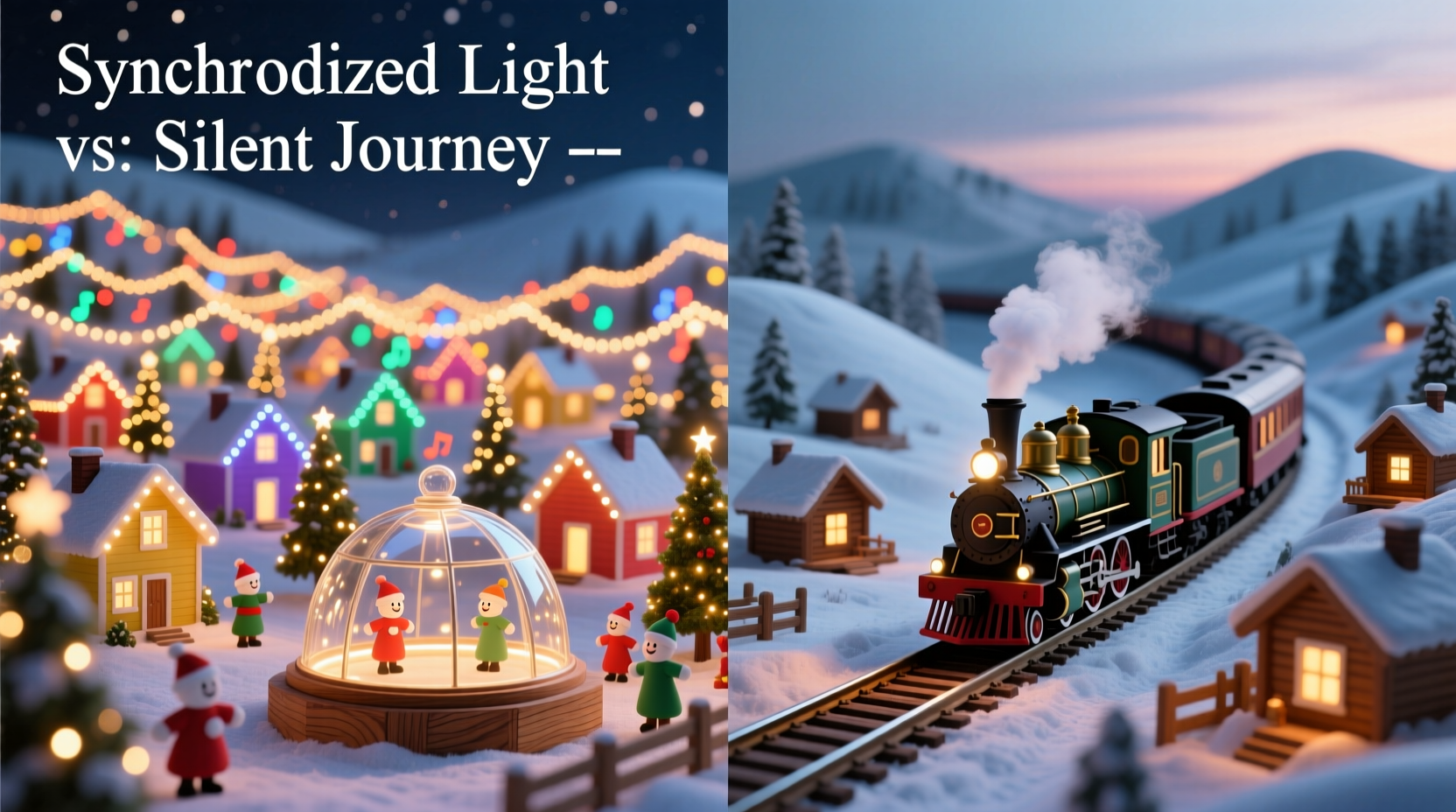
A smart Christmas village is a collection of miniature buildings, figurines, and accessories designed to resemble a festive town during the holidays. What sets the “smart” variety apart is its integration with modern technology: Wi-Fi or Bluetooth connectivity, app-based controls, synchronization with music, and programmable lighting effects.
These systems often include LED-lit houses, churches, shops, and seasonal decorations that can change colors, pulse rhythmically, or fade in sequence—all timed to holiday music played through a speaker or smartphone. Some models even sync with voice assistants like Amazon Alexa or Google Home, allowing for voice-activated scenes such as “Winter Wonderland” or “Midnight Mass.”
The appeal lies in automation and immersion. With a single tap, your entire village comes alive in coordinated brilliance. For tech-savvy families or those who love dynamic holiday experiences, this level of interactivity adds excitement and convenience.
Key Features of Smart Christmas Villages
- Synchronized lighting: All elements respond to music or timers in unison.
- App control: Adjust brightness, color schemes, speed, and schedules remotely.
- Music integration: Built-in speakers or Bluetooth audio pairing enable sound-responsive displays.
- Expandability: Many systems support additional buildings or accessories from the same brand.
- Energy efficiency: LED lighting reduces power consumption and heat output.
Brands like Department 56, Kurt Adler, and Gemmy have introduced smart-enabled lines that blend classic craftsmanship with digital innovation. These are particularly popular among urban dwellers with limited space but high expectations for visual impact.
Exploring Standalone Train Sets: The Timeless Classic
Standalone train sets represent the enduring heart of holiday décor. Typically featuring a locomotive, passenger cars, track layout, and sometimes accompanying scenery, these sets operate independently of broader lighting systems. They run on low-voltage electricity, powered by a transformer that regulates speed and direction.
Unlike smart villages, most traditional train sets do not require apps, Wi-Fi, or software updates. Their charm lies in simplicity, tactile engagement, and mechanical authenticity. Watching a physical train move along a looped track evokes nostalgia and provides a meditative rhythm to the season.
Many collectors seek out vintage models or premium brands like Lionel, Bachmann, or MTH Electric Trains, valuing craftsmanship over connectivity. These sets often become heirlooms, passed down through generations with care and pride.
“Train sets aren’t just decorations—they’re stories in motion. Each chime of the bell carries memory.” — Daniel Reeves, Model Railroading Historian
Advantages of Traditional Train Sets
- No dependency on technology: No need for apps, firmware updates, or network connections.
- Tactile interaction: Manual speed control offers hands-on involvement, especially engaging for children.
- Durability: Well-maintained metal trains can last decades.
- Custom layouts: Tracks can be arranged in creative configurations—figure eights, mountains, tunnels—limited only by space.
- Compatibility: Many O-gauge or HO-scale components are interchangeable across brands and eras.
For purists and hobbyists, there's unmatched satisfaction in assembling a layout, adjusting the throttle, and hearing the familiar hum of the engine. It’s less about spectacle and more about presence.
Smart Villages vs. Train Sets: A Detailed Comparison
| Feature | Smart Christmas Village | Standalone Train Set |
|---|---|---|
| Setup Complexity | Moderate (requires app pairing, positioning sensors) | Low to moderate (lay track, connect power) |
| Technology Dependency | High (needs smartphone, battery/power, app stability) | Low (basic electrical circuit) |
| Interactivity Level | High (music sync, remote control, voice activation) | Medium (manual speed/direction control) |
| Maintenance Needs | Moderate (software updates, dusting LEDs, battery checks) | Low (clean tracks, lubricate gears occasionally) |
| Space Requirements | Compact to medium (modular layouts) | Medium to large (track radius needs clearance) |
| Lifespan | 5–10 years (subject to tech obsolescence) | 20+ years (with care) |
| Best For | Modern homes, renters, tech enthusiasts, small spaces | Collectors, families, hobbyists, larger living areas |
This table highlights a fundamental trade-off: convenience and sensory richness versus durability and simplicity. Smart villages excel at delivering instant, immersive experiences with minimal manual input. Train sets reward patience and attention with longevity and emotional resonance.
Real-World Example: Two Homes, Two Choices
In suburban Denver, Sarah Thompson, a working mother of two, recently upgraded her holiday décor. Her previous setup—a mix of mismatched lighted houses and a wind-up train—felt outdated. She opted for a smart Christmas village with app-controlled lighting and music sync. Now, every evening at 6 PM, her display activates automatically, matching tunes from a curated playlist. Her kids love selecting themes like “Santa’s Arrival” or “Silent Night Mode.”
“It takes five seconds to turn everything on,” she says. “And when guests arrive, I can dim the lights and start a show with my phone. It feels magical without being overwhelming.”
Meanwhile, in rural Vermont, retired engineer Robert Langley maintains a sprawling O-gauge train layout in his basement. Every Thanksgiving weekend, he invites neighbors and grandchildren to help assemble the track around a custom-built mountain pass. His Lionel locomotive runs continuously throughout December, complete with smoke effects and realistic whistles.
“I don’t want something that turns on with a button,” Robert explains. “I want to hear the wheels click on the rails, feel the warmth from the engine, see the way the snow settles on the caboose. That’s what Christmas felt like when I was young.”
Both approaches are valid—one prioritizes ease and spectacle, the other values ritual and realism.
Choosing Based on Your Lifestyle
Your ideal choice depends less on which option is objectively better and more on how it fits your daily life. Consider the following factors:
Available Space
Smart villages typically occupy smaller footprints and can be displayed on tabletops, mantels, or shelves. If you live in an apartment or have limited floor space, a compact, self-contained village may be the only practical solution. Train sets, especially those aiming for realism, require significant surface area for smooth curves and scenic elements.
Technical Comfort
If you enjoy smart home devices and regularly use apps to manage lights or thermostats, a connected Christmas village will feel natural. However, if you’ve ever struggled with Bluetooth pairing or dread another device requiring updates, a plug-and-play train set might offer greater peace of mind.
Family Involvement
Young children may be captivated by the movement of a real train more than static lights. The act of placing figures, laying tracks, or controlling the throttle fosters engagement. Conversely, older kids or teens might appreciate programming light shows or creating playlists for a smart display.
Budget and Long-Term Value
Entry-level smart villages range from $150–$400, with premium kits exceeding $600. While impressive, they risk becoming obsolete if the manufacturer discontinues app support. Train sets vary widely: basic sets start around $100, while collectible models can cost thousands. But unlike electronic gadgets, mechanical trains retain value and functionality far longer.
Step-by-Step: How to Decide Which Option Is Right for You
- Assess your display area. Measure the space available. Can it accommodate a circular or oval track (minimum 4-foot diameter for O-gauge)? If not, lean toward a smart village.
- Evaluate your tech ecosystem. Do you already use smart plugs or holiday projectors? If yes, integrating a smart village will be seamless.
- Consider who will interact with the display. Are children involved? Do they prefer watching motion or pressing buttons? <4> Determine your maintenance tolerance. Are you willing to update firmware annually, or would you rather clean tracks once a year?
- Set a budget with future expansion in mind. Both systems can grow over time. Plan for incremental additions—extra buildings or rail extensions—without overspending upfront.
- Test before committing. Visit a department store during the holidays or attend a model train show to see both types in person.
Frequently Asked Questions
Can I combine a smart village with a train set?
Yes, many people integrate both. Some smart villages include train stations or rail crossings that complement standalone sets. Just ensure separate power sources and avoid overlapping control signals. Position the train so it moves through the village naturally without disrupting lighting sensors.
Do smart villages work without Wi-Fi?
Most require initial setup via Wi-Fi or Bluetooth, but some allow offline operation after configuration. Check product specifications—models with built-in programs (e.g., “Twinkle,” “Fade,” “Pulse”) can function without constant connectivity.
Are train sets safe around pets and toddlers?
Generally, yes—but supervision is recommended. The tracks pose a tripping hazard, and small couplings or wheels could be choking hazards if detached. Keep transformers out of reach, and consider using plastic-covered tracks if young children are present.
Final Recommendation: Blend Tradition with Innovation
Rather than choosing strictly between smart villages and train sets, consider a hybrid approach. Use a core train set as the centerpiece and surround it with smart-lighted buildings. This gives you the kinetic energy of a moving train and the ambient glow of synchronized lighting. Modern controllers allow independent operation, so you can run the train all day while scheduling light shows for evenings.
As holiday traditions evolve, the goal remains the same: to create warmth, wonder, and connection. Whether through the quiet hum of a passing engine or the dazzling rhythm of dancing lights, what matters most is the moment shared—the gasp of a child, the smile of a guest, the stillness of reflection beneath a glowing steeple.
“The best Christmas display isn’t the brightest one—it’s the one that makes someone say, ‘This feels like home.’” — Clara Mendez, Holiday Design Curator
Take Action This Season
This year, think beyond decoration. Think about experience. If you’re drawn to smart villages, research models with open ecosystems—those that don’t lock you into proprietary apps. If you lean toward train sets, visit a local hobby shop and ask about beginner-friendly kits. And if you’re undecided, start small: add one smart building next to your existing train or try a Bluetooth-enabled locomotive that bridges both worlds.




 浙公网安备
33010002000092号
浙公网安备
33010002000092号 浙B2-20120091-4
Comments
No comments yet. Why don't you start the discussion?