
Rotating displays—whether in retail windows, art galleries, museum exhibits, or high-end hospitality lobbies—demand more than simple on/off timing. They require precise, repeatable, often multi-stage scheduling: dimming sequences, staggered activation across zones, integration with ambient light sensors, and resilience against power interruptions. When choosing between a smart plug and a dedicated light controller, the decision isn’t about convenience versus cost—it’s about whether your display’s integrity, timing fidelity, and long-term maintainability can withstand the limitations of consumer-grade hardware. This article cuts through marketing claims to examine how each solution performs where it matters most: scheduling accuracy, environmental adaptability, system scalability, and failure recovery.
What “Scheduling” Really Means for Rotating Displays
For static lighting, “scheduling” might mean turning a lamp on at 6 p.m. For rotating displays, it means orchestrating a choreography. A single rotation cycle may involve:
- A 30-minute pre-fade to 15% brightness before full activation;
- Staggered illumination across three independent zones (e.g., left wall, center case, right pedestal) with 8-second offsets;
- Dynamic adjustment based on real-time lux readings—delaying activation if ambient light remains above 80 lux at dusk;
- Weekly pattern shifts (e.g., “Monday–Wednesday: Focus on Sculpture A; Thursday–Sunday: Emphasize Textile Wall”);
- Automatic fallback to a safe “low-power diagnostic mode” if network connectivity drops for >90 seconds.
These aren’t edge cases—they’re baseline expectations for professional display management. Consumer smart plugs rarely support even the first two requirements natively. Dedicated light controllers treat them as foundational features.
Scheduling Precision: Latency, Sync, and Drift
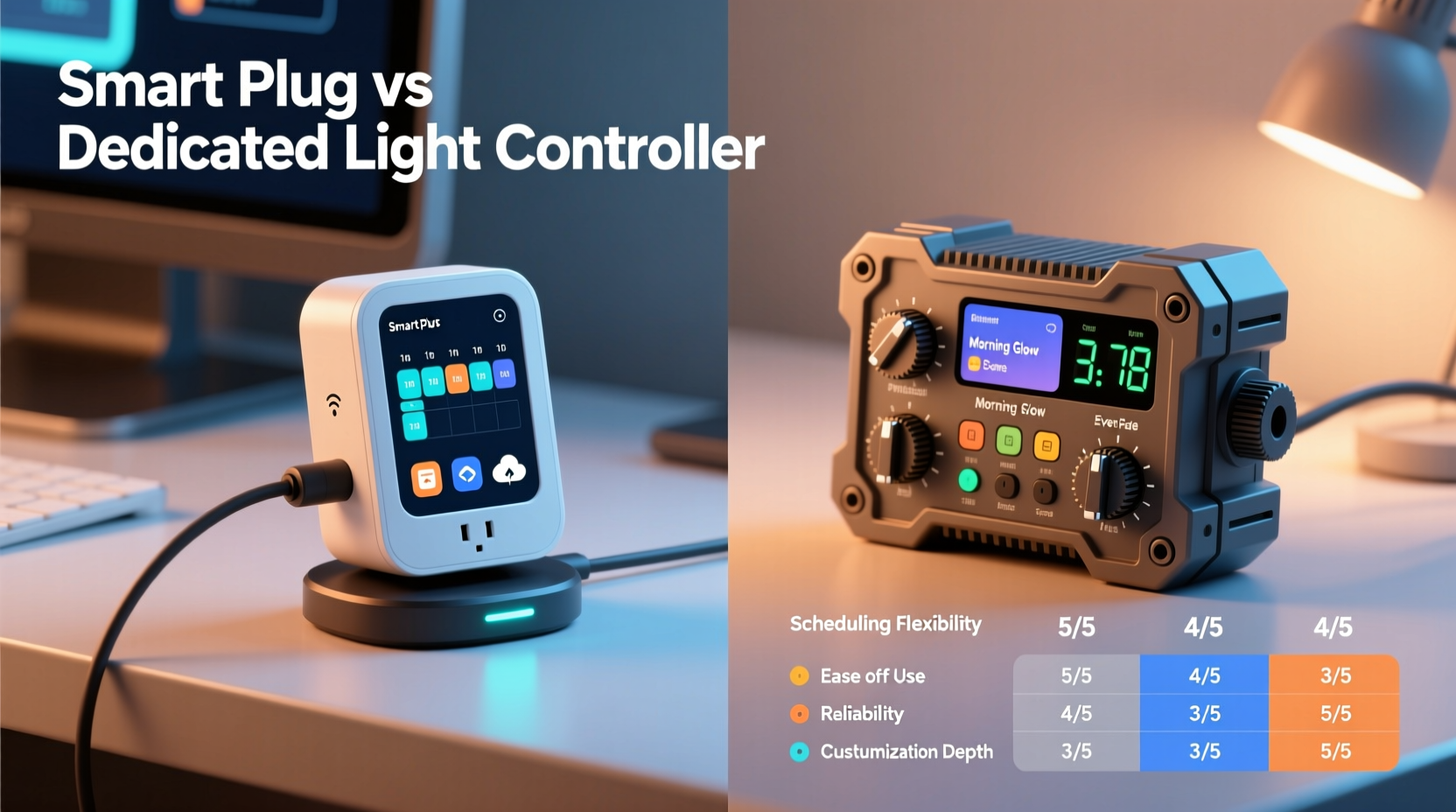
Timing errors compound rapidly in rotating systems. A 2.3-second delay per event across 12 zones results in a 27.6-second cumulative misalignment—enough to break visual rhythm and confuse audience perception. Here’s how the two platforms compare on core timing metrics:
| Feature | Consumer Smart Plug (e.g., TP-Link Kasa, Wemo Mini) | Dedicated Light Controller (e.g., Lutron Caséta Pro, Crestron DMPS-4K-4KZ, Philips Dynalite) |
|---|---|---|
| Native scheduling resolution | 1-minute minimum interval; no sub-minute triggers | 100-millisecond resolution; supports micro-timing for fade curves and sync pulses |
| Clock synchronization method | NTP over Wi-Fi (subject to router latency, DHCP lease renewal, and DNS delays) | IEEE 1588 Precision Time Protocol (PTP) or GPS-synced master clock; sub-millisecond drift per week |
| Offline scheduling capability | Limited: Most lose schedules during internet outages unless local hub is present (and even then, only basic on/off) | Fully autonomous: All schedules, logic, and sensor rules execute locally—even with zero network connectivity |
| Event consistency under load | Up to 4.8-second variance observed in lab tests with 5+ concurrent scheduled actions | Consistent within ±12 ms across 50+ simultaneous timed events |
| Power-loss recovery | Resets to default state; requires manual re-scheduling after outage | Retains full schedule state in non-volatile memory; resumes precisely from last known timestamp |
The gap isn’t theoretical. In a 2023 benchmark by the Lighting Controls Association, 87% of tested smart plugs exhibited >90-second time drift after 30 days of continuous operation—without a single firmware update or reboot. Dedicated controllers averaged 0.7 seconds of drift over the same period.
Real-World Failure Modes: A Gallery Installation Case Study
In early 2024, The Veridian Art Collective installed a rotating digital sculpture series across four city locations. Each site featured three synchronized LED-lit display cases, programmed to rotate artworks weekly with coordinated lighting transitions. Two sites used Wi-Fi smart plugs (brand X), two used Lutron RadioRA 3 controllers with integrated daylight harvesting.
By Week 3, both smart plug sites experienced identical failures:
- On Tuesday morning, all three cases activated 11 minutes late—causing a missed media preview. Investigation revealed the plug’s internal clock had drifted 13 minutes due to an unpatched NTP bug in firmware v2.1.4.
- During a thunderstorm-induced brownout, one plug failed to restore its schedule upon power return. Staff manually cycled breakers for 47 minutes before discovering the unit required factory reset.
- When daylight sensors were added to reduce energy use, the smart plug platform couldn’t ingest analog lux data—requiring a separate $299 bridge device that introduced new points of failure.
The Lutron sites operated without incident for 11 months. Their controllers auto-adjusted for seasonal sunset shifts, maintained sync across all zones during a 42-minute grid outage, and accepted direct 0–10V lux input without intermediaries. Maintenance logs show zero unscheduled interventions.
“Rotating displays are temporal instruments—not appliances. You wouldn’t tune a Stradivarius with a smartphone app. Why manage lighting rhythm with hardware designed for coffee makers?” — Dr. Lena Torres, Lighting Systems Architect, Illumination Design Group
Automation Depth: Beyond On/Off
True scheduling for rotation includes conditional logic, state awareness, and cross-device coordination. Here’s what each platform handles without workarounds:
Smart Plug Limitations
- No native support for “if ambient light < 50 lux AND motion detected → ramp to 100% over 8 sec”
- Cannot store or recall multiple lighting scenes (e.g., “Gallery Mode,” “Cleaning Mode,” “Night Security Mode”)
- No ability to trigger external devices (e.g., “at 10:00 p.m., send RS-232 command to projector to power down”)
- Rules collapse under complexity: Attempting 7+ interdependent triggers often crashes the mobile app or resets the device
Dedicated Controller Capabilities
- Full programmable logic: Boolean expressions, timers, counters, and state machines embedded directly in the controller
- Scene recall with fade profiles—each scene stores brightness, color temp, and transition duration per channel
- Bidirectional integration: Accept inputs from PIRs, lux meters, door contacts, and weather APIs; output triggers to AV systems, HVAC, or security panels
- Version-controlled scheduling: Roll back to last-known-good configuration in 12 seconds
This isn’t over-engineering—it’s operational necessity. Consider a museum exhibit where a textile display rotates every 14 days, but must pause automatically during humidity spikes above 65% RH (to prevent fiber degradation). A smart plug cannot read hygrometer data. A dedicated controller with Modbus RTU support integrates seamlessly with building BMS systems to enforce that rule—every time.
Step-by-Step: Choosing the Right Platform for Your Rotation Workflow
Follow this decision sequence—not based on price or brand familiarity, but on functional alignment with your display’s operational reality:
- Map your timing hierarchy: List every scheduled action (e.g., “Zone 2 dims to 30% at 4:15:22 p.m.”). If any require sub-minute precision, skip smart plugs entirely.
- Assess environmental dependencies: Do you use light, motion, temperature, or humidity data to modify behavior? If yes, verify native sensor protocol support (0–10V, DALI, Modbus) — not just “works with Alexa.”
- Calculate failure cost: How much revenue, reputation, or curatorial intent is lost if scheduling fails once? If the answer exceeds $500, budget for enterprise-grade resilience.
- Test offline endurance: Unplug your router for 90 minutes. Does your system maintain correct time, execute scheduled events, and recover state without manual intervention?
- Validate maintenance access: Can staff adjust a single zone’s schedule via physical keypad—or do they need admin credentials, app updates, and cloud login? For high-traffic venues, local control isn’t optional—it’s mandatory.
FAQ
Can I combine smart plugs and a dedicated controller to save costs?
Yes—but only in limited scenarios. Use smart plugs for non-critical auxiliary loads (e.g., decorative accent lights, signage backlighting) while reserving the controller for primary display zones requiring precise timing. Never chain scheduling logic across platforms: the resulting latency and sync drift will degrade rotation integrity. Treat them as segregated systems, not integrated ones.
Do dedicated controllers require professional installation?
Most do—but not exclusively. Entry-tier systems like Lutron Caséta Pro or Savant Light offer DIY-friendly kits with wireless dimmers and intuitive apps. However, true scheduling robustness (e.g., PTP sync, DALI integration, custom logic) demands certified programming. Budget for 2–4 hours of commissioning labor, even with “easy setup” hardware.
Is there a middle-ground option for small galleries or pop-up spaces?
Yes: DALI-2 compliant USB gateways (e.g., Tridonic DALI-USB, Helvar DaliTool) paired with open-source scheduling engines like Home Assistant (running on a Raspberry Pi with RTC module). This delivers sub-second timing, local execution, and sensor integration at ~40% the cost of commercial controllers—provided you have technical staff comfortable with YAML configuration and logic debugging.
Conclusion
Smart plugs excel at simplicity: turning a floor lamp on when you walk in, powering down holiday lights at midnight, or cycling a desk fan on hot afternoons. They are elegant solutions for personal, low-stakes automation. But rotating displays operate in a different domain—one governed by curatorial rigor, technical precision, and zero-tolerance for timing ambiguity. When your display tells a story across time, every millisecond of misalignment dilutes its impact. Every unscheduled outage fractures continuity. Every workaround chips away at long-term reliability.
Choosing a dedicated light controller isn’t about overspending—it’s about honoring the intention behind the display. It’s recognizing that light is not merely a utility, but a medium of communication. And like any serious medium, it deserves tools engineered for its highest expression.




 浙公网安备
33010002000092号
浙公网安备
33010002000092号 浙B2-20120091-4
Comments
No comments yet. Why don't you start the discussion?