
Sleep is foundational to health, yet many struggle to understand their nightly patterns. Wearable technology has made it easier than ever to monitor sleep stages, heart rate variability, and recovery metrics—but not all devices deliver the same experience. For those who find traditional smartwatches uncomfortable during sleep, a new class of discreet wearables—smart rings—is gaining traction. These compact devices promise clinical-grade insights without the bulk of a wristband. As interest grows, a critical question emerges: can a smart ring truly compete with a smartwatch in sleep tracking accuracy and utility?
This article explores the trade-offs between smart rings and smartwatches for sleep monitoring, focusing on comfort, data reliability, battery life, and long-term usability. Whether you're a biohacker, fitness enthusiast, or someone simply looking to improve sleep hygiene, understanding these differences helps you choose the right tool—one that supports your goals without disrupting your rest.
Comfort and Wearability During Sleep
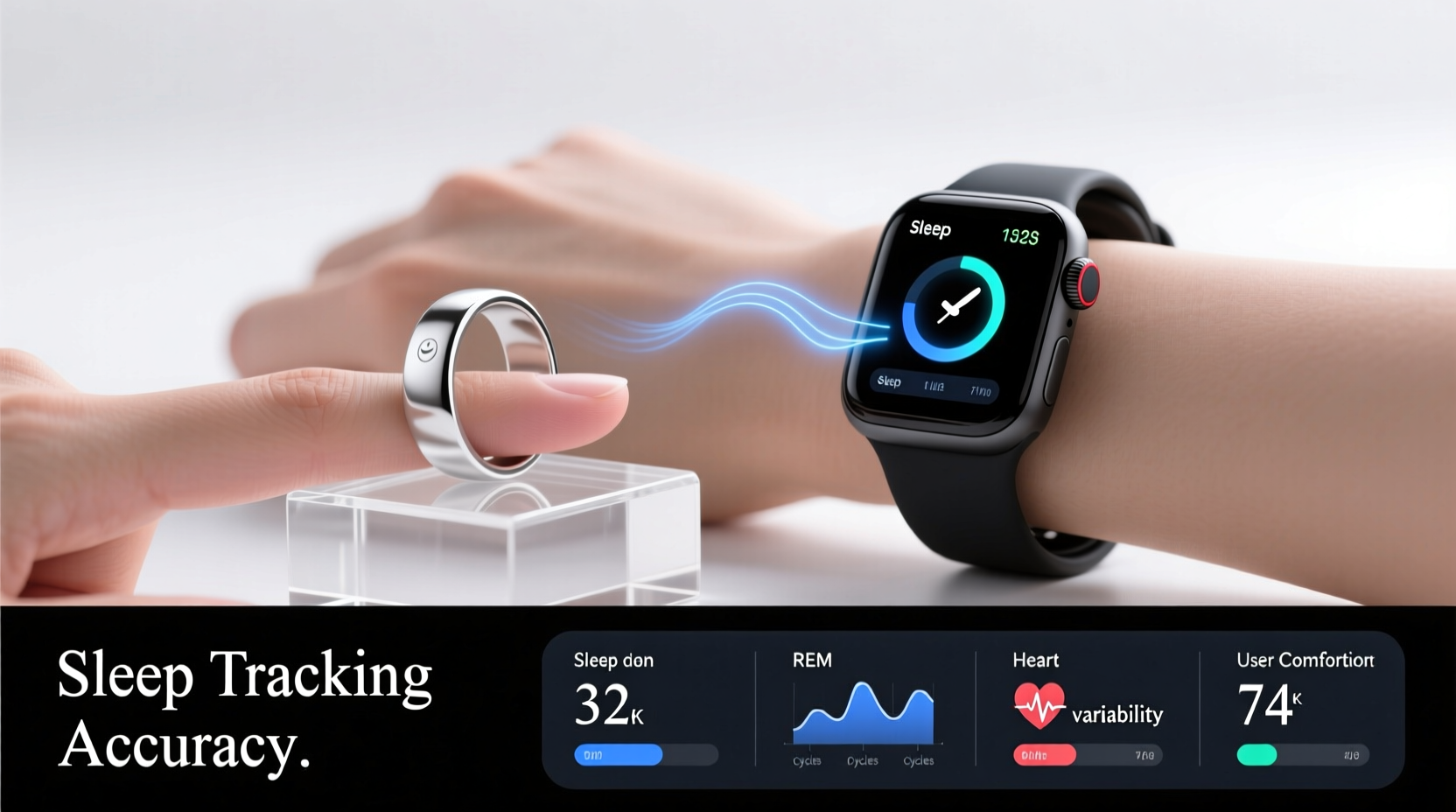
The most immediate advantage of smart rings over smartwatches is comfort. Smartwatches, even sleek models like the Apple Watch or Garmin Venu, sit prominently on the wrist. Their weight, size, and rigid structure can cause discomfort when lying on your side or moving during REM cycles. Some users report waking up due to pressure points or the sensation of something “too present” on their arm.
In contrast, smart rings are designed to be nearly imperceptible. Worn on the finger—typically the index or middle—they apply minimal pressure and avoid contact with bedding. The ring form factor allows natural hand positioning without interference. This makes them ideal for light sleepers, side sleepers, or anyone sensitive to tactile feedback during rest.
However, fit matters. A ring that’s too tight can restrict circulation; one that’s too loose may shift during movement, affecting sensor contact. Most manufacturers recommend sizing guides and offer multiple band options to ensure a secure yet comfortable fit.
Data Accuracy and Tracking Capabilities
Accuracy is where the debate intensifies. Smartwatches have had a head start, with years of algorithm development and access to larger sensors. Devices like the Fitbit Sense 2, Whoop 4.0, and Apple Watch utilize photoplethysmography (PPG) sensors across a broader surface area, enabling stable readings of heart rate, blood oxygen, and movement. They also integrate accelerometers and gyroscopes to detect body position and micro-movements throughout the night.
Smart rings, though smaller, are catching up quickly. Leading models such as the Oura Ring Gen3 and Ultrahuman Ring Air use multi-wavelength PPG sensors positioned beneath the finger, where blood flow is strong and consistent. Because fingers have dense capillary networks, they can provide high-fidelity heart rate and HRV (heart rate variability) data—key indicators of sleep quality and autonomic nervous system activity.
“Finger-based PPG can outperform wrist-based sensors in nighttime stability due to reduced motion artifact and consistent perfusion.” — Dr. Matthew Walker, neuroscientist and author of *Why We Sleep*
Studies suggest that smart rings often match or exceed smartwatches in measuring core biometrics during sleep. A 2022 validation study published in *npj Digital Medicine* found the Oura Ring’s sleep staging accuracy within 87% agreement of polysomnography (the gold standard), compared to 82% for leading wrist-worn devices.
Still, limitations exist. Rings lack built-in ECG, GPS, and ambient light sensors, which some advanced watches use to contextualize circadian rhythms. They also don’t capture respiratory waveforms as directly as chest straps or specialized wearables. But for pure sleep analytics—duration, efficiency, deep/REM distribution, and readiness scores—rings are now competitive.
Feature Comparison: Smart Ring vs Smartwatch
| Feature | Smart Ring | Smartwatch |
|---|---|---|
| Sleep Comfort | High – lightweight, unobtrusive | Low to Moderate – bulkier, may disrupt sleep posture |
| Heart Rate Accuracy (Night) | High – stable finger PPG signal | Moderate – prone to motion artifacts |
| Battery Life | 5–7 days (requires frequent charging) | 1–3 days (some last up to 14 days in sleep-tracking mode) |
| Sleep Staging Accuracy | 85–88% | 80–85% |
| Daily Activity Tracking | Limited – basic steps, calories | Comprehensive – GPS, workouts, apps |
| Notifications & Interactivity | Minimal – vibration alerts only | Full – calls, texts, apps, voice assistant |
| Water Resistance | Up to 100m (shower-safe) | Typically 50m+ (swim-capable) |
| Price Range | $300–$600 (subscription often required) | $200–$800 (one-time purchase common) |
The table highlights a key insight: smart rings excel in passive, sleep-focused monitoring but sacrifice versatility. If your primary goal is optimizing rest and recovery, a ring may be the superior choice. If you want an all-in-one device for workouts, navigation, and communication, a smartwatch remains more practical.
Real-World Use Case: Athlete Recovery Monitoring
Consider James, a 34-year-old endurance cyclist training for a century ride. He previously used a Garmin Forerunner to track sleep but found the watch uncomfortable after long rides when his wrists were already fatigued. He’d often remove it before bed, defeating the purpose of continuous recovery tracking.
After switching to the Oura Ring, he wore it consistently for six weeks. The ring’s temperature sensor detected a 0.4°C rise in his resting body temperature two nights before he developed mild flu symptoms—allowing him to reduce training intensity and avoid full illness. His HRV trendline, previously erratic, stabilized as he adjusted bedtime based on the ring’s readiness score. Over time, his deep sleep increased by 18 minutes per night, correlating with improved performance in morning interval sessions.
James didn’t need notifications or music control during sleep. What mattered was reliable, automatic data collection that didn’t interfere with rest. For him, the smart ring wasn’t just more comfortable—it led to better decisions.
Choosing the Right Device: A Step-by-Step Guide
Selecting between a smart ring and smartwatch shouldn’t be arbitrary. Follow this decision framework to align your choice with lifestyle and health goals.
- Define your primary objective: Is it sleep optimization, fitness tracking, or general wellness? If sleep is the top priority, lean toward a ring.
- Assess comfort needs: Try wearing a smartwatch to bed for three nights. Note any discomfort or habit of removal. If you struggle to keep it on, a ring is likely a better fit.
- Evaluate data depth: Review sample reports from both device types. Do you value detailed sleep staging and HRV trends (ring strength), or do you prefer workout integration and real-time alerts (watch strength)?
- Consider battery habits: Rings require charging every few days, often needing removal. Watches may last longer but are bulkier. Decide which routine suits your discipline.
- Check subscription models: Many smart rings (Oura, Ultrahuman) require monthly fees for full analytics. Compare this to the one-time cost of a watch with free app access.
- Test compatibility: Ensure the device syncs with your smartphone OS and integrates with health platforms like Apple Health or Google Fit.
Common Misconceptions About Smart Rings
Despite growing popularity, several myths persist about smart rings:
- “They’re less accurate because they’re small.” Size doesn’t dictate accuracy. Sensor placement and algorithm sophistication matter more. Finger PPG often outperforms wrist sensors at night.
- “You need to wear them on a specific finger.” While manufacturers recommend certain fingers for optimal blood flow, minor variations in placement don’t significantly impact results if the fit is snug.
- “They’re only for biohackers.” While early adopters were tech enthusiasts, modern rings serve general users seeking better sleep, stress management, and women’s health tracking (e.g., menstrual cycle predictions).
- “They replace medical devices.” No consumer wearable diagnoses conditions. They provide trends and insights, not clinical diagnoses. Always consult a physician for health concerns.
Frequently Asked Questions
Can a smart ring track sleep as well as a medical sleep study?
No consumer device matches the precision of polysomnography, which measures brain waves, eye movement, and muscle activity via electrodes. However, smart rings offer remarkably close estimates of sleep stages using heart rate and movement data, making them excellent for long-term trend analysis.
Do smart rings work for people with cold hands or poor circulation?
Reduced peripheral blood flow can affect PPG readings. Some rings compensate with adaptive algorithms and heating elements (like the Ultrahuman Ring Air). Users with Raynaud’s or chronic circulation issues should test devices carefully and consider supplemental tracking methods.
Is it safe to wear a smart ring every night?
Yes. Medical-grade materials and low-power sensors make prolonged wear safe for most. However, clean the ring daily to prevent buildup of sweat and bacteria, and rotate fingers occasionally to avoid localized irritation.
Final Recommendations and Action Plan
If uninterrupted, high-quality sleep tracking is your goal, a smart ring offers a compelling alternative to the traditional smartwatch. Its minimalist design removes the physical and psychological friction of bulky wearables, increasing compliance and data continuity. For individuals focused on recovery, hormonal balance, or managing stress-related insomnia, the precision of finger-based biometrics delivers actionable insights without sacrificing comfort.
That said, no single device fits all. Hybrid approaches are emerging: some users wear a smart ring at night and a lightweight fitness tracker during the day. Others rely on watches with enhanced sleep modes that minimize screen brightness and haptics.
“The future of health monitoring isn’t about bigger screens or more features—it’s about invisibility and consistency.” — Dr. Eric Topol, Director of the Scripps Research Translational Institute
Ultimately, the best device is the one you’ll wear consistently. If you’ve struggled with smartwatch discomfort, give a smart ring a fair trial. Measure improvements in sleep duration, consistency, and subjective energy levels over four weeks. Track whether the data leads to meaningful behavior changes—earlier bedtimes, reduced caffeine intake, better wind-down routines.
Conclusion: Prioritize Sleep Without Compromise
Sleep tracking shouldn’t come at the cost of sleep itself. The rise of smart rings proves that innovation isn’t always about adding features—it’s about removing barriers. By delivering accurate, insightful data in a form that respects the body’s need for comfort and stillness, smart rings are redefining what wearable health technology can be.
You don’t need a dashboard on your wrist to understand your rest. You need reliable information, delivered quietly, night after night. Whether you choose a ring or a watch, let your decision be guided by what helps you sleep better—not what looks impressive on your arm.




 浙公网安备
33010002000092号
浙公网安备
33010002000092号 浙B2-20120091-4
Comments
No comments yet. Why don't you start the discussion?